Detroit News Review
He Drove, She Drove
New 4Runner lacks distinction
By Paul & Anita Lienert / Special to The Detroit News
2003 Toyota 4Runner
Anita's rating: *** (above average)
Paul's rating: *** (above average)
Likes: Torquey, responsive new V-8. Sturdy new chassis. Power rear window in tailgate. Standard ABS and stability control.
Dislikes: Optional rear storage shelf cuts down on usable cargo space. Climate controls are confusing, not intuitive. No vanity mirrors. Ride still harsher than car-based SUVs. Styling is more derivative than distinctive. Can lower, but can't raise power rear window from key fob. Lacked running boards. V-8 has less horsepower than V-6. Deep-set gauges hard to read (Anita). Digital readout in center console hard to read (Paul).
Type: Front-engine, four-wheel drive, five-passenger sport-utility vehicle.
Price: Base, $32,075; as tested, $33,594 (inc. $510 destination charge).
Engine: 4.7-liter V-8; 235-hp; 320 lb-ft torque.
EPA fuel economy: 15 mpg city/19 mpg highway.
12-month insurance cost, estimated by AAA Michigan: $1,428 (Rates may be higher or lower, depending on coverage and driving record.)
Where built: Japan
We have a friend who's been asking us for months about the 2003 4Runner. He's been driving a full-size Ford pickup, but really wants the popular Toyota sport-utility vehicle.
He may want to keep his Ford truck. Toyota has redesigned its mid-size, made-in-Japan SUV, and the result is a vehicle that looks more derivative than distinctive. We even see elements of the Ford Explorer here and there -- and that's not necessarily a bad thing.
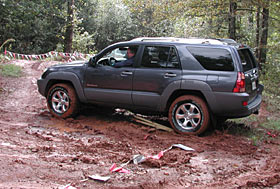
We tested a 4Runner Sport Edition 4x4, priced at $33,594. It's pretty nice -- but definitely not best-in-class.
He: The first time I jumped into the new 4Runner was when you came to pick me up at the airport, around 8:30 at night. It was pretty dark out by then, and as we took off, I tried to find the climate controls to adjust the temperature and fan. I almost drove off the road trying to find them. Even in broad daylight, the fancy designer-look rotary dials are confusing. They are not intuitive at all. Once you decipher them and live with them for a while, I suppose it gets a little easier. I also noticed the digital display in the center console is hard to read in the daylight. Not a good start for a vehicle that has always impressed us as a solid, middle-of-the-road offering in the mid-size SUV segment.
She: I think the 4Runner is still solid. It just launches you on the freeway with that new 4.7-liter V-8, which gives you lots of torque. I was surprised to see, however, that the 4Runner's V-8 makes less horsepower than the standard V-6. My overall impression of the new 4Runner is that it is a very masculine product, clearly designed by men for other men, from the hood scoop on the Sport Edition to the glaring lack of even a plain, unlighted vanity mirror on the passenger side.
He: And, guys, we're talking about a real safety hazard here. Every time I went to check the rear-view mirror, it was twisted in Anita's direction. That was fine as long as she was driving. I think.
She: How could they forget something as basic as that when they put so many other cool features on the new 4Runner? Like that power rear window in the tailgate. What a blessing in today's world of airport checkpoints. If the guard asks to see in the back, you just hit the button to the right of the steering wheel, and the window rolls down. He sure looked surprised.
He: So did I when I discovered that you can lower that rear window from the key fob, but you can only raise it from inside the vehicle. Duh!
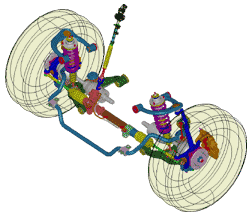
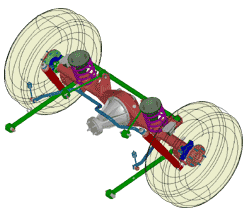
She: I have to say the 4Runner feels solidly built. That's a new truck chassis that Toyota says it will use for the new Lexus GX470. But I thought the ride was not as comfortable as on some of the car-based SUVs that we've tested, including the Toyota Highlander. And the 4Runner is more difficult to park than the Highlander. It feels so big and unwieldly, it always took me several passes to get it parked -- parallel or angle. I also found it difficult to climb in and out without running boards, which seems like another real oversight on a fancy SUV that costs almost $34,000.
He: I give Toyota credit for including antilock brakes, plus stability and traction control. But side air bags and air curtains are an extra-cost option that was not installed on our test vehicle.
She: The 4Runner, like the best SUVs, has a command seating position that puts you up higher than other vehicles and lets you see well ahead of you on the freeway. Toyota seems to have stuck with the classic SUV formula, in that regard. It just doesn't seem to have raised the bar much with this latest generation.
He: I notice that Toyota tried to add a few more family-friendly features, like a $625 rear-seat audio system -- but no DVD player -- and a $100 rear "double-decker" cargo shelf, that lets you stack more packages, but doesn't easily accommodate larger bags and boxes without removing the entire shelf. So where does that leave us? With a solid, well-built SUV that falls short in some areas and lacks distinction in a crowded field of powerful competitors.