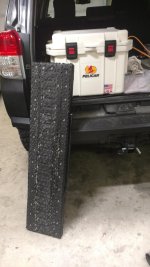
Does anyone use bridging ladders for bridging?

Please don't get caught up in the "mod hype." Think for a minute: No matter where you go in North America (and Mexico), what are your chances that A) You need to bridge a gap and B) If you do need to bridge a gap that it won't be a foot too long for your bridges? As [MENTION=96008]Engineer[/MENTION] said, you are not going through uncharted Amazon jungle. You are going to go where thousands have already been, and without bridging ladders lol. Get a set of max trax if you must spend money on stuff.

People have this romantic notion of going off exploring in the US and that they need a Unimog to go there. While a Unimog is nice, it's about as practical as a bridging ladder. It's the US and if you go somewhere where you need a short temporary bridge, chances are the 4Runner is not the vehicle that got you there.

You need stuff like this where there are no roads, trails or anything else. When you start exploring those places you need more that bridging ladders. You hike, bike or use a dirt bike.


There are spots in AZ, where I go hunting, that these would be perfect. There are washes where bridging a 2 ft gap can make all the difference in the world. One of the areas I like to go back into, had a crevasse cut through the dirt road. I was able to go around it (barely) - I suspect next year it will be impassable without something like these.

So, yes, there are spots in the U.S. where they have utility.
 
The idea of carrying a small bridge is to avoid cutting (which is not allowed in many places) and looking for materials to fill holes... Also, you end up leaving no trace and don't end up sanitizing the trail for the next guy who comes along.

It's really a smart thing to carry along for rigs that have moderate capabilities and clearance, but it simply has not become a fashion statement like maxtrax. The overlanding guys tend to want to put things on their trucks that they see on others... If they have not seen it before... they don't want it. Put it on that ridiculous show expedition overland and it will be sold out everywhere..... Think Trasharoo, maxtrax, swing outs, light bars.... They are all very useful in some scenarios, but also a fashion statement and mostly not necessary for what 90% of them do.

It would be really dependent on where you're going. We definitely shouldn't be cutting trees in areas where it's not permitted.

I used to work with the forest service when I was a trailmaster of a club to maintain trails. Part of that was the effort to sanitize them. Basically 90% of our trails were driveable in most cars 50 years ago because they were logging or mining roads built for logging and mining trucks. They've just lacked maintenance for a long time. We built a handful of log bridges to replace ones that had fallen apart, filled in mud holes, things like that. The trails aren't anything like a natural condition. They haven't been for 200 years. They're a deteriorated road, so I don't have much heartburn with improving them when expedient.

Maxtracks are so en vogue right now. Really the whole idea of camping for the weekend and calling it "overlanding" is pretty popular.
 
Last edited:
It would be really dependent on where you're going. We definitely shouldn't be cutting trees in areas where it's not permitted.

I used to work with the forest service when I was a trailmaster of a club to maintain trails. Part of that was the effort to sanitize them. Basically 90% of our trails were driveable in most cars 50 years ago because they were logging or mining roads built for logging and mining trucks. They've just lacked maintenance for a long time. We built a handful of log bridges to replace ones that had fallen apart, filled in mud holes, things like that. The trails aren't anything like a natural condition. They haven't been for 200 years. They're a deteriorated road, so I don't have much heartburn with improving them when expedient.

Maxtracks are so en vogue right now. Really the whole idea of camping for the weekend and calling it "overlanding" is pretty popular.

Yeah we called it camping back east too.

Marketing hype.
 
If you need a bridge - you probably need a chainsaw. If you select proper logs, you'd be surprised how easy it is to drive across them. A small rock on each side will usually keep them from rolling. One of our offroad club events is a combination competition that includes one part where we cut a phone pole in half and you have to tip them across a pit, then drive across them. It's actually a whole lot easier than you'd think. - but if you get the wrong logs that aren't strong enough... it's gonna be a long day.
I really think you are misunderstanding what I mean by "bridging."

Also, are you telling me that had I started a thread titled "where to store my chainsaw for chopping down trees to get me through obstacles," it would have been a popular topic? I could see this being valid in special circumstances...like working on clearing roads for the Forest Service...but I absolutely can't imagine chopping down trees to clear and create paths being supported as a regular practice for recreational offroading. But, again, I think your recommendation might be coming out if our severely misaligned conceptualizations of "bridging."


My trailer was built to go offroad. For example the steel frame I built for it has a set of 2x2 tubing that runs all the way around the outer rim. The lights are set above the rear steel bumper. It's designed essentially with rock sliders and I just drag it over obstacles. The trailer will pull over just about anywhere my 4runner will tow it. The biggest issue is hitch height. That's what drags long before anything else. If I were doing it again I would build the trailer with a very tall hitch height and rely on an inverted drop hitch to keep everything up as high as possible off the ground.
Thanks for the tip regarding the "slider" design! Sounds very practical.
 
I really think you are misunderstanding what I mean by "bridging."

Also, are you telling me that had I started a thread titled "where to store my chainsaw for chopping down trees to get me through obstacles," it would have been a popular topic? I could see this being valid in special circumstances...like working on clearing roads for the Forest Service...but I absolutely can't imagine chopping down trees to clear and create paths being supported as a regular practice for recreational offroading. But, again, I think your recommendation might be coming out if our severely misaligned conceptualizations of "bridging."


Thanks for the tip regarding the "slider" design! Sounds very practical.

LOL - you're totally right that if you said - how do I store my chainsaw you might get strung up. It really depends on where you're going and what's common and/or acceptable. I don't carry a chainsaw in Utah. I usually do in Montana because even if I'm not making a bridge, I still probably cut some firewood. If I lived in Alaska I probably wouldn't leave home without one.

If you're going to build an offroad camper I could probably give you a lot of advice on things I screwed up on mine that would be done better. Just shoot me a PM. I can also give you the computer drawings I did for mine. If you're buying one, there's a lot of good options.
 
Good read all around, lots of ideas in there for improvised recovery or obstacle defeating methods, but check out page 83:

http://www.bits.de/NRANEU/others/amd-us-archive/Fm20-22(62).pdf
Finally got around to reading through that. As I mentioned above, the practice outlined on said page is far, FAR beyond the scope of what I was seeking.

I came into this assuming everyone had the same concept of "bridging," but boy was i wrong! I haven't gotten any satisfaction from talking down to others from behind a keyboard since I was a teenager, but if you guys thought I was hoping to carry around 15-foot ladders to span vehicle-swallowing gaps, I can see where all the smart-ass comments came from.

All I had in mind was smoothing transitions over mild obstacles to reduce risk of damaging my vehicle(s).

3120568_orig.jpg
 
Last edited:
...Really the whole idea of camping for the weekend and calling it "overlanding" is pretty popular.

...but... but... but... I like running my A/C all night and watching Netflix on the RV campground's WIFI using my Yeti 400 to power my ARB fridge that stores my creamer for my morning latte. I know how to rough it. I had to hang my pants over my swing out arm rear bumper after I stepped in a puddle going to the vending machine. ...and just for your information, my MaxTrax have seen plenty of action at 75MPH on the Interstate.

I just know I am an overlanding warrior. ( :typing: )

:target:

/sarcasm
 
Finally got around to reading through that. As i mentioned above, the practice outlined on said page is far, FAR beyond the scope of what I was seeking.

I came into this assuming everyone had the same concept of "bridging," but boy was i wrong! I haven't gotten any satisfaction from talking down to others from behind a keyboard since i was a teenager, but if you guys thought I was hoping to carry around 15-foot ladders to span vehicle-swallowing gaps, i can see where all smart-ass comments came from.

All I had in mind was smoothing transitions over mild obstacles to reduce risk of damaging my vehicle(s).

3120568_orig.jpg

In all seriousness, it really depends on your load and what you are bridging. I would be wary of trusting a single MaxTrax to support one wheel while bridging an obstacle. However, doubling them up my prove more useful. I have used rocks, logs, spare tires, and even a crappy cooler to bridge gaps in my old Scout II. I never got into the MaxTrax since I don't off-road like I used to, but it doesn't hurt to be prepared.
 
I think someone PMd me or something about a picture of my ladder/traction device... Well I was loading it up tonight and snapped a pic. Construction described above...
 

Attachments

  • bridge.jpg
    bridge.jpg
    131.3 KB · Views: 407
All I had in mind was smoothing transitions over mild obstacles to reduce risk of damaging my vehicle(s).

3120568_orig.jpg

I have them on my list for the same reason. Easy of transition; not all spotters properly gauge depth/drop. Ability to stage a route alone. And crux also makes a kit that lets you turn it into a table, so multi functional around camp. Plus it matches nicely with American Camp Chairs.

Okki
 
Please don't get caught up in the "mod hype." Think for a minute: No matter where you go in North America (and Mexico), what are your chances that A) You need to bridge a gap and B) If you do need to bridge a gap that it won't be a foot too long for your bridges? As [MENTION=96008]Engineer[/MENTION] said, you are not going through uncharted Amazon jungle. You are going to go where thousands have already been, and without bridging ladders lol. Get a set of max trax if you must spend money on stuff.

People have this romantic notion of going off exploring in the US and that they need a Unimog to go there. While a Unimog is nice, it's about as practical as a bridging ladder. It's the US and if you go somewhere where you need a short temporary bridge, chances are the 4Runner is not the vehicle that got you there.

Our 4Runner has gotten us to a number of places where a bridge would have been very helpful - desert washouts, Moab ledges, etc. Spent hours stacking rocks to get thru about 100yds of a steep washout on the Lockhart Basin road; washed out roads in the Mojave where I thought 'break out the shovel & fill it in'. Hell no - that sand was more like concrete aggregate my pick couldn't dent.
Yes, a bridge is a pain to haul around - if I had huge tires and xclnt approach angles, I probably wouldn't need one, but I drive a 4Runner, and my romantic notion is moseying down the road, not spending hours with a pic and shovel trying to fill in ledges & washouts
 
Last edited:

Members online

Forum statistics

Threads
278,310
Messages
3,554,080
Members
248,016
Latest member
Advally Service

Trending content

Back
Top