3rd gen ball joint issues?

So I've been poking around here a bit, and have seen several references to these being an issue.

Had a customer of mine who's a 4Runner nut, mention it to me a week or two ago when we were talking trucks, no wI'm seeing it here too.

I've got 120K on mine, and I know I haven't done them.

Should I be watching for anything, or asking my garage to specifically check something, or am I better off just replacing them before they become a problem, since (in lieu of answers to the first two questions) there's no warning, they just fail?

My customer told me it's ugly and huge $ when they go, so I'd rather get out in front of it.

Is it a design problem? Is there a better version available, or is it just a thing to content with?

Thanks as always!
 
Register to hide this ad
Is it a design problem? Is there a better version available, or is it just a thing to content with?

Thanks as always!
My interpretation of the consensus here:

- It is a design weakness. The lower ball joint is constantly stressed in tension.
- You'll get 200k+ miles out of them at stock height
- You'll get 50-100k miles out of them if lifted
- OEM parts are FAR BETTER than any aftermarket replacement

Just get new OEM ball joints with new bolts, install them and stop worrying about it for a few years.

-Charlie
 
A pair is like $240.
I assume if you own an old truck you know how to work on it. If you don't, well then you probably should figure that out. Even then, I'm sure shop labor wouldn't be terrible.

Buy both oem lower ball joints and do them. Issue resolved.

In addition, replacement koyo radiators are like $100 or so, and if you have an automatic it's a matter of time before the trans cooler goes and your trans dies. I've yet to see someone who has had a rad failure and didn't end up replacing the trans, no matter how many things they tried to fix it.

It's a little under $400 in parts to resolve two of the biggest design problems with the chassis. I did mine so I could forget about it for another 100,000
 
In addition, replacement koyo radiators are like $100 or so, and if you have an automatic it's a matter of time before the trans cooler goes and your trans dies. I've yet to see someone who has had a rad failure and didn't end up replacing the trans, no matter how many things they tried to fix it.
I'd just like to put in a different perspective on this one - if the coolant and ATF was changed on schedule and you don't live in a road salt prone area, the pink milkshake is a non-issue. The corrosion is caused by old fluids that no longer protect the metals in the radiator.

I replaced my OEM radiator lat year at around 270k miles and the trans cooler in the radiator was in perfect condition inside and out (I pulled it apart to check). The top tank, on the other hand, was looking old - so it was still time to replace it.

-Charlie
 
I'd just like to put in a different perspective on this one - if the coolant and ATF was changed on schedule and you don't live in a road salt prone area, the pink milkshake is a non-issue. The corrosion is caused by old fluids that no longer protect the metals in the radiator.

I replaced my OEM radiator lat year at around 270k miles and the trans cooler in the radiator was in perfect condition inside and out (I pulled it apart to check). The top tank, on the other hand, was looking old - so it was still time to replace it.

-Charlie

Yes but you are talking about a truck you just got that is between 16 and 22 years old, which unless you have detailed records from day one you cannot prove the fluids we're changed on time.

The cost of a radiator is $102 on Amazon.

The penalty if your assumption is wrong is a dead transmission.

You really think there's a case to be made for not preventatively changing a $100 radiator here?

I mean I just don't see it.
 
You really think there's a case to be made for not preventatively changing a $100 radiator here?
Kind of... The same issue can happen on many auto trans vehicles that use the same style cooler. The rest of the truck is just so reliable that something like this seems like a big issue.

It isn't a hair-on-fire issue in my mind. :flame: I did it while the radiator was going to be out anyway during a timing belt/water pump job.

Then again, my lower ball joints were still tight at 270k miles too... Still replaced them at that time though... :wave:

-Charlie
 
Thanks guys!

So, I've been tossed in at the deep end, and likely most of you haven't followed or seen my previous input here.

Rather than quote each, and respond, I'll just cover it all here....

Ball joints, okay, cool got it, I'll seek out a pair and have my garage get in to it.

Sell it tjnptel1? HAHAHA! Sorry, no. Just got over trying to sell it, and am now hip deep in setting it up to last me a looooong time to come.

As for it being an old vehicle, and working on it myself? Nope, not my bag. No tools, no garage, no lift, and no skill set.

jgue467, "Why not just check them like you would any other vehicles' ball joints?" You assume I have the vaguest idea what that check would consist of! :noidea:

I own a bicycle shop, have been a bike mechanic professionally for 30+ years, but other than bolts and nuts and wrenches being used for both, not much else translates over that well, skill set wise. I vastly prefer to surround myself with a trusted network of professionals for things I just want done right, with a minimum of fuss. I detest doing stuff myself, only to get part way in, discover I haven't the tools, or knowledge, to get it done, then have it sit for weeks, half done, while I flop about trying to get that stuff figured out. Self employed man, no time for that crap! I like my vehicles working like they should, at all times...

As for the radiator, dumb question.

A: you're talking a tranny cooler right, not the radiator for the motor?

B: my radiator was replaced a year or so ago, when I clocked a deer at 60mph. Assuming there's a separate tranny one, would it likely have been replaced due to the damage in the vicinity, or is it hidden and out of harms way, somewhere else?

End of the day, I'm a polite, if slightly mechanically/terminologically clueless information seeker, who plays well with others, and loves his Toyotas like it's his job (at least 10 in my history of ownership). I am NOT a DIYer, nor a car mechanic, just so's ya'll knows....

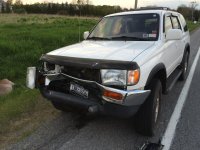
Here, have a pic of my post deer hit baby, lest you think I'm just a tire kicker. She looks a whole lot happier now. :bravo:
 

Attachments

  • 0.jpeg
    0.jpeg
    132.7 KB · Views: 1,385
Kind of... The same issue can happen on many auto trans vehicles that use the same style cooler. The rest of the truck is just so reliable that something like this seems like a big issue.

It isn't a hair-on-fire issue in my mind. :flame: I did it while the radiator was going to be out anyway during a timing belt/water pump job.

Then again, my lower ball joints were still tight at 270k miles too... Still replaced them at that time though... :wave:

-Charlie

The plastic covers on the radiator do have a finite life. They age due to the thermal cycling and exposure to coolant and will eventually crack even if the cooling system is properly maintained. At 200k a fresh radiator is a smart idea!

OP -- welcome to T4R!!
 
As for it being an old vehicle, and working on it myself? Nope, not my bag. No tools, no garage, no lift, and no skill set.

jgue467, "Why not just check them like you would any other vehicles' ball joints?" You assume I have the vaguest idea what that check would consist of! :noidea:

A: you're talking a tranny cooler right, not the radiator for the motor?

B: my radiator was replaced a year or so ago, when I clocked a deer at 60mph. Assuming there's a separate tranny one, would it likely have been replaced due to the damage in the vicinity, or is it hidden and out of harms way, somewhere else?

End of the day, I'm a polite, if slightly mechanically/terminologically clueless information seeker, who plays well with others, and loves his Toyotas like it's his job (at least 10 in my history of ownership). I am NOT a DIYer, nor a car mechanic, just so's ya'll knows....
How did you learn how to work on bikes? Cars are the same way. Try, fail, learn, try again. If you can rebuild a bike fork or align a rear derailleur, you can fix a car.

The front lower ball joints are in tension with the vehicle on the ground and can't easily be checked using the methods that work on most ball joints. The front end has to be off the ground to do it.

The stock tranny cooler is IN the radiator. The bottom tank, to be exact. I uses the (cooled) engine coolant to cool the transmission fluid. Since you replaced it last year, you are all good there.

And as for that love of Toyotas - you aren't alone here... :happy:

-Charlie
 
Why not just check them like you would any other vehicles' ball joints? When they move with tension underneath the tire, it is time.

:cowboy:

sorry...what does that mean move with tension under the tire? will a bad one be noticeable just driving down the street? thanks!
 
sorry...what does that mean move with tension under the tire? will a bad one be noticeable just driving down the street? thanks!
I have no problem with someone who doesn't want to spend time working on cars; for me, if I have more money than time, I hire someone. But I don't always have that much money. Also, on many smaller routine maintenance jobs, the service pros often seem to treat them as unimportant and will do a half-assed job.
On the ball joints: There are two orientations that Toyota could have used to engineer a steering ball joint into this front suspension:
One, the desirable one, is where the weight of the vehicle is deployed constantly in a vector that pushes the ball and socket together and...
Two, the orientation that Toyota used in these vehicles, where the weight of the vehicle is constantly trying to pull the ball and socket apart at all times.
In the first one, if the socket/ball wears down and becomes loose, the joint stays together and makes a knocking or rattling noise, and you get to fix it... before it fails.
With the design in these 3Rd gens, once the ball/socket wear down and develop freeplay and/or metal fatigue, the ball/socket can...powered by the full force of the front suspension...instantly and without warning catastrophically separate...usually while the vehicle is driving. Fun, eh?
Many owners report no warning noises before the joint separates.
With this design, you have a potential trouble spot where---if the joint had been properly oriented in the design---none needs to exist.
Viddy this thread: http://www.toyota-4runner.org/3rd-gen-t4rs/84794-ball-joint-failure-my-turn.html
A suggestion: Since you have self-identified as an 'information seeker', treat yourself to the FSM (Factory Service Manual, which does cost $$$,) or at least to the much cheaper Haynes manual so you can learn more about the vehicle. Being able to see what's involved in a service job makes you better prepared to assess the cost estimates you get when you take your car in for service.
Note: The 'upside down' orientation of the balljoints in this generation of Toyota 4Runner is not unique to this model or manufacturer--it is found all over the industry and across multiple eras of the automotive design. Sometimes, they just pick a shi**y design.
 
Last edited:
I own a bicycle shop, have been a bike mechanic professionally for 30+ years, but other than bolts and nuts and wrenches being used for both, not much else translates over that well, skill set wise.

I owned a bicycle repair shop for a while too- the principles are the same! Just have to be more careful that it doesn't fall on you while you're working on it.

You must be doing better than I did though if you're running a bike shop that makes enough money to pay car mechanics!
 
Hey Brad, pleasure to meet another biker!

Nah, more a convergence of luck. I'm a one man shop, and recently bought the building I operate out of which sort of "modifies my expenses" a bit. So, no employee overhead, and a small, low key approach to inventory. The $ is in service, you lose money paying employees to sit around and hopefully trip over a sale...

I have a small local garage a few doors down, seasoned mechanic, in a small town, been there for over 30 years. You can't gouge, rip off, or perform crummy work, and stay open, in a 1 horse town!

I routinely get called out for "bringing them weird sh*t" but they do it with a smile, and get the job done well.

Many years ago, had the tranny go in my '84 'Yota pick up, I sourced a used one cheap, they installed it for $150. I have no idea if that's cheap or not, but it worked, and was affordable for me at the time.

That sort of thing.

Pluton and Phatty, I hear you, my issue is, no time, no garage, no lift.

Spent a few years doing stuff in my driveway, oil and tire changes, that sort of thing. It was about as much fun as yanking toe nails with a pair of pliers. I get no pleasure out of it. Took a long time, I was running back and forth for tools, and if I ran into a problem, well, there my vehicle sat, unusable, and I was stuck. For my $, way easier to let the pro down the road get me done.

Funny story about this? My good buddy is a car mechanic. He'll rip engines out, does brakes in his sleep, etc.

He brings all his bike work to me. Not having the right tools, nor deep understanding of the way bike things work, it's simpler to let me do that for him. He won't even change a tire (though tubeless on bikes is a bit more of a PITA than a tubed set up).

I guess we just all have our points at which we walk away. And while I love my truck, I love it running and getting me places, I do not love it being out of order because I lack the setting to DIY effectively.

I love places like this though, as there's always a lot of perspective, information, and collective knowledge.

I did just change my upgraded lightbulbs myself this morning though, so maybe there's hope for me yet!!!:bravo:
 

Members online

Forum statistics

Threads
278,307
Messages
3,554,049
Members
248,016
Latest member
Advally Service

Trending content

Back
Top