Airing down for sharp rocks?

whistlingwind

New member
I could use some advice on airing down from the experts.

I managed to get puncture flat on my first off-highway run on my brand-new tires and was wandering if airing down some would help prevent this.

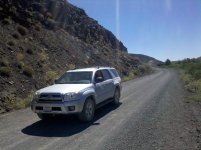
My off highway use is mostly on roads with sharp rocks (see pic) and no sand. I have read somewhere (here on the forum?) airing down will help the tires conform to sharp rocks rather than punctures. If so, what would be a good pressure range?

Its a stock 2006 4Runner with Goodyear Wrangler Silent Armor (P265/65/R17) tires, normal pressure is 31 PSI.

Thanks!

PS: I just picked up a set Staun deflators on Craiglslist.
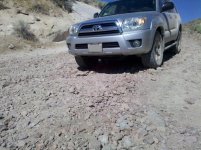
 

Attachments

  • a_rough.jpg
    a_rough.jpg
    105 KB · Views: 2,773
Register to hide this ad
Ok a lot of us play with our pressures to find what works best. Since the silent armor is a mild AT I would start somewhere between 18-22 PSI. That will still allow some sidewall but also give it some more cushion. The more stout AT or MT people air down to 12-16psi and I have even known a few to go lower but they usually have bead locks to keep the tire on the rim.

What part of CA and where do you normally wheel?
 
Im not familiar with the silent armors but, 20lbs should be a good start and use your judgement from there. You probably have a C load rating on your tires so airing down will help reduce the chances of another puncture but wont puncture proof it (not that any tire is puncture proof). This is because you sidewall is a weaker than the typical AT/MT Tire that typically has a Load E rating which has a stronger sidewall and much more resistant to punctures. Depending on how often you are going to be wheeling in areas with jagged rocks, you may want to consider taking a small loss now and swapping to a tire with a Load E rating. A small loss now could be less expensive than replacement of future tire punctures. It also could have been just a fluke on the puncture. Just a thought. Any pics of the pucture and the rock that did it?
 
I run the Silent Armors myself and haven't had any issues at all unlike when I ran BFG A/T's. I suspect it would have happened regardless of the tire, sometimes sh!t happens. Don't let one bad experience make you rethink your tire choice.

31 lbs normally is pretty soft, I run at 36 for highway use and will typically air down to around 22-24 on the trails.

GYSA are D load rated.
 
Last edited:
Airing down is a good idea for trails on many fronts, however as said above it is dependent on many factors, i.e. trail/terrain, speed, tire type and size.

Normally for an AT tire with a 65 to 70 size sidewall on stock type wheels I would recommend 20-25 PSI for general trail use. This make the ride smoother and also provides better traction on most surfaces.

In the case of sharp rocks, airing down helps the thread portion as the tire has more give. Unfortunately it also exposes the sidewall more, where a sharp objects can easily puncture the tire. So it is a balance to find the right pressure that will work for your setup.

From experience on the trail with many 4RUnners with AT tires (with P or LT ratings, and various makes) with 16-18" wheels and 31 to 33" tires it seemed that 20-25 PSI worked the best for general trails, rocks, etc. With less sidewall and a lower rated tire (like a P or LT -C) you probably want to start at 25 first and then work your way down. With a higher rated tire and more sidewall like 33" tire on 16" wheel you can probably start at 20 PSI.

For large rocks you probably want to drop below 20 PSI for more traction, even down as low as 15, but that can get a little low for a 65 sidewall tire on rocks.

For sand 10-12 PSI works best, especially to avoid popping a bead off with higher speed soft sand fun on the dunes. Again star a bit higher and go lower pending tire/wheel combo.

--Andries
 
Another thing to watch is wheel spin. You start spinning you tires on sharp rocks and you will cut them up. Airing down will help with traction. If you are going to spend much time on sharp rocks your best bet is to get a tire better suited for that type of off-roading.
 
Last edited:
Thanks to all for the great suggestions. I'll start out at 20-25 pounds, since that seems to the consensus for general trail use anyways. And like CXS said, my rock puncture may have happened regardless.

And airing down to 20-25 will make for a better ride on the washboard sections, hopefully.

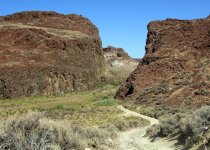
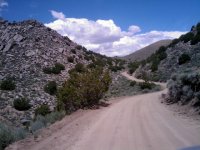
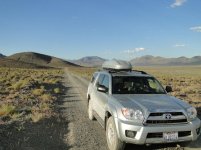
Most of my off road travel is on 3-4 day trips in the north west corner of Nevada. Places like Black Rock, Smoke Creek, Soldier Meadows, Nightingale, Sahwave.... About half my travel is on gravel/dirt roads with occasional rocky sections like pictured above. The rest is on 'jeep trails' (that's what it says on the topo maps, anyway) that have never seen a blade. All pretty tame comparatively, with no extreme stuff.

Again, thanks to all for the advice.

See you out there
W. Wind
 

Attachments

  • smoke creek.jpg
    smoke creek.jpg
    82.2 KB · Views: 2,585
  • high rock.jpg
    high rock.jpg
    121.6 KB · Views: 2,665
  • kumiva pass.jpg
    kumiva pass.jpg
    54.9 KB · Views: 2,551
  • blue wing.jpg
    blue wing.jpg
    84.1 KB · Views: 2,599
Pressure isn't going to make a lot of difference if you are running a tire with normal car/SUV rated tires. Light Truck and heavier rated tires (like serious offroad tires) will have stronger sidewalls, and a stronger sidewall (more plys) will be more resistant to punctures.
 
Pressure isn't going to make a lot of difference if you are running a tire with normal car/SUV rated tires. Light Truck and heavier rated tires (like serious offroad tires) will have stronger sidewalls, and a stronger sidewall (more plys) will be more resistant to punctures.

What the side wall is constructed of and designed for is what is important. The MTR/Kevlar is a great choice for being on rocks and it is only a 3ply side wall. The TrXus MT tires I have on my Jeep (3 ply I believe) have a thicker side wall than the E rated (10 ply) on my F250.
 

Members online

No members online now.

Forum statistics

Threads
278,306
Messages
3,554,045
Members
248,016
Latest member
Advally Service

Trending content

Back
Top