Alternator Voltage Question

Texas_4Runner

New member
I had to jumpstart my 4Runner so I drove it to O’Reilly’s and they said my battery was good and the voltage regulator failed.

I drove home, charged my battery to full, cleaned the terminals that were filthy. This morning it struggled to start but I was able to get back to O’Reilly’s. A different person told me the battery was bad. It’s over 3 years old so I put in a new one.

Then they tested the alternator again and said the voltage regulator still failed. I went home and used a multimeter and got the following numbers.

With 4Runner off 12.78V
@idle No lights 13.46V
[MENTION=21408]2000[/MENTION] rpm no lights 13.55V
@idle with lights 13.42V
@idle with headlights, radio, and AC on high 13.36V

I’m supposed to drive to MT tomorrow and I don’t really want to put in a cheap remanned Ultima alternator from O’Reilly’s. Based on those numbers the alternator seems to be working. And I don’t hear a whine.

What are your thoughts? Should it be closer to 14V?
 
Register to hide this ad
Those numbers sound good to me. 13.5 - 13.25 is perfect.

If alternator was bad, cranking the car and using voltage it would go down not up.

Your alternator holds close to 13.5, which is what a voltage regulator is supposed to due.

Battery (car off) could be higher though, over 13, just my 2 cents. If it is brand new it probably needs to charge more.
 
Last edited:
Get a GM diode to replace the 7.5A Alt-S fuse. You'll gain about 1 volt. Cold start up I see anywhere around 14.8 then settles to about 14.2 - 14.4.

I've done this to my 07 & 19.

Sent from my moto g power using Tapatalk
 
Is the new battery an AGM? Was the old battery an AGM? They require higher voltage to fully charge, but it shouldn't be an issue in a brand new battery. It becomes an issue after several months of not getting a full charge. A standard "Wet Cell" battery should be charging fine with 13.5v to 14.0v.
The GM diode is an alternative but takes a fuse out of the equation and in an extremely unlikely circumstance it could start a fire. There are fused options, but you have probably already left for your trip, so it won't do you much good now.
Sounds like you might have a parasitic draw or your starter might be having trouble, judging by your volt readings. You could have dirty connections at the starter. A battery voltage of 12.78 at rest for 6 hours or more should be plenty of juice to start your truck. Your lower voltage readings with all accessories on look to be in an acceptable range, but under load while moving they could be dropping lower. I have an Ultima in my 5th gen and it's been doing pretty good, but your right, you never know with remans.
Here is a video I did involving the "Dirty Parts Voltage Booster". It does the same thing the GM diode does, but has a fuse inline for circuit protection. If you have a wet cell battery, the booster might over charge it and cause problems that way. There are a few variables involved with this so more research might be needed. A quality lithium jump booster is a good thing to have as well. Hope it's something simple and your trip goes well with no troubles. Good Luck!
 
Last edited:
Last time I checked mine it was 12.2V with car off and 14V with car running. But that was March and it was cold. I’m pretty sure the battery voltage will read higher when cold
 
Get a GM diode to replace the 7.5A Alt-S fuse. You'll gain about 1 volt. Cold start up I see anywhere around 14.8 then settles to about 14.2 - 14.4.

I've done this to my 07 & 19.

Sent from my moto g power using Tapatalk

Does running the GM fuse stress the alternator?

I read on another post the OEM alternators are specced to accept the higher voltage, however my alternator died within 6k miles of installing the GM fuse to properly charge my AGM battery.

Perhaps a stupid question as I was still running the 16 year original alternator @ 242k miles but it does make me wonder if it hastened the failure.
 
Does running the GM fuse stress the alternator?

I read on another post the OEM alternators are specced to accept the higher voltage, however my alternator died within 6k miles of installing the GM fuse to properly charge my AGM battery.

Perhaps a stupid question as I was still running the 16 year original alternator @ 242k miles but it does make me wonder if it hastened the failure.

I've been running this setup for quite a while now. I had swapped out to an AGM battery on both my trucks and they both ran and charged great. I still have the '19 and no issues to date and my wife drives it daily. The '07 I ironically had the alternator give out on me last year with about ~250K miles on it as well, and to be honest at that age and mileage I wasn't mad nor would've blamed the diode for that. Just wear & tear at that point. I can see with a voltage gauge that the voltage regulator charges these high at startup, and as the battery recharges, it settles to a 14.1-14.4 range. Right where the AGM needs to be.
 
Just bought a voltage booster pro "texas slim" for 03-09 4runner SR5 v6 but before installing i checked my battery volts at rest, 12.14v, then at idle, 14.56v and it kept climbing and climbing each 3 seconds 14.65v, 14.71v, 14.78v, 14.80v, .85v, .86v, .87v, 88v, 89v, .90v and it kept climbing even after idle smoothed out. Is this normal? What if it goes to 15v or higher? What part would i need to look at fixing?
I got 2 AGM batteries in parallel that need that 14.4v charge but apparently my alternator is already outputting 14.4v. Am I wrong?
Do I even need this volt booster? It has 2 switch settings with a boost of high=0.8 (1v) and low=0.4 (0.5v). Was planning on using the low setting thinking my stock alternator was only outputting 13.5 or so. At least this is commonly known about 4runners not charging AGMs properly.
Can somebody experienced chime in?
 
Last edited:
Last time I checked mine it was 12.2V with car off and 14V with car running. But that was March and it was cold. I’m pretty sure the battery voltage will read higher when cold

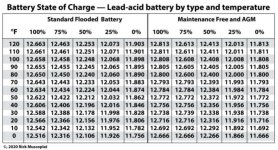
Battery voltage will read lower when it's cold
 

Attachments

  • State-of-charge-chart-with-temp-s.jpg
    State-of-charge-chart-with-temp-s.jpg
    81.8 KB · Views: 1,587
I had to jumpstart my 4Runner so I drove it to O’Reilly’s and they said my battery was good and the voltage regulator failed.

I drove home, charged my battery to full, cleaned the terminals that were filthy. This morning it struggled to start but I was able to get back to O’Reilly’s. A different person told me the battery was bad. It’s over 3 years old so I put in a new one.

Take the alternator to another shop and have it tested. I have owned 5 Toyotas, still have 3 of them. I have replaced 1 alternator since 1989 and that was on a '91 Camry when it was 29 years old.

Did you check the voltage of the battery when you had trouble starting? Always check the voltage before you crank. If you had filthy terminals then you have a poor connection that will manifest as a bad battery. Your voltage readings are very good. If you have trouble starting and the voltage is 12.7 then I would suspect the terminals are dirty.

3 years is not old for a battery, but you can cause problems when you don't maintain them. (My battery is from 2015, wife's is 2019). If it's not a maintenance free battery you should check the water level periodically, especially in the summer.

Corroded connections/clamps can cause a host of problems and symptoms. Always keep the terminals clean and tight.
 
4Runner, AGM battery, alternator output, and code P0607

This is a bit of a tangent, but I wanted to share my personal experience with an AGM starter battery in my 4th gen 4Runner, which led to the worst type of automotive issue - intermittent electrical gremlins.

After a cold start, alternator will read ~14.3v for a few minutes, and after warmed up (if I remember right) will drop to ~13.6v. I did not realize this behavior was the status quo, and not desired for the health of an AGM battery, until after two days of painful and frustrating diagnosis.

Alternator output in the ~13v range is NOT a sufficient voltage to keep an AGM battery happy long term. I had TERRIBLE intermittent electrical gremlins about a month after switching to an AGM battery. Have you ever had the power go out in your house for a half a second? My issue was like the automotive equivalent of that - engine would briefly cut power, followed by check engine light, VSC lights, code 0607 - control module failure. The car would continue to idle along, but the pedal would yield ZERO throttle response. Then, the shift from drive into park was rough. I would shut the car off, disconnect the battery terminals, reconnect, and restart the vehicle and things would be normal again for a time.

I could find ZERO useful information about this code in our trucks online. Quite unusual for this vehicle; there's so much useful information online on this forum and elsewhere. I redid ALL my grounds: battery side, chassis ground, frame ground, engine ground. Rechecked my battery connections a half dozen times. No relief.

I only put two and two together when I was reading my voltage at the battery with the vehicle running - ~13.6v, not the ~14v range I expected, for no other reason that I ignorantly assumed ALL cars would read in the ~14v range with the alternator spinning away. Not the case. So, logic dictates: "I have electrical problems, the only thing that's changed in my truck recently is the battery, therefore I should focus my attention there." I began to search things like "AGM battery alternator voltage", and quickly became aware of AGM battery voltage considerations, and things people do to accommodate in our trucks: things like the GM diode, Texas Slim mod, etc.

I switched back to a lead acid battery and no problems since.

My AGM starter battery was not getting to a full charge from driving the 4Runner around. And somehow, this was causing P0607 intermittently. I could have compensated for it by using a battery tender to top it off from time to time (something that I'm now aware people actually do, but I have no interest in doing.) Or, I could have addressed the issue with the various diode mods.

I meant to write up a thread about my experience, but it's been a few months and the above is the best detail I can remember. Tossing the info in this thread, maybe it'll inform someone, or at least get on someone's radar who is searching "4th gen 4runner P0607"
 
Last edited:
After a cold start, alternator will read ~14.3v for a few minutes, after which it will drop to ~13.6v.

It is normal for these trucks to read ~13.6v most of the time. That is NOT a sufficient voltage to keep an AGM battery happy. While I'm now aware of the GM diode, and the Texas Slim mod..... I had idea no idea about the special considerations of an AGM battery at the time, nor it's (in)appropriate applications for a 4Runner/Tacoma

My issue was so bad that the car would intermittently lose power for a brief moment in motion, throwing code P0607 - control module failure. My theory is that the AGM battery has the ability to soak up a lot of power quickly, and it was intermittently (very briefly) starving the ECU of the necessary voltage to run. Switched back to a lead acid battery and no problems since.

I meant to write up a thread about my experience, but it's been a few months and the above is the best detail I can remember. Tossing the info in this thread, maybe it'll inform someone

Cars run off the alternator, not the battery. The battery is to provide starting power and power when the engine isn't running. Cars haven't run off of the battery since generators. Way back in 1969 I started my car and then disconnected the battery. It ran fine. (Don't do this today. The battery needs to be in the circuit to prevent damage to other electrical components.)

An AGM's advantage is that it can be placed in any position, even upside down, and never needs to have water added. Other than that, it's just another wet cell battery. I use 2 in my travel trailer, which has a power supply to properly charge them. At 100% on a normal day the voltmeter reads 12.7. A regular charger will get them close to full, enough so that I wouldn't worry about missing .1V. I have used a regular charger on my 4 (2 in the trailer and 2 backup in the garage) and they top off at 12.7.

The AGMs I have used or seen are deep cycle, not starting batteries. There may be AGM starting batteries but I don't see the advantage to them. A normal wet cell, maintenance free or regular, is more than sufficient if you properly maintain it.

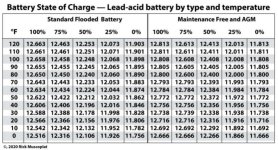
Battery voltage is affected by temperature, another thing to consider.
 

Attachments

  • State-of-charge-chart-with-temp-s.jpg
    State-of-charge-chart-with-temp-s.jpg
    81.8 KB · Views: 240
Cars run off the alternator, not the battery. The battery is to provide starting power and power when the engine isn't running. Cars haven't run off of the battery since generators. Way back in 1969 I started my car and then disconnected the battery. It ran fine. (Don't do this today. The battery needs to be in the circuit to prevent damage to other electrical components.)

An AGM's advantage is that it can be placed in any position, even upside down, and never needs to have water added. Other than that, it's just another wet cell battery. I use 2 in my travel trailer, which has a power supply to properly charge them. At 100% on a normal day the voltmeter reads 12.7. A regular charger will get them close to full, enough so that I wouldn't worry about missing .1V. I have used a regular charger on my 4 (2 in the trailer and 2 backup in the garage) and they top off at 12.7.

The AGMs I have used or seen are deep cycle, not starting batteries. There may be AGM starting batteries but I don't see the advantage to them. A normal wet cell, maintenance free or regular, is more than sufficient if you properly maintain it.

Battery voltage is affected by temperature, another thing to consider.

No disagreements from me. I went back and edited my post to better explain my story. My AGM starter battery, with lack of any diode mod, caused me terrible intermittent electrical issues. Issues that I couldn't find anyone else on the internet referencing. This seemed like a decent thread to drop the info into. Maybe someone will find it useful in the future. :cheers:
 
Last edited:
No disagreements from me. I went back and edited my post to better explain my story. My AGM starter battery, with lack of any diode mod, caused me terrible intermittent electrical issues. Issues that I couldn't find anyone else on the internet referencing. This seemed like a decent thread to drop the info into. Maybe someone will find it useful in the future. :cheers:

That's really strange. I don't know why an AGM battery would cause intermittent electrical issues. It's really just a regular lead-acid battery but instead of liquid electrolyte it's wrapped in a fiberglass mat and the case is sealed. There's no electronics involved like there is with LiFePo4 batteries. Maybe there's a bad / broken internal connection somewhere? I've seen all kinds of strange electrical issues and the best way to resolve them is to swap parts with known good parts, like you did.

Regardless of what the voltage shows on a battery, the best test is a load test. Harbor Freight sells a very simple battery load tester. I have found it to be invaluable in determining the actual strength of a battery. If you still have the AGM you might want to try that, unless they did that at the auto parts store. Still, a good tester to add to your workbench. :)
Access to this page has been denied
 
That's really strange. I don't know why an AGM battery would cause intermittent electrical issues. It's really just a regular lead-acid battery but instead of liquid electrolyte it's wrapped in a fiberglass mat and the case is sealed. There's no electronics involved like there is with LiFePo4 batteries. Maybe there's a bad / broken internal connection somewhere? I've seen all kinds of strange electrical issues and the best way to resolve them is to swap parts with known good parts, like you did.

Regardless of what the voltage shows on a battery, the best test is a load test. Harbor Freight sells a very simple battery load tester. I have found it to be invaluable in determining the actual strength of a battery. If you still have the AGM you might want to try that, unless they did that at the auto parts store. Still, a good tester to add to your workbench. :)
Access to this page has been denied

I did have the battery tested at an Autozone, and the CCA it was putting out was 15-20% under the battery's rating. Which (I assume) tracks linearly with it being 15-20% undercharged, on account of the alternator's voltage output being too low, with my lack of diode mod.

I can only speculate that there was some transient voltage/amperage dip happening that caused the ECU to not be fed enough power, only for the briefest moment. I assume with a diode mod, and >14v in the system while running, I would not have had the issue :shrug:

Anyhow I plan to use a DC to DC charger and turn that 24f AGM battery into a leisure battery for camping, etc.
 
Anyone here use a voltage booster pro Texas slim? It adds either 0.4v-0.5v on low setting or 0.8v-1.0v to your alternator charge. I got 2 Weize AGM batteries wired in parallel (dual purpose type for starting and rv).
My 2003 4runner v6 charges at 14.1v to 14.9v At idle (voltage climbs higher for a while then falls to max idle, usually around 13.2 volts).
If you're concern is idle charge on a AGM like many truckers or 4x4 off road campers like me you want that AGM charging with that 14.1 volt minimum.
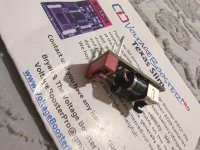
Instead of buying a custom alternator, keep your 130amp alternator and buy a simple Texas slim pro. Pull your 7.5amp mini fuse for your alternator and replace it with this thing. See photo. I'll solve your issue on LOW setting making your idle 14.1 instead of that weak 13.1 volts that ruins it. The good news is even when your drive it doesn't send the charge into the danger zone. The high setting would mess your AGM up charging it at 15-16 volts depending on your alt charge in motion.
I bought one just as a backup. It solves having to lug around a AGM charger. Its not unsafe and is dependable. I bought 2 (1 to use 1 for a backup)
 

Attachments

  • IMG_20241008_223438.jpg
    IMG_20241008_223438.jpg
    125.8 KB · Views: 165

Members online

Forum statistics

Threads
278,306
Messages
3,554,045
Members
248,016
Latest member
Advally Service

Trending content

Back
Top