Check Engine Light: Lean Fuel Condition

WrenchTech

New member
The 1999 4runner that I bought last week, came to me with a check engine light illuminated. The former owner said that he had it checked out and and that it was showing a faulty oxygen sensor. I took it down to AutoZone to be tested. Their code reader said that the vehicle was running with a lean fuel condition caused by low coolant temperature, which was not allowing the Engine management System to go into closed loop mode. AutoZone said that the cause could be either a faulty temperature sender or a bad thermostat. It's interesting that the former owner talked about an oxygen sensor, which could also causing a lean fuel situation. The easiest thing for me would be to test the temperature sender. I think I will be able to rule out the thermostat if I start the truck when it's cold outside and I get heat in the interior of the cab in a normal amount of time.

I am looking for a factory service manual too. I really really like the printed ones, but for this generation over runner they're pretty darn expensive. Can anybody point me to a good online resource with a searchable table of contents. Please and thank you.
 
Register to hide this ad
Change the PCV valve first. It certainly can cause a lean condition! And at $3 it's the cheapest fix.

I changed mine. It was ancient, and stuck open. It was overheating the top end to the point of making the valves clatter!
 
Don't start by chasing the thermostat/temp sensor angle. That's rarely it. Typical worthless AutoZone input. If you can read temp off the ECU and those readings make sense, it's likely a MAF issue. Start with a good MAF and throttle body cleaning and go from there. Check all vacuum connections. Don't throw parts at it.
 
My lean code was from a vacuum leak. I put the throttle body gasket on wrong.

But saying that what are your MAF readings at idle with a warmed up engine.

With the vehicle sitting overnight your IAT and ECT sensor readings should be within 10 degrees of each other and close to the ambient temp.


Sent from my iPhone using Tapatalk
 
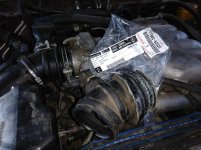
My lean code, P0171 was caused by a crack in the nearest rubber intake 'hose' next to the runner intake. Used a toyo oem part and purrs like a kitten now! Luck and enjoy the Runner! :cowboy:
 

Attachments

  • new air intake hose.jpg
    new air intake hose.jpg
    132.4 KB · Views: 2,185
It sounds like you have code P0125 - Insufficient coolant temperature for closed loop.
This is a red herring code; you'll see this code when your engine detects that your coolant temperature is normal, but your primary oxygen sensor isn't reaching the proper switch rate that it should be in when in closed loop (vs open loop) operation. It is indeed odd that the code description makes it sound like a coolant temperature issue. That code would be P0128 though.

The most common fix here is to replace the primary oxygen sensor which provides feedback to the engine computer as to how lean or rich the fuel mixture is, and the ECU responds appropriately.
A weak, lazy, old, dirty crappy sensor may report slowly, or even incorrectly and cause lean conditions as well as this code/problem.
 
My engine goes closed loop as soon as it sees a valid O2 sensor signal. Usually that’s within a minute of idling. This evening my engine started at 57f and by the time the ECT reached 84f I was showing closed loop.

A rusty Sensor mount or leaking exhaust flange before the primary O2 sensor will cause oxygen dilution and will cause the code as well.


Sent from my iPhone using Tapatalk
 
Why not just pull the physical code your self or get the code auto zone pulled. Don't follow what they are telling what is going wrong. Ask for the code then leave lol

Sent from my Pixel 2 XL using Tapatalk
 
Don't start by chasing the thermostat/temp sensor angle. That's rarely it. Typical worthless AutoZone input. If you can read temp off the ECU and those readings make sense, it's likely a MAF issue. Start with a good MAF and throttle body cleaning and go from there. Check all vacuum connections. Don't throw parts at it.

This. MAF & vacuum leaks are the majority of P0171 codes, which I'm guessing that's the code they came up with. You'd be shocked on how many sensors are affected by those two issues.
 
My dad had the P0171 code(lean code) on his 4runner, we went through all the advice that has been said in this thread, but what fixed it was replacing the front O2 sensor. Just something to consider if you are still having the code after trying all the advice above.

That's one good thing about owning multiple 4runners in the family. It's easy to change out parts with known good ones, saving us from buying it until we know exactly which part is faulty. If this is possible for you, try switching parts out.
 
I started with an 0171 and cleaned the MAF and replace the pcv valve and the issue went away for about a week. Needed a NEW MAF. Then a few days later got an 0125 (open engine loop). Upstream 02 replaced this.
 
Last edited:
Change the PCV valve first. It certainly can cause a lean condition! And at $3 it's the cheapest fix.

I changed mine. It was ancient, and stuck open. It was overheating the top end to the point of making the valves clatter!

Hmmmmm.... I wonder if that's what's going on with my Runner. It's a '96 3.4 with 367k on it as of today, and the last couple of years I've been noticing this annoying rattling sound when I accelerate, usually between 2500-3000 rpms. I hunted and hunted for it and finally chalked it up to some loose heat shield resonantly vibrating, but maybe not? The motor runs strong and doesn't have any issues (other than a mileage thing and throwing a code P0125 constantly).

I'm going to clean the hell outta my MAF and the K&N air filter this weekend, and drop a new PCV and upstream O2 sensor in to see if that fixes the rattle and the CEL code. I'll report back.

Cold War, did the valve clatter go away once you replaced the PCV?
 
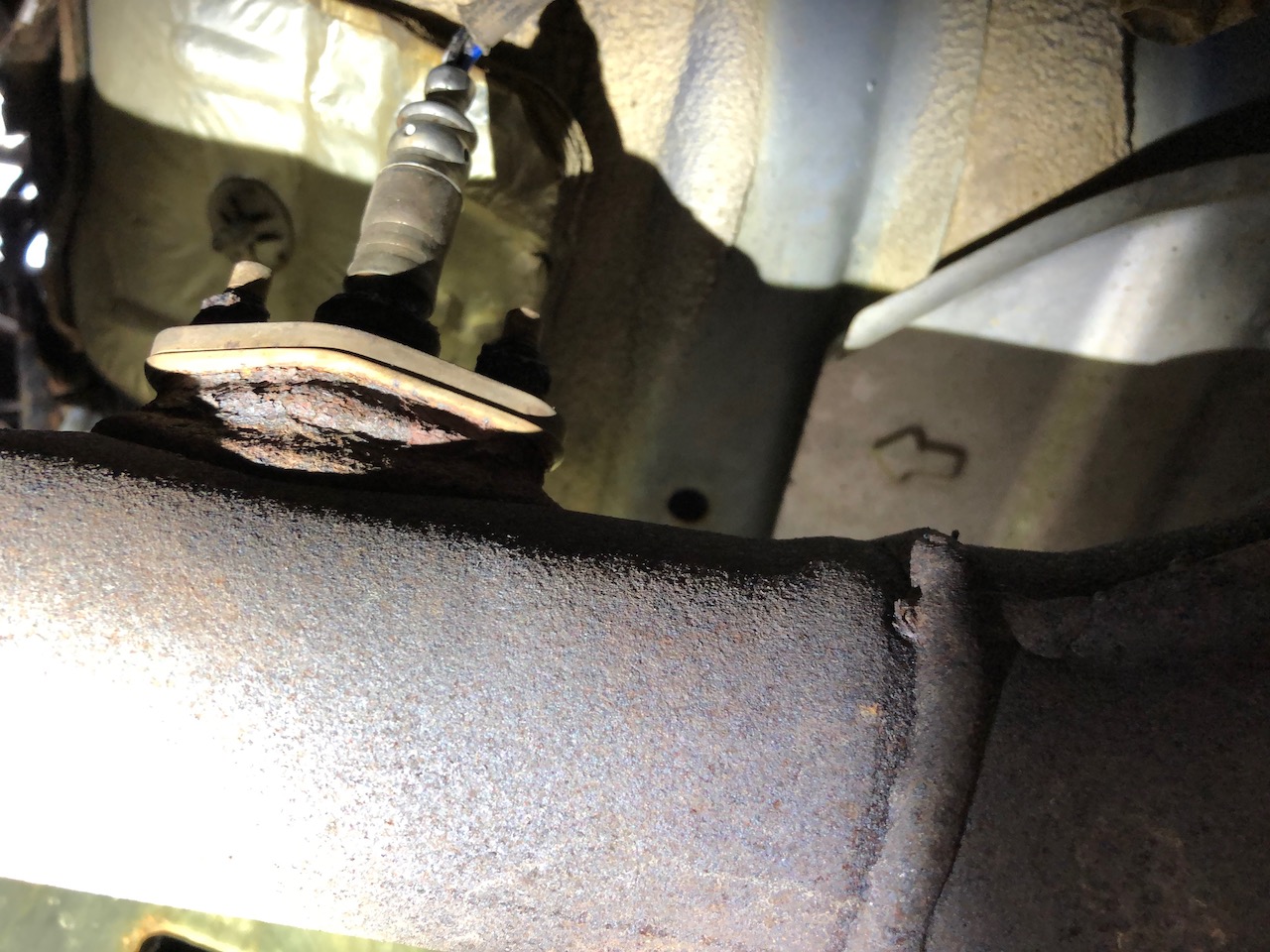
I got one of those wifi dongles that you plug in to the OBD port. It tells me that my runner's got PO125 and PO171 codes, along with the message that my coolant is not warm enough to put the engine management into closed loop mode. It also says that my coolant is at 194˚F, which I believe is correct. And it said that my intake air was 75˚F when the outside temp was about 27˚F. Is that MAF problem or just under-hood air temp? I just did a fuel mileage test and I found that I'm getting 10 mpg in mixed driving. I know that I was told to check the PVC valve and look for vacuum leaks. I didn't do it yet but I'm headed out to the driveway to do that right now. When I looked at the O2 sensors I noticed that the front sensor looks like its been on there for a long time, so long that the nuts that secure it are almost rusted away. Luckily the flange and the studs look ok. The vehicle has 295k miles on the odometer. -- Matt
 
I got one of those wifi dongles that you plug in to the OBD port. It tells me that my runner's got PO125 and PO171 codes, along with the message that my coolant is not warm enough to put the engine management into closed loop mode. It also says that my coolant is at 194˚F, which I believe is correct. And it said that my intake air was 75˚F when the outside temp was about 27˚F. Is that MAF problem or just under-hood air temp? I just did a fuel mileage test and I found that I'm getting 10 mpg in mixed driving. I know that I was told to check the PVC valve and look for vacuum leaks. I didn't do it yet but I'm headed out to the driveway to do that right now. When I looked at the O2 sensors I noticed that the front sensor looks like its been on there for a long time, so long that the nuts that secure it are almost rusted away. Luckily the flange and the studs look ok. The vehicle has 295k miles on the odometer. -- Matt


I’d replace the front O2 sensor.

Look to see if you are in closed loop.

I’d think about clearing codes and see what comes back after replacing the old as dirt front O2 sensor.

To check the temp sensors let it sit overnight and turn in ignition without starting and check the ECT and inlet air temp. They should be within 10 degrees of each other and within 10 degrees of ambient temp.


Sent from my iPhone using Tapatalk
 
Last edited:
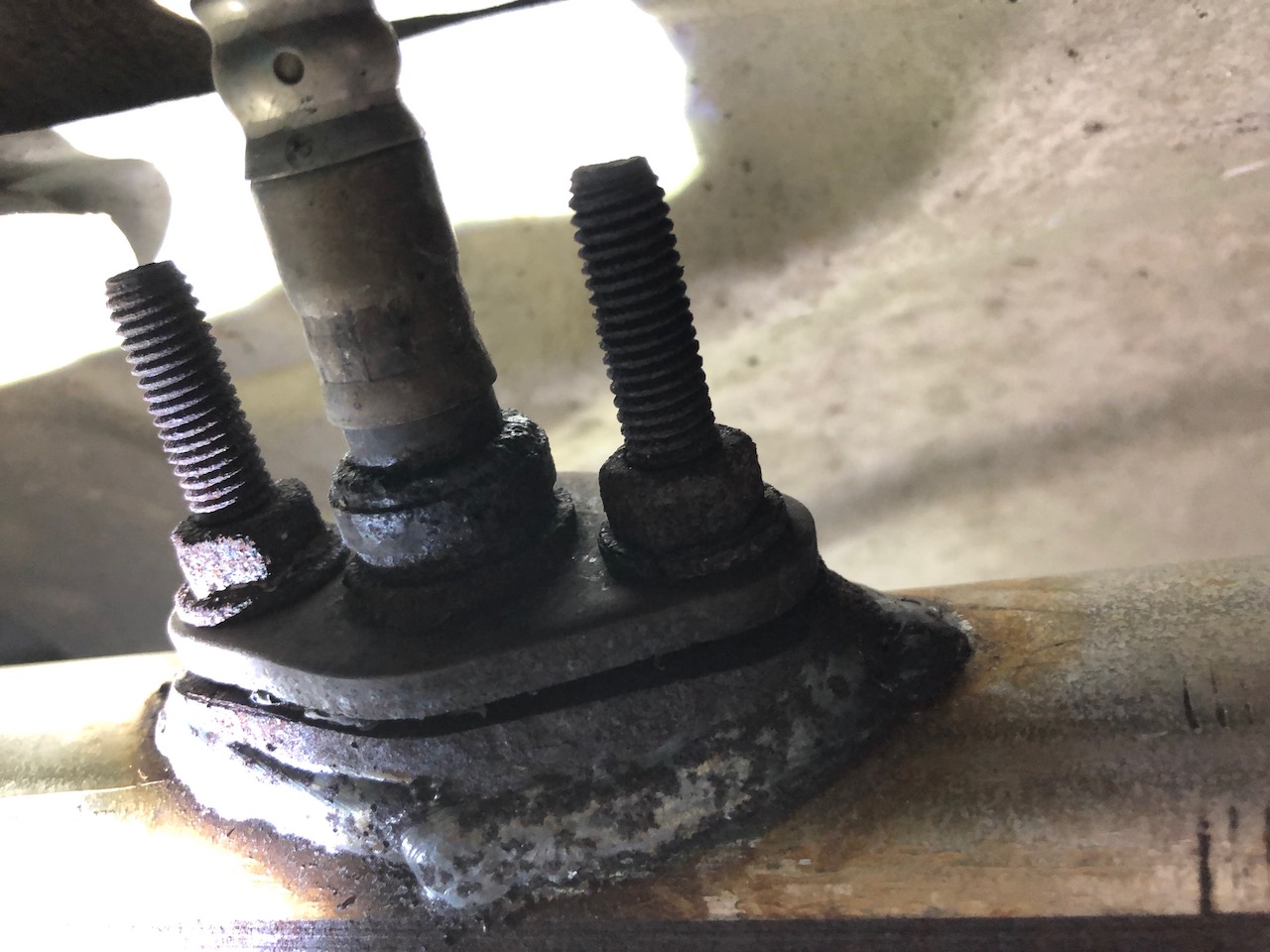
I got the PCV valve out. The valve and the grommet broke into about 20 different pieces while removing them. I had to fish pieces out of the valve cover with a stiff wire with a hook bent into the end and with my shop vac. I should have a new grommet and a new PCV valve in hand shortly. I also ordered a PCV hose from Toyota. I think the MAF might have a problem. It's not measuring the intake air temperature correctly. I am pretty sure it was reading 50° warmer than the actual temperature. The front O2 sensor has got to have at least 100,000 miles on it. I say that because the nuts that hold it down onto the flange don't have a hex shape any longer. They have rusted away. Fortunately the studs and the flange on that combination head pipe and catalytic converter. I don't want to think about how much that would cost to replace. The rear O2 sensor looks slightly newer, or at least the exhaust system that is attached to is newer, but it looks like the gasket is falling apart. I will probably go ahead and replace them both

o2_front.jpg


o2_rear.jpg
 
Last edited:
You need new gaskets. The new sensors should come with gaskets. My 96 had balls of rust where the nuts were for the front O2 sensor with 220k miles.


Sent from my iPhone using Tapatalk
 
Spray those studs for a feww days minimum. Spray it every day with pb plaster. Do it Every day after you order your sensors lol

Sent from my Pixel 2 XL using Tapatalk
 
Lots of times these front 02 sensors go bad. My 97 5 speed lost it's at 118k miles. My 02 camry lost its front 02 sensor at 100k

I think I changed Tetanus 1 as well but I have to my excel sheet

Always check for vacuum issues like the other users suggested. Very common for a PCV valve to be stuck and buy a new grommet before you touch those things because 90% of the time its dry rotted and cracked if never changed.

These engines are mostly 20 years old and extremely easy to have a hose split cracked etc. In the vacuum line

Verify no exhaust leaks too.

Before changing these O2 sensors out pull open the Factory service manual and verify they are bad. It's super easy to check these with a meter and the manual tells you what the resistances are supposed to be. And it's better then replacing and finding out that is not the issue.


Sent from my SM-J337V using Tapatalk
 
Any tips on picking o2 sensors? I looked on rockauto.com and there are about a dozen or more to choose from ranging from about $23 to $160. I usually try to buy parts made by Japanese OEM suppliers for my Toyotas. I see that rock has Denso brand o2 sensors for about $44, part# 2344162, which is the same part that Autozone sells for $100. I'm also getting conflicting info on whether I need different sensors for the front and the back positions. Autozone says I need part # 2344161 for the front, and 2344162 for the rear. Rock says use 2344162 for both. Then Bosch and NTK complicate matters even further by using the terms "bank 1 sensor 2" and "bank 1, sensor 1", indicating different sensors for the different positions. :ybrick:

BTW I am going to consult with my local muffler guru and see if he can weld new flanges on to my pipes at both locations so I have a good base and fresh studs to install my new o2 sensors. Randy's Performance Muffler, in Lake Geneva, Wisconsin, is a gift to our community. He has extremely reasonable prices and does excellent work. And he's swamped. You have to get on his waiting list to get in.
 
Last edited:

Members online

No members online now.

Forum statistics

Threads
278,306
Messages
3,554,045
Members
248,016
Latest member
Advally Service

Trending content

Back
Top