Dual Battery Setup 1.5 Years In (AGM Woes)

Xtremluck

New member
So I built my dual battery setup just about 1.5 years ago. Which consists of two AGM batteries connected via a National Luna Intelligent solenoid. It has been working really well with close to 60 days of camping under its belt. Details on the build are here:
Dual Battery Setup (5th Gen Toyota 4runner) - Google Docs

I've recently noticed that my secondary battery hasn't been holding a charge sitting at around 12.2 volts after charging from the alternator for three hours. My battery isolator also will disconnect the batteries when the engine is running if I turn on all my off-road lights at the same time at night while traversing trails. I think some of this may be related to battery degradation especially since our alternator's charging voltage isnt ideal for AGM.

I dont have the ability to charge both batteries via shore power unfortunately. So I'm trying to find a solution. It would seem that ripping out the current solenoid system for an intelligent DC-DC charger would make the most sense but one of my requirements is the ability to link the batteries to winch or jump start the vehicle. With a DC-DC charger this would not be possible.

I know there are other folks here who have similar setups. What have you been doing? Augmenting with solar? Moving back to lead acid?
 
Register to hide this ad
A DC-DC is the best because it can optimize the charging profile, you could always just carry jump leads to jump from your second battery (or carry a jump pack)


Solar is good to keep things topped off, but it's still going to struggle if you dont fix the charging

(Also, get a voltage booster to keep the starting battery in good condition)
 
Have you looked at your power needs vs battery size?

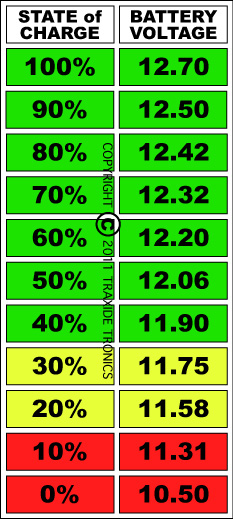
Here’s a state of charge charge for generic 12v AGM.
893139_SoC_Table.jpg


As you can see using 50% of the capacity will cut the battery life in half vs using 35% of the charge, using to much of its capacity between charges is damaging.
DC-12V-130AH.png


DC/DC is the way to go, make sure to get a diode to bump the alternator outage for AGM applications as well.

Here’s how I set mine up.
https://www.youtube.com/watch?v=ha4L7yUlTdk&feature=youtu.be
 
In my dual battery setup I only have 1 AGM battery. I have added the diode module to kick-up the alternator voltage some. I have a shore power ctek charger to use periodically to charge the AGM with its programmed profile to hopefully recondition as needed.
 
I have set up a system for my girls 5th gen that addresses all of these things. First, the charging of the secondary battery is done via roof mounted solar through an MPPT charge controller. It is never connected to the engine, but runs a dometic fridge infinitely unless the engine is started, then the solar charger tops off the battery while driving and runs the accessories off of the engine, thereby reducing the wear on the secondary battery while still charging the main battery. Next, the secondary battery is this:

12V, 100Ah LFP Battery (ABS, BLF-12100AS) – Bioenno Power

Which is the probably best battery option you can get. Its lighter and more powerful than any other battery type, is fireproof, lasts 20 years and made in the US. Also, it accepts 20A continuous charge and is fully charged by Solar at 9am every morning even while running a fridge the entire night. The starting battery never gets discharged and the aux battery remains fully charged at all times either by the sun or if there is a problem by the alternator using a completely separate circuit that cannot drain the main battery.
 
I had the same issues with my NL system when I had my Land Cruiser, Tacoma and FJ. Paul May at Equipt was very helpful but nothing seemed to work. If I decide to put dual battery setups in my T4Rs I’m going with Redarc.
 
So I built my dual battery setup just about 1.5 years ago. Which consists of two AGM batteries connected via a National Luna Intelligent solenoid. It has been working really well with close to 60 days of camping under its belt. Details on the build are here:
Dual Battery Setup (5th Gen Toyota 4runner) - Google Docs

I've recently noticed that my secondary battery hasn't been holding a charge sitting at around 12.2 volts after charging from the alternator for three hours. My battery isolator also will disconnect the batteries when the engine is running if I turn on all my off-road lights at the same time at night while traversing trails. I think some of this may be related to battery degradation especially since our alternator's charging voltage isnt ideal for AGM.

I dont have the ability to charge both batteries via shore power unfortunately. So I'm trying to find a solution. It would seem that ripping out the current solenoid system for an intelligent DC-DC charger would make the most sense but one of my requirements is the ability to link the batteries to winch or jump start the vehicle. With a DC-DC charger this would not be possible.

I know there are other folks here who have similar setups. What have you been doing? Augmenting with solar? Moving back to lead acid?

In a previous 4Runner I had, I was using two AGMs (a group 31 and a group 34) tied together with a Blue Sea ML-ACR. That setup ran for many trouble free years with a fridge on 24/7/365 and a variety of lights, radios etc. all being fed from that system. The ML-ACR has a manual activation mode that can be triggered either with an in-cab switch or manually using a knob on the relay box itself.

I just got into a new 2020 4Runner and I'll likely be using the same ACR for the charging system as I get the build together. I'm not likely to use a group 31 again though as the weight is extreme with a second battery as backup. Probably a pair of Group 27 AGMs.
 
You probably nuked (sulfation) it by just letting the stock alternator charge it for the entirety of it's life. AGM's want to charge between 14.1-14.9v and your stock alternator isn't going to give you that kind of output.

I run a voltage booster + solar + charge at home very occasionally and haven't had any problems.
 
NL also wasn't doing it for me any longer

Noticed the same after about a year with my National Luna.
I have the factory Panasonic? battery and an Optima Yellowtop and was noticing I just couldn't get enough charge into the Optima.
Recently replaced and rewired for a Redarc 25. I noticed an immediate difference. I don't have all the fancy voltage monitors but I could tell my ARB 63 which is always on was running all week with no change to drive times/alt charging times.

I still use 'shore power' if ARB is on and I'm not using 4runner for a few days. I've an on-board NOCO for that.

Meandering point is...after a year or so with the National Luna, I recently swapped for Redarc 25 and I noticed a significant enough improvement to (for me) warrant the cost and effort of the swap.
 
I have set up a system for my girls 5th gen that addresses all of these things. First, the charging of the secondary battery is done via roof mounted solar through an MPPT charge controller. It is never connected to the engine, but runs a dometic fridge infinitely unless the engine is started, then the solar charger tops off the battery while driving and runs the accessories off of the engine, thereby reducing the wear on the secondary battery while still charging the main battery. Next, the secondary battery is this:

12V, 100Ah LFP Battery (ABS, BLF-12100AS) – Bioenno Power

Which is the probably best battery option you can get. Its lighter and more powerful than any other battery type, is fireproof, lasts 20 years and made in the US. Also, it accepts 20A continuous charge and is fully charged by Solar at 9am every morning even while running a fridge the entire night. The starting battery never gets discharged and the aux battery remains fully charged at all times either by the sun or if there is a problem by the alternator using a completely separate circuit that cannot drain the main battery.

Do you have more details on this setup? How much total do you have invested?
 
I'm not a fan of the NL system. I've ran into all these issues in the past... charging, maintenance, and battery degradation is one thing, but even with a healthy system and a very high load, it can cause the second battery to disconnect with the engine running due to the voltage drop.

For those who don't go the direction of a DC-DC, and use a charge relay, I really think the Blue Sea #7611 is an excellent option if you don't want to spend money on the larger ML series.

During high load, if the system voltage drops under 12.75 it can cause the ACR to go open, which only compounds the problem.

The 7611 has an option to drop (via switch or ignition control) the low open voltage to 12.25 volts. This is primarily done to increase capacity as it allows the starter to participate in feeding the load, but also helps combat against high load open conditions.

I use this ACR a lot in my builds, but these days am building a lot more custom lithium systems using a DC-DC as the advantages are huge.

I did a write up with some detail here if anyone is interested.
Blue Sea ACR - Automatic Charging Relays

Edit: None of this will fix the charge voltage required to properly charge/maintain an AGM if that is your choice of battery.
 
Last edited:
New here. I've used the Perfect Switch Dual Rectifier for years.

<iframe width="560" height="315" src="https://www.youtube.com/embed/XvBkmqXH1PQ" frameborder="0" allow="accelerometer; autoplay; encrypted-media; gyroscope; picture-in-picture" allowfullscreen></iframe>
 
I have set up a system for my girls 5th gen that addresses all of these things. First, the charging of the secondary battery is done via roof mounted solar through an MPPT charge controller. It is never connected to the engine, but runs a dometic fridge infinitely unless the engine is started, then the solar charger tops off the battery while driving and runs the accessories off of the engine, thereby reducing the wear on the secondary battery while still charging the main battery. Next, the secondary battery is this:

12V, 100Ah LFP Battery (ABS, BLF-12100AS) – Bioenno Power

Which is the probably best battery option you can get. Its lighter and more powerful than any other battery type, is fireproof, lasts 20 years and made in the US. Also, it accepts 20A continuous charge and is fully charged by Solar at 9am every morning even while running a fridge the entire night. The starting battery never gets discharged and the aux battery remains fully charged at all times either by the sun or if there is a problem by the alternator using a completely separate circuit that cannot drain the main battery.

Can you self jump, i.e. connect the two batteries together if needed? Other than using jumper cables.
 
Do you have more details on this setup? How much total do you have invested?

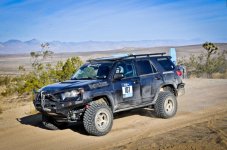
Sure, what details are you interested in? Her truck was in the Rebelle rally this year, heres a pic of it with the roof rack and integrated solar panel. We made the rack and battery holder ourselves since nothing exists that we wanted.

costs were:

100w solar panel $80
10 awg wire 30 ft $30
200A breaker $20
2awg distribution block $20
bioenno MPPT charger $140
Bioenno 100AH 12V battery $800
Roof rack (unistrut) $200
70A relay $10
Battery holder (steel) $40

Full disclosure: She is sponsored by Bioenno, so of course we used their battery.
 

Attachments

  • Luna6_jpg.jpg
    Luna6_jpg.jpg
    137 KB · Views: 2,203
Can you self jump, i.e. connect the two batteries together if needed? Other than using jumper cables.

If you want, I guess you could switch positions on the distribution block to jump one to the other but there is no need since it is impossible to drain the main battery.
 
Redarc 25 is what I run on my truck with a Odyssey 34 for the accessories. Stock battery sees 13.9 while accessory battery see 14.4. Haven't had any issues yet. DC to DC is the way to go.
 
If you want, I guess you could switch positions on the distribution block to jump one to the other but there is no need since it is impossible to drain the main battery.

Understood but there is always a need. If the main battery takes a dump make sure you can use the aux. battery to start the vehicle and get you back to civilization and a new main. Which sounds like you can by switching leads or carrying jumper cables. Had my main battery take a dump overnight where it dropped cells and resulting voltage was only 6v. I self jumped with aux battery to get truck started and buy new main.
 
So I built my dual battery setup just about 1.5 years ago. Which consists of two AGM batteries connected via a National Luna Intelligent solenoid. It has been working really well with close to 60 days of camping under its belt. Details on the build are here:
Dual Battery Setup (5th Gen Toyota 4runner) - Google Docs

I've recently noticed that my secondary battery hasn't been holding a charge sitting at around 12.2 volts after charging from the alternator for three hours. My battery isolator also will disconnect the batteries when the engine is running if I turn on all my off-road lights at the same time at night while traversing trails. I think some of this may be related to battery degradation especially since our alternator's charging voltage isnt ideal for AGM.

I dont have the ability to charge both batteries via shore power unfortunately. So I'm trying to find a solution. It would seem that ripping out the current solenoid system for an intelligent DC-DC charger would make the most sense but one of my requirements is the ability to link the batteries to winch or jump start the vehicle. With a DC-DC charger this would not be possible.

I know there are other folks here who have similar setups. What have you been doing? Augmenting with solar? Moving back to lead acid?

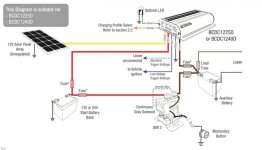
You can link/jump your batteries with a DC/DC charger. I have it on my rig. Here's the Redarc wiring guide.

BCDC Dual with Jump-Start - The New Ultimate Dual Battery Setup | REDARC Electronics
 

Attachments

  • Screen Shot 2020-01-14 at 6.19.17 PM.jpg
    Screen Shot 2020-01-14 at 6.19.17 PM.jpg
    36.7 KB · Views: 1,590
So I built my dual battery setup just about 1.5 years ago. Which consists of two AGM batteries connected via a National Luna Intelligent solenoid. It has been working really well with close to 60 days of camping under its belt. Details on the build are here:
Dual Battery Setup (5th Gen Toyota 4runner) - Google Docs

I've recently noticed that my secondary battery hasn't been holding a charge sitting at around 12.2 volts after charging from the alternator for three hours. My battery isolator also will disconnect the batteries when the engine is running if I turn on all my off-road lights at the same time at night while traversing trails. I think some of this may be related to battery degradation especially since our alternator's charging voltage isnt ideal for AGM.

I dont have the ability to charge both batteries via shore power unfortunately. So I'm trying to find a solution. It would seem that ripping out the current solenoid system for an intelligent DC-DC charger would make the most sense but one of my requirements is the ability to link the batteries to winch or jump start the vehicle. With a DC-DC charger this would not be possible.

I know there are other folks here who have similar setups. What have you been doing? Augmenting with solar? Moving back to lead acid?

I'm running 2 Odyssey batteries connected via a Blue Sea ACR. My batteries can charge via Alternator, Shorepower (CTEK hardwired) and I have a 100w solar panel on the roof rack.

I absolutely love this system, I haven't turned my ARB fridge off in over 2 years and my Victron battery monitor is at 100% almost full time even if sitting parked. If camping I do have 2 100w panels that I'll rig up to my 4R via the rear Anderson plug that powers my turtleback trailer when attached.

If you search my username I did a pretty detailed write up somewhere along the way on how I wired everything up.
 

Members online

No members online now.

Forum statistics

Threads
278,316
Messages
3,554,120
Members
248,016
Latest member
Advally Service

Trending content

Back
Top