Dual Battery Vs. Portable Battery

I've considered that, just as a project to feed my curiosity as much to power the rig. I hope competition puts some downward pressure on prices and 75 Ah 12V LIFEPO4 can be had for around $500 in the near term. I don't mind spending that or slightly more if that means I get a 7 or 10 year warranty and roughly 3000 cycles out of it.

I have one question on the portable systems that one builds. I know on a permanently mounted dual battery setup, we need to ground the aux battery. If I were to do it I would just run the negative cable to the same chassis ground where my starter battery is grounded. But suppose I have a lithium battery in a removable box. I realize that the DC to DC is going to be grounded via the starter battery and linked up to the aux battery in the box but is that all that is required? Do I need to create a chassis ground for the portable unit on top of that?

It's easier to just think of portable systems as isolated. Like a flashlight or any other battery operated device.

The only time you really chassis ground is on systems using an automatic charging relay. When the ACR is engaged, both batteries are connected in parallel. They share a common ground and positive, and is charged by the same alternator, and participate in the same loads when combined.

Systems charged by a DC-DC are not required to share a chassis ground. The batteries are not in parallel, which is why recommended when dealing with AGM voltages, other chemistry, or other system voltage.

Many of the Orion models are completely isolated, these are the ones I use for various reasons. The flow of current is generally directional and is limited by the DC converter. The biggest downside to isolated converters is efficiency. They might be 88% efficient where a non-isolated converter could be 95%.

You can achieve your goals now at that price if you were to DIY ~ $500/kWh, using brand new LifePO4 cells.

Batteries are fun, I like that you considered it. For me, building has less to do with cost, and more to do with the shape of the battery and where you can make it fit.

Either way, have fun, sounds like you are on the right path.
 
Even with the system completely dead the Victron MPPT would be able to recover and put charge back into the batteries. I use their DC-DC chargers too and together I find them to be a better option.

The Victron controller also has bluetooth for monitoring. You can see trending and live data for solar and battery monitoring. I like to nerd out on this stuff so I find it pretty useful. Also eliminates to need for a bunch of battery or voltage monitors.

So I'm getting ready to order my Victron smart MPPT (75/15) given that my rig is now all wired up to accept it and a fridge. Do you think it is necessary to also have the Smart Battery Sense to allow the MPPT to monitor the temperature at the battery and adjust charging accordingly? I'll be charging the starter battery with the MPPT located all the way at the back and will be backfeeding solar charge to the battery via the blue sea fuse block I installed in the rear jack storage area.
 
Last edited:
So I'm getting ready to order my Victron smart MPPT (75/15) given that my rig is now all wired up to accept it and a fridge. Do you think it is necessary to also have the Smart Battery Sense to allow the MPPT to monitor the temperature at the battery and adjust charging accordingly? I'll be charging the starter battery with the MPPT located all the way at the back and will be backfeeding solar charge to the battery via the blue sea fuse block I installed in the rear jack storage area.

It's one of those items that would never hurt, it will be more accurate... but personally I don't use them.

1. If I need to adjust something, ill do it manually after taking measurements myself.

2. We are not pushing such a high level of current where line resistance become a huge concern.

You can always add one down the road if you want it.
 
Thanks! I'll hold off on it for now and can plan to upgrade to it in the spring when I install a larger starter battery.
 
So getting ready to build my auxillary battery set up. Should get the battle born 50 Ah on Monday and have most of the other stuff delivered on expected soon with the exception of the victron smart shunt which is out of stock pretty much everywhere I looked (expected mid September ship date).

My plan is to either source a box or look into a wooden box built to size with some marine carpeting. Trying to avoid the latter so will go down to the hardware store to see what off the shelf tool boxes can be re-purposed. I had a group 24 NOCO battery box sitting with me but it doesn't look robust enough to last a long time. Interested in the Rigid and Makita options so will check them out. They are a lot bigger than a battery and the fuse block set up but if they are robust enough for this purpose I might just also mount the charge controller in there though the DC to DC is going to be vehicle mounted.

Would love to here if ya'll have any recommendations..Here's a rough outline for sizes -

- Battery dimensions - 6.75 x 6.88 x 9 (inches)
- Fuse block dimensions - 3.5" x 3.5"
- Victron smart shunt - 4.5" x 2" x 2"

Would prefer to mount the battery right side up as that takes the least amount of width in the box. So basically am looking for a 12-13 inch wide box with a foam covered wood acting as a separator that snugly holds the battery in place. The remaining space is where I'll mount the fuse block and the shunt. The top needs to have some room to clear a terminal fuse and also enough gap to accommodated a flush mounted breaker on the lid.

Would love some ideas here on what off-the shelf storage system can be re-purposed..

Edit: The 22" tool box's are just too big even if I leave room for an additional 50 Ah battery down the road. The only viable medium sized tool box that I really liked was the Milwaukee but at 16" x 9" it is also a tad bit too larger. The NOCO Group 24 is probably the smallest I could comfortably squeeze in the battery, fuse block, shunt and wiring but there is really nothing, with higher quality, that works in that form factor. I was able to get a great deal on the Milwaukee because of a few dings and scratches (right about where I plan on installing a circuit breaker :) ) so going with that. Will follow up once I'm into the build..
Some advise on how best to secure the battery inside would be very valuable given I'll have more real estate than the battery (for room to grow).
 
Last edited:
Just finished wiring up my DC-DC charger and cabling (still need to mount a housing/holder for the Anderson connector when not in use). Just using a cable cuff for now until I figure out a proper way to house the wiring and connector. The real estate above and to the right of the charger is reserved for a victron phoenix inverter in the future since I don't need the portability of an inverter so it won't be in the box.
Now on to building out the battery box and then mounting the solar panel :lookout:
 

Attachments

  • IMG_3481.jpg
    IMG_3481.jpg
    73.4 KB · Views: 1,640
  • IMG_3482.jpg
    IMG_3482.jpg
    69.1 KB · Views: 1,784
Last edited:
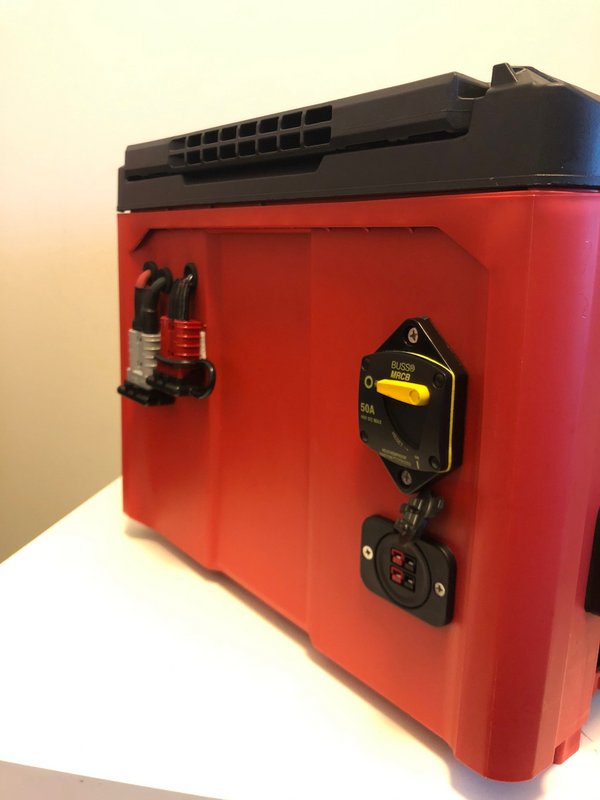
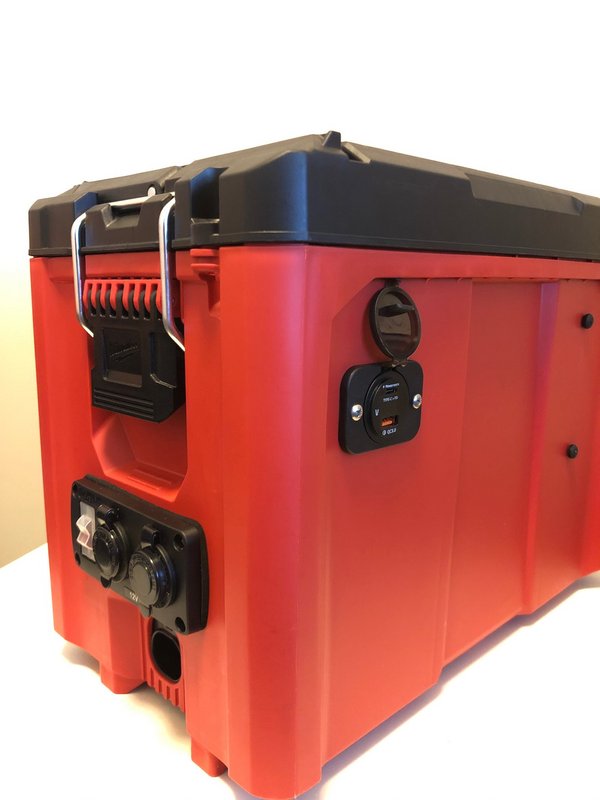
Here's my completed (still need some aesthetic improvements but overall it fits and checks out) portable auxiliary battery. Relatively simple to put together. 50 usable Ah (LiFePO4), 20 A DC-DC charge capacity, 10 Amp MPPT built in. My DC-DC is outside the vehicle but the box can accommodate a Victron 18 or 30 A DC-DC unit.The battery has a max continuous current of of 60 amps.

2 Anderson SB50 connectors (one dedicated for unregulated solar) and 2 Powerpole connectors along with a USB type C, QC 3.0 port, one cigarette lighter port and a couple of 2.1A USB ports. The USB Type C/QC port has a small voltage read out but the box has a built in Victron Smart Shunt so I get capacity use data via bluetooth so didn't really need that feature (type-c ports are really hard to find). Choice of materials and components was in part driven by stuff that I had already purchased for a more standard dual battery installation (another G-34) which I chose to reuse for this instead of return. I had initially thought about building my aux box around a Trojan 100 Ah deep cycle AGM battery but that would have entailed a larger box, which would have weighed closer to 80 lb and would not have been practical or portable. My current setup has about the same usable battery capacity and weighs only 26.4 lb.

My next DIY project will be to do something similar to [MENTION=144483]Bumbo[/MENTION] and build a DIY LiFePO4 battery from raw cells and BMS. I reckon I could fit about 100 usable Ah of capacity into the same form factor though safely securing the system into the box (the current battery fits snug and will survive off-road abuse) will be a challenge.

IMG-3576.jpg


IMG-3584.jpg
 
Last edited:
I really dislike hard sided panels for mobile use.

You should consider flexible panel... they make for a decent middle ground. They do cost a little more and are not as efficient, but they pack away nicely.

I have a 60 watt folder and it easily keeps up with my fridge and tops off the battery.

nlrJl9R.jpg


E0HM49p.jpg

Mine stays up there 100% of the time, requires no setup/tear down, and keeps solar going into the battery all day long, even while I run into 7-11 or the grocery store.

Only gripe I have is I have to hop up on my sliders once a month or so, and make sure it's clean
 
A bit of a thread jack on someone's old thread here, but...

I'd like to run a 100 watt appliance (Starlink) for 8+ hours a day. What would it take to do that?

I installed a group 31 battery last year but don't have any additional accessories yet. My x2power group 31 battery is 100ah. So thats 12v X 100ah = 1200 watt hours, right? Is there a significant loss for running an inverter to get 120v?

We plan to be driving several hours every other day, on average. We likely will not always need to run the starlink during the day, but need the option.

I'd like to avoid solar if possible.
 
A bit of a thread jack on someone's old thread here, but...

I'd like to run a 100 watt appliance (Starlink) for 8+ hours a day. What would it take to do that?

I installed a group 31 battery last year but don't have any additional accessories yet. My x2power group 31 battery is 100ah. So thats 12v X 100ah = 1200 watt hours, right? Is there a significant loss for running an inverter to get 120v?

We plan to be driving several hours every other day, on average. We likely will not always need to run the starlink during the day, but need the option.

I'd like to avoid solar if possible.

Did you get the 100 watt value of spec off the spec sheet, or actually measure it?

Chances are that is the peak load (during transmit), not the RMS load, which would work in your favor in terms of sizing.

Your rough math is correct... 12v x 100ah = 1200 watt hours total capacity.

AGM; Your cycle depth should be half that, so 600 watt hours usable. Deeper discharge you will start to expedite reduction of service life.

DC to AC conversion efficiency is generally 80-90% efficient depending on the size and quality of inverter. Above 90% is generally found in VERY good efficient units that are sized correctly.

If you have big inverter, you can always add a small one to supplement small loads.

The Starlink equipment probably runs on DC power...? Check the wall plug output voltage. If so consider using a DC-DC converter and pickup some efficiency there.

Example of small inverter and DC-DC converters.

https://www.victronenergy.com/uploa...hoenix-Inverter-VE.Direct-250VA-1200VA-EN.pdf

DC-DC converters - Victron Energy

Best thing to do is meter actual power consumption over a 24 hour period of normal use, and then size the battery accordingly.
 
Last edited:

Members online

Forum statistics

Threads
278,316
Messages
3,554,111
Members
248,016
Latest member
Advally Service

Trending content

Back
Top