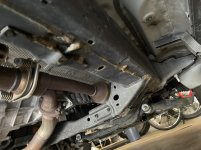
I was giving my 4runner yet another chassis wash after the last road salt of the year and noticed some corrosion on the frame welds. The truck is a 2016 with about 48k miles and I take good care of it. My wife’s 2012 Pilot, with twice the age and mileage, has zero corrosion. Is this rust on my 4runner anything to worry about? Thank you in advance.

You are using an out of date browser. It may not display this or other websites correctly.
You should upgrade or use an alternative browser.
You should upgrade or use an alternative browser.
Frame weld corrosion
- Thread starter RAVL 2016
- Start date
Register to hide this ad
I do my 2016 runner every November to clean up all the rust. I wire brush the rust welds then I spray cold galv paint..then another day I use rustoleum black spray can performance paint ..
I did the pans under the engine paint it , and I did it 3 yrs ago and the pans now look like new....
Australian iron is a poor rust issue.. Minnesota iron in the old days my old vehicles have not any rust issues ...
I did the pans under the engine paint it , and I did it 3 yrs ago and the pans now look like new....
Australian iron is a poor rust issue.. Minnesota iron in the old days my old vehicles have not any rust issues ...

Buba1
New member
Has it ever been oil sprayed or treated with anything to protect it from the harsh winter road salts? From what I can see, it's just minor surface rust, so nothing to be concerned about, yet. Rust can spread very quickly though, and if you plan to keep your truck for a long time you will notice it if you do not do anything about it right now to prevent it from spreading further.
Weld in general are porous so unless they added additional coating they’ll always be first to rust. Also the welds should be tougher than the metal it’s joining if done correctly.
That all being said not a major issue but once it starts it’ll spread. I’ll wire brush any rust and spray with some tough enamel paint. There’s definitely better paint options but most require more prep. After painting and curing, I’ll fluid film the underbody and more importantly inside the frame which is bigger issue since it holds salt and water better and you can’t tell how bad the rust is inside.
That all being said not a major issue but once it starts it’ll spread. I’ll wire brush any rust and spray with some tough enamel paint. There’s definitely better paint options but most require more prep. After painting and curing, I’ll fluid film the underbody and more importantly inside the frame which is bigger issue since it holds salt and water better and you can’t tell how bad the rust is inside.
I have not sprayed the chassis with anything like fluid film and I am the original owner. I have cleaned the chassis/underside fairly diligently with a warm water jet spray and distilled dawn dish detergent - I do it soon after it gets dirty, generally no more than a few days after a snow storm. The cars are cleaned frequently so any type of non permanent oil, besides being messy, will be short lived.
I appreciate the advice to treat it or paint it but candidly I find that it is disappointing to have to do that on a car that I consider fairly new, particularly given how corrosion resistant new cars have become. Since the car is dealer serviced since new, I may raise it with them to see how they react or what they suggest. But to get into spot painting the chassis every spring is not a task I want to undertake on a car. If that is the route I would have to go to keep it from getting rusty, I would likely sell it, particularly given what it will bring today.
Thank you again in advance.
I appreciate the advice to treat it or paint it but candidly I find that it is disappointing to have to do that on a car that I consider fairly new, particularly given how corrosion resistant new cars have become. Since the car is dealer serviced since new, I may raise it with them to see how they react or what they suggest. But to get into spot painting the chassis every spring is not a task I want to undertake on a car. If that is the route I would have to go to keep it from getting rusty, I would likely sell it, particularly given what it will bring today.
Thank you again in advance.
Last edited:

Syr4RinNC
New member
Not a concern at all.
People have a big phobia of rust without having actually been through a "rusted out vehicle"
All of your bolts and everything else is clean. nothing looks seized. If you look at older 4runners, you will see that rust does not typically spread from the welds, it just stays there and is mostly cosmetic. That isnt even worth sanding as youll damage the metal and finish further and further expose it to issues.
if it bothers you, Id just clean it with soap/ water and after it dries you can apply rusteolum rust converter
The honda pilot is a unibody design and is going to have more plastic and other protective things underneath. A better comparison would be if you have a highlander to your wife's pilot or if she had a pick up truck
People have a big phobia of rust without having actually been through a "rusted out vehicle"
All of your bolts and everything else is clean. nothing looks seized. If you look at older 4runners, you will see that rust does not typically spread from the welds, it just stays there and is mostly cosmetic. That isnt even worth sanding as youll damage the metal and finish further and further expose it to issues.
if it bothers you, Id just clean it with soap/ water and after it dries you can apply rusteolum rust converter
The honda pilot is a unibody design and is going to have more plastic and other protective things underneath. A better comparison would be if you have a highlander to your wife's pilot or if she had a pick up truck
Horsethief
New member
These seem to be pretty prone to it. Honestly, I'm surprised it took this long for you to notice. Here in New England, you could go look at a new one on the lot and see a little bit of rust underneath.
If you don't feel like sanding and all that, I would at least have it sprayed with fluid film or similar. Or
Or, like you said get out of it while the getting is still good. Though I wouldn't be surprised if the market for these is shrinking fast with the unpredictability of fuel prices lately.
Incidentally, I have a 2007 Volvo that I've done zero in the way of rust prevention on, and it looks much cleaner underneath and under the hood than my 13 4Runner. Also, the Volvo came with a 12-year corrosion warranty from the factory. I think Toyota's is like three.
If you don't feel like sanding and all that, I would at least have it sprayed with fluid film or similar. Or
Or, like you said get out of it while the getting is still good. Though I wouldn't be surprised if the market for these is shrinking fast with the unpredictability of fuel prices lately.
Incidentally, I have a 2007 Volvo that I've done zero in the way of rust prevention on, and it looks much cleaner underneath and under the hood than my 13 4Runner. Also, the Volvo came with a 12-year corrosion warranty from the factory. I think Toyota's is like three.

Jivewalker
Member
wire brush it and hit it with some fluid film or cosmoline
LowKey1969
New member
I'm reposting this here from the New Members area, just realized the regulars may not look over there very often...
Our "new to us" 2012 SR5 has a wee bit of rust on it's underside having spent it's time in New Jersey, despite only 46k miles.
Now it's here in sunny Florida, so no more heavy doses of road salt.
I'm thinking two or three good pressure washings with dawn to get any residual road salts out as well as old grease, oil & whatnot, let it dry well, a light wire brushing on anything that looks flaky, poke/probe anything that looks really nasty, followed by some Prematex Rust treatment, and finally some Fluid Film.
I'll probably swap out the front break calipers. Had it to the local dealership for a VERY minor interior cosmetic issue* and while they had it in the shop they advised me I needed new brake pads and rotor turnings all around, and that the front breaks were sticking.
Not wanting to pay their rates on the brakes I picked up some OEM pads and did my first break job in probably 25 years. Of course 3 out of the 4 brake pad retaining pins were frozen and refused to yield to a PB Blaster, then Kroil soak over a few days time. Out came the dremmel, hammer, and punch. Plenty of sil break grease. Somethings still sticking (based on the very very slight shimmy in the wheel). I suppose I could try to puzzle my way through pulling the pistons, but I think the easier and wiser course is to just get a couple of OEM rebuilds, as a decade in the NE with their road salt has to have taken it's toll. I may upgrade to steel braided lines while I'm at it, as I'm also at the mark for doing a complete change of brake fluid.
I'll be messing with the rear brakes next weekend. Oh Joy.
I'm going to post a few pictures of the front half of the underside in hopes some of you more experienced with 4Runners in the NE can give me a better idea of what I'm likely to be looking at problem wise based on the amount of rust seen. The skid plate seems to have had the worst of it, as the beefed up area around the jack point (where the larger hole is) is rusted out, and I think there was supposed to be another skid plate back towards the tranny which isn't there anymore.
Pics....If I can figure out how....






Pardon the rather haphazard photography. I was taking a break from dealing with a grease gun stuck on the zerk for a spider...else I was considering explosives
*covered under warranty by the seller. And at the prices on Toyota plastic I think they just lost all their profit....
Our "new to us" 2012 SR5 has a wee bit of rust on it's underside having spent it's time in New Jersey, despite only 46k miles.
Now it's here in sunny Florida, so no more heavy doses of road salt.
I'm thinking two or three good pressure washings with dawn to get any residual road salts out as well as old grease, oil & whatnot, let it dry well, a light wire brushing on anything that looks flaky, poke/probe anything that looks really nasty, followed by some Prematex Rust treatment, and finally some Fluid Film.
I'll probably swap out the front break calipers. Had it to the local dealership for a VERY minor interior cosmetic issue* and while they had it in the shop they advised me I needed new brake pads and rotor turnings all around, and that the front breaks were sticking.
Not wanting to pay their rates on the brakes I picked up some OEM pads and did my first break job in probably 25 years. Of course 3 out of the 4 brake pad retaining pins were frozen and refused to yield to a PB Blaster, then Kroil soak over a few days time. Out came the dremmel, hammer, and punch. Plenty of sil break grease. Somethings still sticking (based on the very very slight shimmy in the wheel). I suppose I could try to puzzle my way through pulling the pistons, but I think the easier and wiser course is to just get a couple of OEM rebuilds, as a decade in the NE with their road salt has to have taken it's toll. I may upgrade to steel braided lines while I'm at it, as I'm also at the mark for doing a complete change of brake fluid.
I'll be messing with the rear brakes next weekend. Oh Joy.
I'm going to post a few pictures of the front half of the underside in hopes some of you more experienced with 4Runners in the NE can give me a better idea of what I'm likely to be looking at problem wise based on the amount of rust seen. The skid plate seems to have had the worst of it, as the beefed up area around the jack point (where the larger hole is) is rusted out, and I think there was supposed to be another skid plate back towards the tranny which isn't there anymore.
Pics....If I can figure out how....
Pardon the rather haphazard photography. I was taking a break from dealing with a grease gun stuck on the zerk for a spider...else I was considering explosives
*covered under warranty by the seller. And at the prices on Toyota plastic I think they just lost all their profit....
The extent of corrosion there is disappointing. You can still catch it, but it undermines my confidence in Toyota quality because while NJ gets snow, it isn't exactly Buffalo or the great white north. Given the rustproofing techniques that are available today, that, at least in my judgment, represents Toyota cutting costs on the back of the consumer. Surprising, because the 4runner is supposed to be the benchmark when it comes to durability and build quality.
I am sure you will get a handle on it, and I will keep an eye on mine, but this is one of those things that will play a significant role in my thinking the next time we have to buy a car/truck.
Good luck with cleaning that up and enjoy the truck in FL.
I am sure you will get a handle on it, and I will keep an eye on mine, but this is one of those things that will play a significant role in my thinking the next time we have to buy a car/truck.
Good luck with cleaning that up and enjoy the truck in FL.
LowKey1969
New member
Well, that is the result of ten winters in New Jersey.
It's entirely possible that the last owner didn't know or bother to wash the underside periodically in the winter.
In any case reductions in quality by Toyota would have been a decade in the past and would/should have shown up on subsequent years, and of all places on the internet "here" is where I suspect such problems would be well known already.
Can anyone tell me of any specific areas that I should be looking at on the vehicle to catch or correct corrosion damage that isn't going to be easy to deal with?
I mean, should I be trying to flush out the inside of the frame rails?
Based on the level of rust shown in the photos are there parts I can't easily see that I should be especially concerned about?
Or is this level of rust still considered minor surface rust?
I spent the last 15 years or so in a desert far away, so serious rust wasn't exactly a common issue on vehicles.
Hell, this is the first vehicle I've owned since 2006.
It's entirely possible that the last owner didn't know or bother to wash the underside periodically in the winter.
In any case reductions in quality by Toyota would have been a decade in the past and would/should have shown up on subsequent years, and of all places on the internet "here" is where I suspect such problems would be well known already.
Can anyone tell me of any specific areas that I should be looking at on the vehicle to catch or correct corrosion damage that isn't going to be easy to deal with?
I mean, should I be trying to flush out the inside of the frame rails?
Based on the level of rust shown in the photos are there parts I can't easily see that I should be especially concerned about?
Or is this level of rust still considered minor surface rust?
I spent the last 15 years or so in a desert far away, so serious rust wasn't exactly a common issue on vehicles.
Hell, this is the first vehicle I've owned since 2006.
Last edited:
I'd say that looks pretty good for having lived through a decade of Northeast winters. And while maybe the PO wasn't overly obsessive about washing the salt off, I'd wager they didn't simply ignore it or that under carriage would look a lot worse.
Much of what's shown in your pictures appears to be surface oxidation. You may be surprised at how effective a stiff wire brush is at removing rust at this stage. Unfortunately it looks like the calipers are pretty bad. For my own peace of mind, I'd take the opportunity to get a fresh start on the brake system. Drain/flush the fluid, clean up/inspect/paint those calipers and any fastener involved and then install new pads/rotors when putting it back together (might need to paint the rotor hats if using after market parts). Once they're off, cleaning up and painting the calipers should be a pretty easy job with either a drill brush or bench grinder/wire wheel.
Much of what's shown in your pictures appears to be surface oxidation. You may be surprised at how effective a stiff wire brush is at removing rust at this stage. Unfortunately it looks like the calipers are pretty bad. For my own peace of mind, I'd take the opportunity to get a fresh start on the brake system. Drain/flush the fluid, clean up/inspect/paint those calipers and any fastener involved and then install new pads/rotors when putting it back together (might need to paint the rotor hats if using after market parts). Once they're off, cleaning up and painting the calipers should be a pretty easy job with either a drill brush or bench grinder/wire wheel.
LowKey1969
New member
Thanks.
I lived in NYC and Upstate NY as a kid...many, many, many decades ago. I recall my Grandmothers car having a dinner-plate sized hole through the floorboard in front of the passenger seat, covered by a thin sheet of plywood then a floormat, due to rust from road salt. And many other vehicles also had body cancer.
Obviously no road salt down here, but I want to get rid of that rust thoroughly. The intent is to keep this vehicle going past 300k!
I lived in NYC and Upstate NY as a kid...many, many, many decades ago. I recall my Grandmothers car having a dinner-plate sized hole through the floorboard in front of the passenger seat, covered by a thin sheet of plywood then a floormat, due to rust from road salt. And many other vehicles also had body cancer.
Obviously no road salt down here, but I want to get rid of that rust thoroughly. The intent is to keep this vehicle going past 300k!
LowKey1969
New member
take care of it now so it does not spread and more manageable.. otherwise, it will be more time consuming to do. i spent like a week of removing rust and flaking metal and cleaning and painting it.
That's the plan. :becky:
Dismounted the spare tire and poked around the back end.
Not as bad as I thought it might be.





Lexington
Member
I was just thinking about washing and protecting my underside so finding this thread was good timing.
I’m in California but the vehicles first 3 years were in Colorado so I really haven’t had to worry much about salt and it’s in decent shape. But I want to keep it protected as I plan to keep this vehicle for a very long time.
I have a couple of questions though.
What’s the bast way to wash your underside?
With fluid flush how often does this need to be reapplied. Are there other similar products?
From what I’ve read if you decided to paint you should do that first before using Fluid Flush correct?
I’m in California but the vehicles first 3 years were in Colorado so I really haven’t had to worry much about salt and it’s in decent shape. But I want to keep it protected as I plan to keep this vehicle for a very long time.
I have a couple of questions though.
What’s the bast way to wash your underside?
With fluid flush how often does this need to be reapplied. Are there other similar products?
From what I’ve read if you decided to paint you should do that first before using Fluid Flush correct?
Lexington
Member
Just looking around for undercoating protection I did find this video.
Best Car Undercoating? Let's find out! Is Flex Seal the Best Rust & Salt Protection? - YouTube
Best Car Undercoating? Let's find out! Is Flex Seal the Best Rust & Salt Protection? - YouTube


