How To Make A Bridle

DesertCanyons

New member
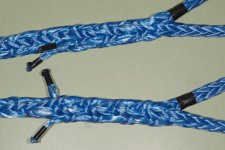
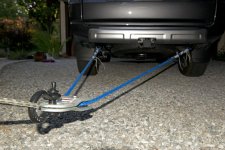
After lots of consideration about recovery gear I decided to make my own 1/2" diameter Samson AmSteel Blue rope bridle.
In January I started another thread about all of the other Recovery Gear. You can see what everyone had to say about what they carry. On page 8 you can see what I eventually purchased to carry with me in the So Cal deserts. The thread on Recovery Gear Options:
http://www.toyota-4runner.org/5th-gen-t4rs/213078-recovery-gear-options.html
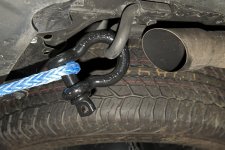
[MENTION=13878]GrantK[/MENTION] posted some good illustrations of proper shackle use on page 9. Unfortunately, shackles do not fit under the bumper the way the illustrations suggest. See my photos here of the recovery loop, shackle and bridle eye.

Southeast Overland makes these bridles in 3/8" Sampson rope for a few dollars more ($20 more) than I spent on the line. But after buying the lashing line I needed to finish the eyes, it was a break even. They have a note and good photos of how the bridle is used.
Southeast Overland Bridle:
http://www.southeastoverland.com/in...ct_id=200&virtuemart_category_id=71&Itemid=33

A 1/2" bridle line requires a snatch block with a pulley that can handle 1/2" rope. Most of them are made for 3/8" line. I bought the Rugged Ridge snatch block through Amazon for $55. It has a rated capacity of 30,000 lbs. Rough Country makes a lighter, 16,000 lb. pulley block for half the price.
http://www.amazon.com/Rugged-Ridge-...ue&ref_=ox_sc_act_title_13&smid=ATVPDKIKX0DER

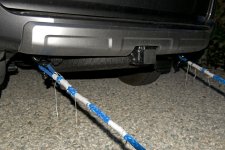
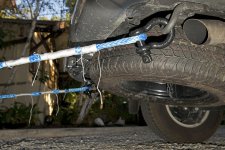
Photos of the bridle mounted on the back of the frame:
 

Attachments
  • Bridle7831.jpg
    Bridle7831.jpg
    141.3 KB · Views: 5,706
  • Bridle7832.jpg
    Bridle7832.jpg
    137 KB · Views: 1,874
  • Bridle7835.jpg
    Bridle7835.jpg
    142.9 KB · Views: 1,895
  • Bridle7836.jpg
    Bridle7836.jpg
    138.4 KB · Views: 1,871
Last edited:
Register to hide this ad
The Samson AmSteel Blue 1/2" rope

I bought 17 feet of the Sampson Amsteel Blue 1/2" line from LFS Marine in Bellingham, WA. Capacity in a single pull is 30,600 pounds (13,900 kg) compared to 17,600 pounds for 3/8" line. When used as a bridle with a snatch block that 1/2" line has a capacity of about 58,140 pounds. That's much more than what's needed for a static pull but worth having for a dynamic pull with a snatch strap. Here's a link to the LFS Marine page on rope and line:
Rope and Line - Rope & Line

"AmSteel®-Blue is a torque-free 12-strand single braid that yields the maximum in strength-to-weight ratio and, size for size, is the same strength as steel-yet it floats. AmSteel®-Blue outlasts wire 3:1, making it an excellent wire rope replacement. It has extremely low stretch and superior flex fatigue and wear resistance. Samthane coating enhances that already high abrasion and cut resistance. "

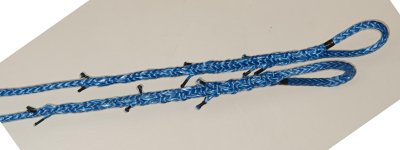
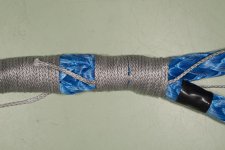
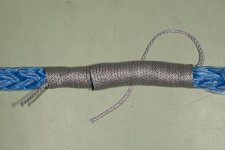
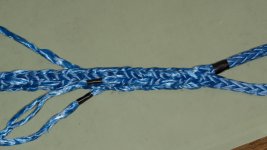
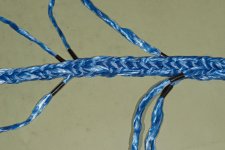
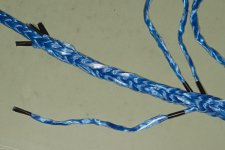
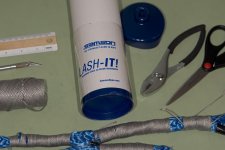
I lashed a lot longer than needed so I could capture the individual strand tail ends. When you do that it becomes hard to pull the line ends back into the lashing. Use pliers to pull it. Before I finished I cut the lashing ends close to the rope. The Lashing Line is available from LFS Marine. Here are some photos of the bridle before and after lashing the weave. Scroll the first photo to the right.
 

Attachments

  • Bridle7801.jpg
    Bridle7801.jpg
    131.6 KB · Views: 1,803
  • Bridle7806.jpg
    Bridle7806.jpg
    138.5 KB · Views: 1,830
  • Bridle7809.jpg
    Bridle7809.jpg
    132.5 KB · Views: 1,810
  • Bridle7812.jpg
    Bridle7812.jpg
    133 KB · Views: 1,818
Last edited:
A better book for splicing and making eyes

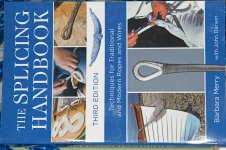
A better book for splicing and making eyes by weaving the strands back into the rope is "The Splicing Handbook, 3rd Ed., : Techniques for Traditional and Modern Ropes and Wires" by Barbara Merry with John Darwin. Available from Amazon. It illustrates a weave for splicing and eyes rather than a simple tapered end turned back into the center of the rope shown in the Samson book. The weave appears to be stronger and more durable for repeated field use.

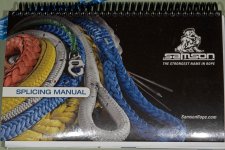
I also bought the Sampson Splicing Manual and a tubular splicing fid. I made eyes at each end of a 12 foot bridle by weaving the line back into itself. After paying for the book and tool the first 1/2" bridle will cost a bit more than a 3/8" bridle but the 2nd one will cost less. I may make these for a few friends.
Splicing Tools and Accessories - Rope & Line
Edit: added link to book, tools and supplies
http://www.lfsmarineoutdoor.com/rope-and-line/splicing-tools-and-accessories.html

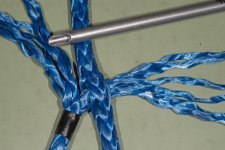
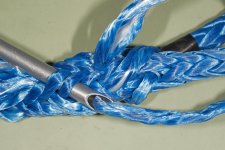
Having 17 feet of line allowed me to make the weave longer than shown in the book, adding a 4th weave to each of 3 tapers. The book calls for only 3. Making the weave.
Photos of the process of weaving
 

Attachments

  • Bridle7763.jpg
    Bridle7763.jpg
    142.9 KB · Views: 1,782
  • Bridle7771.jpg
    Bridle7771.jpg
    138.5 KB · Views: 1,798
  • Bridle7774.jpg
    Bridle7774.jpg
    141.2 KB · Views: 1,824
  • Bridle7784.jpg
    Bridle7784.jpg
    133.7 KB · Views: 1,815
  • Bridle7785.jpg
    Bridle7785.jpg
    134 KB · Views: 1,770
Last edited:
2nd recovery point and methods

I ordered a 2nd recovery point from Toyota for the right rear corner of the frame. It's the same piece used for the left rear recovery/anchor point. The threaded holes are already there above the tailpipe. Cost is $139 with 2 bolts and 9% CA sales tax. The exhaust tailpipe was rerouted to clear the recovery loop. I shorten the tailpipe but I really wanted to turn it sideways behind the rear tire. My local muffler shop shortened it using the Toyota SS tailpipe for $40. Someone found the recovery point parts on line for about half what I paid. That info may be posted in my Recovery Gear Options thread, linked above.

Buy both books and read the short sections on 12 strand eye construction and lashing. It's easy once you figure it out. I re-wove my first attempt as I ran out of loose strand length. Use a longer tail than they suggest and just keep weaving until the strands finish with a short tail protruding.

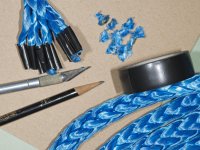
More photos of making the weave and some of the tools:
 

Attachments

  • Bridle7786.jpg
    Bridle7786.jpg
    132 KB · Views: 1,789
  • Bridle7762.jpg
    Bridle7762.jpg
    149.6 KB · Views: 1,817
  • Bridle7761.jpg
    Bridle7761.jpg
    143.8 KB · Views: 1,801
  • Bridle7815.jpg
    Bridle7815.jpg
    130 KB · Views: 1,802
Bury Splice

I've never seen a splice like that in dynema. I use it all over on my boat but I use a standard brumel splice or long bury. I've never seen a pro do it that way either. I'm sure it's strong though. Did Sampson recommend that type of braided splice?

1/8" Dyneema Break Test Final: Bury Splice vs Brummel Splice - Chicago Yacht Rigging Inc.Chicago Yacht Rigging Inc.

Samson Shows a bury splice with the end tapered by successively cutting stands down to 3 (or something) and then using a fid to feed it back up the center of the braid and stitching it. It relies totally on the squeeze of the outer line around the buried taper as the outer line stretches.

I've used the bury splice for years on DIY scuba gear and small anchor lines. It's fine for the loads it will see in those cases.

The other book shows the woven splice, which I intuitively felt was stronger because it can't easily pull out. And with the lashing, it will stay woven. I wasn't sure I could pull it off but it was actually quite easy once I studied it and gave it a try.
 
Hitch anchor vs equalized load

I'll just use a $3 hitch pin through my receiver. Maybe keep a spare.:noidea:

Yes, that works fine. A friend of mine does that too. It can bear on the square edge of the hitch and you're limited to one line or strap.

With the bridle and snatch block you can equalize the load on two corners of the frame and double the capacity of the rope. It can also be used to equalize the load on two anchor points for winching out of a jamb. No matter which way the vehicle turns as it moves the load stays equalized on the block pulley.
 
Don't you have the shackles on backwards on the rear of the T4R?

From those recovery points that is the only way (def not ideal) they will function I believe. I remember trying to use that point only to have the shackle contact the body at an angle.From then on I have only every used the rear hitch. I agree that any other instance that shackle would be backwards. The side recovery point seems like it was designed to function with a hook.
 
Soft Shackles on Bridle

I like the idea and it is well executed but I would use soft shackles with that setup.

I agree. It occurred to me after posting the photos. Southeast Overland makes a 1/2" soft shackle. I could make one but the price is so good it's hard to even try duplicating it myself.

Yes, the shackles are backwards. But they won't fit the other way without binding or bending both the recovery loop and the shackle. I think they might be okay with a PVC pipe sleeve around the shackle bolt and washers on the ends of it. A cheap solution.
 

Members online

Forum statistics

Threads
278,309
Messages
3,554,070
Members
248,016
Latest member
Advally Service

Trending content

Back
Top