
I know that I am not the brightest bulb in the box...BUT..

coltonk

New member
Earlier I started a thread about my oil pressure problem..

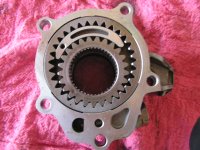
Here is a picture of my (85 4runner 22RE) oil pump.
I have taken the grears out and looked but I dont see how this this thing pumps oil. Since I am haveing trouble with it taking a long time (20-30 seconds) to build oil pressure does anyone see anything wrong??

Can anyone explain these mysteries of the universe??
 

Attachments

  • oil pump.JPG
    oil pump.JPG
    77.4 KB · Views: 885
Register to hide this ad
Looks like a fine pump to me, if you are really worried about it just buy a new one but that one should work just fine. If you install it correctly on the spline and pack it with with lithium grease beforehand and you still have problems, I would start looking at your oil pickup and galleys while the pan is off.
 
It looks fine to me too.

As for how it works, I'll be honest, I can usually figure these things out, but I spent a lot of time staring at mine as well. All I can figure is that the oil is thick enough that just working through the spinning gears will move it.
 
You say it's taking a long time to build pressure... Are you looking at an aftermarket pressure gauge or listening to the "lifters ticking" when you start it up?

If it's the latter, it's not the lifters because it doesn't have any. There's actually a hydraulic timing chain tensioner that has to pump up when you start the motor. When they're new they hold pressure overnight but as they age they let the oil drain out and they take 5-20 seconds to pump back up when you start.

The bad news is that the noise you hear is the timing chain slapping against the side of the timing cover, and if you're hearing that the driver's side timing guide is already broken. After it slaps the cover for a while it cuts deep grooves in it and it will eventually start leaking water into the oil from it.

There really isn't a way to fix all of that other than a new timing kit. I suggest an engnbldr kit with the steel backed drivers side rail. I had that kit on my truck and it worked great. It's a pretty big job though, but if the timing chain breaks you'll bend all of your valves too and then have an even bigger job.

If you're looking at a gauge ignore all of that. lol
 
Your oil pump is a gear type pump. It uses a drive gear connected to an input shaft and a driven gear. The drive gear turns the driven gear, which traps oil between the gear teeth and the pump cavity walls. As the gears rotate, the oil is forced out of the gear teeth to build oil pressure.

Most other types of oil pumps work in a similar way. There are rotor type oil pumps, which are another positive displacement type of pump.
 
This is a fairly newly rebuild on this engine and the oil pump is new as well.. It has always taken a long time to build pressure. I have a mechanical and electric gauge on the truck and they both say about the same thing. There is a lot of noise when you first start the engine but quiets down after pressure builds.

I understand what you are saying about how it works but I dont see any input or exit point for the oil to enter/leave the oilpump. can anyone explain further??
 
I understand what you are saying about how it works but I dont see any input or exit point for the oil to enter/leave the oilpump. can anyone explain further??

The oil is fed into the pump and exits the pump via fittings in the pump body itself. And of course the pump cover (not shown in your picture) plays an integral role because it creates the seal that allows the oil pressure to build up. If you look closely at your picture, you can see a hole where the oil is routed under pressure to a fitting on the side of the pump.
 
I can see what you are saying but I have removed the gears and there are no hole/ports in the oil pump housing. I may be a little dense so how does the gears move oil unless it is friction of the oil and the face(side showing in the picture) of the gears. I have really looked at this set up and it is confusing of the mechanics of how it works.
 
Oil is thick enough that the gears cause it to move. I once saw a demo in an auto parts store where they had a bunch of gears together, one of top of the other, and just by spinning them, the oil moved up to the top, almost 10" over where it was pooled.

The holes are not in the oil pump housing, but in the timing chain cover that it bolts to.
 
I seen the same display with the gears at our local auto parts store..

I guess what I am saying is - I can see no input or exit holes/ports in the oil pump housing. Then how is the oil getting into the gears and back out of the gears. The gears are recessed inside of the oilpump.. The only part of the gears that could get oil would be the smooth face of the gears which would not move much oil. Maybe I am being dense on this..but I am just trying to understand the mechanics of how this works.
 
The oil enters and exits through holes in the timing chain cover that the pump bolts to. I believe that it comes in and out on either side of the crescent in between the gears.
 

Members online

Forum statistics

Threads
278,317
Messages
3,554,129
Members
248,016
Latest member
Advally Service

Trending content

Back
Top