

JB.
New member
For anyone who is unfamiliar with the 4wd handling phenomenon or could use a refresher, here's an attempt at something clear and complete. Otherwise, skip this part.
With a locked center connection -- part-time 4WD (classic 4WD) or full-time 4WD with center differential locked (cdl on) -- the front and rear drive shafts rotate at the same speed, just as if there were one shaft from front to back. During a turn, all four wheels turn in a different size arc and, thus, different speeds. This can't be compensated for by the front and rear diffs because when each side of the diff has traction, any increase in speed on one side is matched by an equal reduction on the other side. Since it's the average speed of the two front wheels and the average speed of the two rear wheels that matters, the effective result is a comparison of one arc for the fronts and one arc for the rears. So, during a turn the rear wheels follow a smaller arc (1 averaged arc) than the fronts and want to turn more slowly. Since the locked drive shaft in between can only rotate at one speed, opposite forces are created between front and rear, with the braking force (skid) being in the front and the drive force (slip) in the back. With same size tires equally inflated, this conflict is near zero when the vehicle is going straight, but starts to come into play as the steering wheel is turned, starting out mild but quickly becoming more severe as the turn is made tighter, resulting in an increasingly heavy feel in the steering wheel and a sensation of brakes being applied. Near the extremes, tires can audibly and visibly skip and skid. On slippery surfaces, this can occur more easily but on pavement more stress is imparted to the drive train, especially at very low speed where releasing energy through the tires is more difficult and there is no momentum to unweight the inside tires during a turn. It also results in handling changes that usually make the car want to turn a little wider (understeer) than it normally would, due to the tendency of a front wheel to skid. (The words bind and windup, in combination with various parts of the drive line - differential, transfer case, axle, transmission - are terms often used to describe this phenomenon. In other domains, a separate phrase - Tight Corner Braking - is also widely used).
______________________________________________________________________________________________________________
I experimented with this quite a while back, but thought I'd finally write it up.
Too much reading, what's the gist? That the center diff lock button is a useful tool for turning off engine suppression because the common warnings about pavement use in locked mode are over-simplified and often exaggerated. The steering effects in locked 4wd are likely milder than many have assumed (much milder, for instance, than the effects of a locked rear diff) making the occasional, rolling street turn nothing to be concerned about. Some owners of '03 thru '07 models may, at times, have wanted an easy way to briefly turn off engine suppression near pavement but have been hesitant to use the diff lock button due to abundant warnings against it. This thread is mostly for them.
(A shorter, non-4th gen specific version of this thread is here)
--
Disclaimer: Anyone who is uncomfortable with any of this should just follow the rule and not drive center locked on pavement. That's the safest route. If this thread makes you unsure and you would like something to make it easy to dismiss, read <a href="http://www.4x4abc.com/4WD101/axle-wind-up.html" target="_blank">this.</a>
My incentive to look into this came from wanting to establish for myself the extent to which the CDL (center diff lock) button was useful as a VSC off switch (to turn off engine suppression) since, in 4th gens up to 08, the two come stock as a package deal. Some people had been known to complain of engine power being cut too much in certain slick conditions (possibly more sensitive in later years). That's a potential problem (that, in my testing, is fixed by reasonable throttle) because conventional wisdom on the appropriate use of a locked center severely limits the CDL as a simple solution since the prospect of nearby dry pavement is supposed to make it too risky to use. For example, turning from a slick side road onto a mostly dry, paved road.
Why not just do the VSC off mod and forget about it? Great mod, no doubt, but not everyone may want to do it, and center locked is still the most capable traction mode. The road conditons that may call for defeating VSC are rare and characterized by very low traction. In that situation, I probably want to go all in.
--
Obviously, turning the steering wheel, say, an inch away from straight won't create any meaningful rotational difference of the unlocked drive shafts. So where does the meaningful difference start and how can it be measured? When does drive line stress become too great to risk? Barring expensive testing with strain gauges and force meters or, better yet, statistical analysis of drive component wear on large numbers of isolated test vehicles, trying to gauge the effects remains an exercise in uncertainty. It seemed, though, there must be a few practical tests and simple calculations that could shed a little more light.
With apologies to Carl Sagan; extraordinary claims require the maker to put his money where his mouth is. In that spirit, here are a few verifiable data points established from behind the wheel of a full-time 4th gen 4runner with center diff locked on pavement. Full steering lock is about 1.5 steering wheel revolutions (SWR) one direction (slight difference between left and right).
(1) With a little speed and neutral throttle, steering effort at around 1/2 to 3/4 SWR is almost indistinguishable from unlocked 4WD. Adding throttle will induce heavy steering a little earlier. (This would be a better test without power steering).
(2) After driving long enough to execute a few such turns, the center diff unlocks easily. More so, in fact, than after a 40ft circle on dirt or snow*. This is relevant because a well known effect of a bound up system is one that gets temporarily or completely stuck in center lock position. (*Driven 20-30ft afterward to get the wheels straight)
(3) In neutral, with enough speed to coast a little, noticeable braking effect doesn't come on until about 3/4 SWR.
(4) (The smoking gun) The center differential will easily lock/unlock while moving at 1/4 SWR (not recommended). It will lock/unlock at 3/8 too, but starts to get a little clunky. How much farther it might go I'm not willing to find out, but 1/2 SWR doesn't seem out of the question. So, however meaningful those drive shaft rotational differences may be to locked drive line stress, they don't seem to be very meaningful to the locking mechanism, which I presume is a simple dog clutch that waits for nearly identical rotational speeds before it can engage. How close are the rotational speeds? Front/rear drive shaft rotational differences start out small but ramp up quickly: (margin for error should be reasonably small)
1/4 SWR ≈ ..0.3%
1/2 SWR ≈ ..1%
3/4 SWR ≈ ..3%
1.0 SWR ≈ ...6%
1.5 SWR ≈ ..15%
It's interesting to compare against the much higher numbers for the rear diff -- 4%, 9%, 15%, 22%, 40%.
Most street turns can be completed with 1/2 SWR or less. Sometimes 3/4 is required but when that's the case the wheel spends only a moment in that position with the average position through the turn being much less. Consequently, I view the diff lock button as a useful solution to road scenarios that may require turning off engine management.
--
If someone decides they're comfortable with the described usage, what are some other considerations? Tire/drive train wear, and fuel consumption are accelerated, but this shouldn't come up enough for that to matter much. Handling will change overall, but most importantly on slick surfaces where the tires will be induced to lose a little traction in turns, reducing steering precision and usually inducing understeer, but, per the above, it should be pretty minimal at around 1/2 SWR. Familiarization with the handling ahead of time is a good idea. When understeer occurs during acceleration it can be especially disconcerting to the unprepared as the vehicle traces a wider path than expected. Steering angle is the most important factor, but even relatively straight roads can present problems if used too long at high speed. The stresses are small, but they are constant under high power output, and transfer and diff fluid temperatures can rise higher than normal if used this way too long. Doubtful anyone would choose to do this intentionally, but forgetting the diff is locked is a possibility.
Other things can affect level of drive line stress -- tire pressure, tread type, pavement condition etc -- so a crisp rule isn't possible but it seems hard to go too wrong around 1/2 SWR with the wheels rolling at a little speed. Steering feel remains a good direct measure though power steering gets in the way of that a little. Just knowing the steering/drive shaft percentages, I imagine, will increase confidence enough for some to put a toe in the water.
So, if you've ever wanted to use the diff lock button on or near pavement to avoid engine suppression, this might be of some interest. I'm not out to convince anyone who doesn't want to be convinced. If anyone feels this subtracts from the value of the Torsen center diff, that's not my view at all. The pairing of the Torsen with a diff lock that engages and disengages quickly, on the fly, hi or lo, is a fantastic combination in my book. Seems a shame to waste that combination where it can be put to good use. (Not only on-road, but off, per point 2, above)
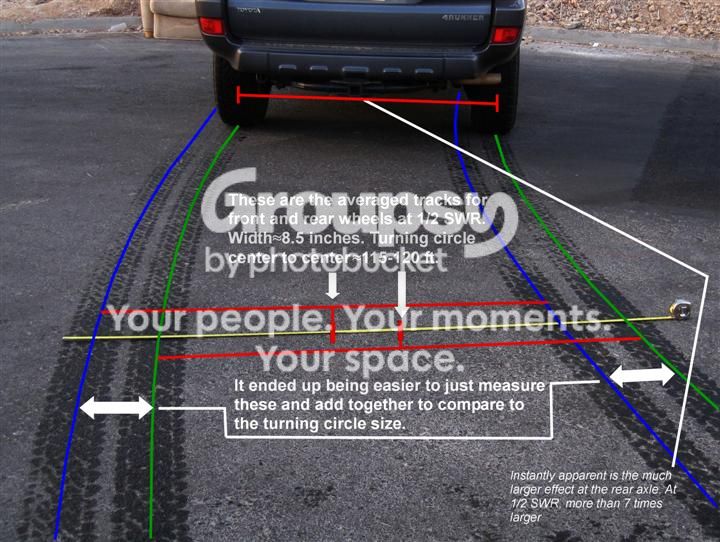
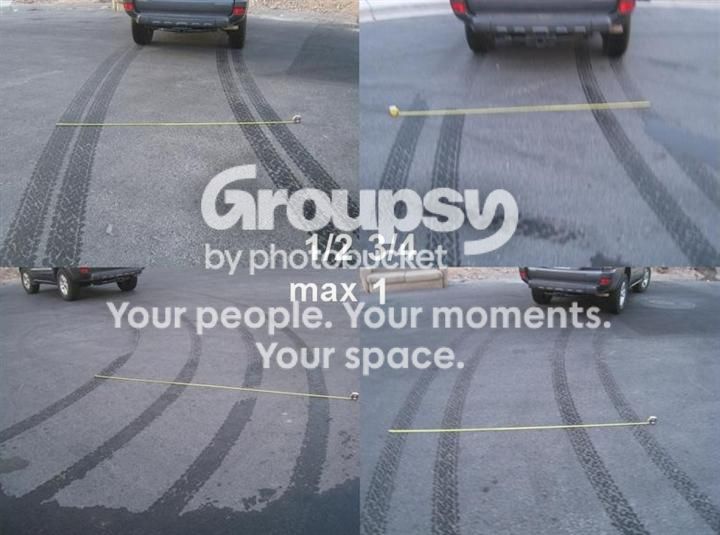
Here's how the measurements were taken. Turning circles were determined by a combination of parking lot step-offs and gps track circles.
With a locked center connection -- part-time 4WD (classic 4WD) or full-time 4WD with center differential locked (cdl on) -- the front and rear drive shafts rotate at the same speed, just as if there were one shaft from front to back. During a turn, all four wheels turn in a different size arc and, thus, different speeds. This can't be compensated for by the front and rear diffs because when each side of the diff has traction, any increase in speed on one side is matched by an equal reduction on the other side. Since it's the average speed of the two front wheels and the average speed of the two rear wheels that matters, the effective result is a comparison of one arc for the fronts and one arc for the rears. So, during a turn the rear wheels follow a smaller arc (1 averaged arc) than the fronts and want to turn more slowly. Since the locked drive shaft in between can only rotate at one speed, opposite forces are created between front and rear, with the braking force (skid) being in the front and the drive force (slip) in the back. With same size tires equally inflated, this conflict is near zero when the vehicle is going straight, but starts to come into play as the steering wheel is turned, starting out mild but quickly becoming more severe as the turn is made tighter, resulting in an increasingly heavy feel in the steering wheel and a sensation of brakes being applied. Near the extremes, tires can audibly and visibly skip and skid. On slippery surfaces, this can occur more easily but on pavement more stress is imparted to the drive train, especially at very low speed where releasing energy through the tires is more difficult and there is no momentum to unweight the inside tires during a turn. It also results in handling changes that usually make the car want to turn a little wider (understeer) than it normally would, due to the tendency of a front wheel to skid. (The words bind and windup, in combination with various parts of the drive line - differential, transfer case, axle, transmission - are terms often used to describe this phenomenon. In other domains, a separate phrase - Tight Corner Braking - is also widely used).
______________________________________________________________________________________________________________
I experimented with this quite a while back, but thought I'd finally write it up.
Too much reading, what's the gist? That the center diff lock button is a useful tool for turning off engine suppression because the common warnings about pavement use in locked mode are over-simplified and often exaggerated. The steering effects in locked 4wd are likely milder than many have assumed (much milder, for instance, than the effects of a locked rear diff) making the occasional, rolling street turn nothing to be concerned about. Some owners of '03 thru '07 models may, at times, have wanted an easy way to briefly turn off engine suppression near pavement but have been hesitant to use the diff lock button due to abundant warnings against it. This thread is mostly for them.
(A shorter, non-4th gen specific version of this thread is here)
--
Disclaimer: Anyone who is uncomfortable with any of this should just follow the rule and not drive center locked on pavement. That's the safest route. If this thread makes you unsure and you would like something to make it easy to dismiss, read <a href="http://www.4x4abc.com/4WD101/axle-wind-up.html" target="_blank">this.</a>
My incentive to look into this came from wanting to establish for myself the extent to which the CDL (center diff lock) button was useful as a VSC off switch (to turn off engine suppression) since, in 4th gens up to 08, the two come stock as a package deal. Some people had been known to complain of engine power being cut too much in certain slick conditions (possibly more sensitive in later years). That's a potential problem (that, in my testing, is fixed by reasonable throttle) because conventional wisdom on the appropriate use of a locked center severely limits the CDL as a simple solution since the prospect of nearby dry pavement is supposed to make it too risky to use. For example, turning from a slick side road onto a mostly dry, paved road.
Why not just do the VSC off mod and forget about it? Great mod, no doubt, but not everyone may want to do it, and center locked is still the most capable traction mode. The road conditons that may call for defeating VSC are rare and characterized by very low traction. In that situation, I probably want to go all in.
--
Obviously, turning the steering wheel, say, an inch away from straight won't create any meaningful rotational difference of the unlocked drive shafts. So where does the meaningful difference start and how can it be measured? When does drive line stress become too great to risk? Barring expensive testing with strain gauges and force meters or, better yet, statistical analysis of drive component wear on large numbers of isolated test vehicles, trying to gauge the effects remains an exercise in uncertainty. It seemed, though, there must be a few practical tests and simple calculations that could shed a little more light.
With apologies to Carl Sagan; extraordinary claims require the maker to put his money where his mouth is. In that spirit, here are a few verifiable data points established from behind the wheel of a full-time 4th gen 4runner with center diff locked on pavement. Full steering lock is about 1.5 steering wheel revolutions (SWR) one direction (slight difference between left and right).
(1) With a little speed and neutral throttle, steering effort at around 1/2 to 3/4 SWR is almost indistinguishable from unlocked 4WD. Adding throttle will induce heavy steering a little earlier. (This would be a better test without power steering).
(2) After driving long enough to execute a few such turns, the center diff unlocks easily. More so, in fact, than after a 40ft circle on dirt or snow*. This is relevant because a well known effect of a bound up system is one that gets temporarily or completely stuck in center lock position. (*Driven 20-30ft afterward to get the wheels straight)
(3) In neutral, with enough speed to coast a little, noticeable braking effect doesn't come on until about 3/4 SWR.
(4) (The smoking gun) The center differential will easily lock/unlock while moving at 1/4 SWR (not recommended). It will lock/unlock at 3/8 too, but starts to get a little clunky. How much farther it might go I'm not willing to find out, but 1/2 SWR doesn't seem out of the question. So, however meaningful those drive shaft rotational differences may be to locked drive line stress, they don't seem to be very meaningful to the locking mechanism, which I presume is a simple dog clutch that waits for nearly identical rotational speeds before it can engage. How close are the rotational speeds? Front/rear drive shaft rotational differences start out small but ramp up quickly: (margin for error should be reasonably small)
1/4 SWR ≈ ..0.3%
1/2 SWR ≈ ..1%
3/4 SWR ≈ ..3%
1.0 SWR ≈ ...6%
1.5 SWR ≈ ..15%
It's interesting to compare against the much higher numbers for the rear diff -- 4%, 9%, 15%, 22%, 40%.
Most street turns can be completed with 1/2 SWR or less. Sometimes 3/4 is required but when that's the case the wheel spends only a moment in that position with the average position through the turn being much less. Consequently, I view the diff lock button as a useful solution to road scenarios that may require turning off engine management.
--
If someone decides they're comfortable with the described usage, what are some other considerations? Tire/drive train wear, and fuel consumption are accelerated, but this shouldn't come up enough for that to matter much. Handling will change overall, but most importantly on slick surfaces where the tires will be induced to lose a little traction in turns, reducing steering precision and usually inducing understeer, but, per the above, it should be pretty minimal at around 1/2 SWR. Familiarization with the handling ahead of time is a good idea. When understeer occurs during acceleration it can be especially disconcerting to the unprepared as the vehicle traces a wider path than expected. Steering angle is the most important factor, but even relatively straight roads can present problems if used too long at high speed. The stresses are small, but they are constant under high power output, and transfer and diff fluid temperatures can rise higher than normal if used this way too long. Doubtful anyone would choose to do this intentionally, but forgetting the diff is locked is a possibility.
Other things can affect level of drive line stress -- tire pressure, tread type, pavement condition etc -- so a crisp rule isn't possible but it seems hard to go too wrong around 1/2 SWR with the wheels rolling at a little speed. Steering feel remains a good direct measure though power steering gets in the way of that a little. Just knowing the steering/drive shaft percentages, I imagine, will increase confidence enough for some to put a toe in the water.
So, if you've ever wanted to use the diff lock button on or near pavement to avoid engine suppression, this might be of some interest. I'm not out to convince anyone who doesn't want to be convinced. If anyone feels this subtracts from the value of the Torsen center diff, that's not my view at all. The pairing of the Torsen with a diff lock that engages and disengages quickly, on the fly, hi or lo, is a fantastic combination in my book. Seems a shame to waste that combination where it can be put to good use. (Not only on-road, but off, per point 2, above)
Here's how the measurements were taken. Turning circles were determined by a combination of parking lot step-offs and gps track circles.
Last edited:


