
LR UCAs and seized alignment cams

dchild

New member
Hi All! Thanks for running such a great forum, I have learned how to do so much here.

My main question today is whether I need to fix my out-of-spec alignment.

I went to get an alignment on my recently-purchased 07 V6 after a 2/1 lift (5100/Moog) and they told me an alignment cam was seized on the passenger LCA so they could not adjust caster (they got everything else). I don't have those numbers in front of me but caster was something like 2.8/2.0 driver/passenger (spec is 2.5-4). I was annoyed by the wandering steering.

I was very reluctant to try and replace the cams and LCA bushings because I've read they are a real PITA at the best of times and so far everything I've done on the underside of my truck has been much harder than advertised due to rust (sheared bolt heads, nut coming loose inside the frame, lots of time with a sawzall and angle grinder). Nor am I excited about replacing the LCAs at $415/ea for OEM. So when I noticed cracked boots on 3 of my 4 ball joints I replaced the stock UCAs with LR UCAs in hopes that the adjustable control arms could compensate for the seized bushings.

The alignment tech refused to touch the LR UCAs - and told me that I have another seized cam on the driver's side - but a different mechanic at the same shop was willing to use the camber adjustment. I ended up with this after they were done.
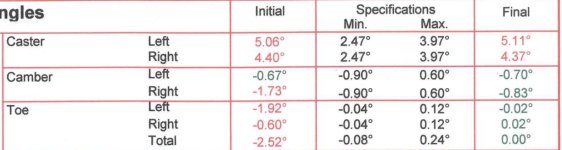
4Runner_Alignment_High_Caster.jpg

I am not sure what to do next. Options as I see them are (in order of preference)

  1. Drive it as is. I definitely prefer too much caster over too little, and I don't think it will accelerate tread wear but I'd like to be sure it is safe. I see from this recent thread that too-high caster can actually be a good thing so I am hopeful for option 1.
  2. Find a shop that will work with the LR UCAs and have them fix the caster
  3. Suck it up and replace the alignment cams + bushings on the stock LCAs (may have to do this anyway due to a clunk)
  4. Replace LCAs with new OEM

What do you guys think?

Thanks!

 

Attachments

  • 4Runner_Alignment_High_Caster.jpg
    4Runner_Alignment_High_Caster.jpg
    44 KB · Views: 678
Register to hide this ad
For whatever it's worth to you, I replaced both of my LCA's with Moog units and am happy with them. They came with new bushings and ball joints and I used Moog greasable cam bolts. They were half the price (at least) compared to OEM.

When I had the old OEMs out and sitting next to the new Moogs, I had a chance to compare them. They appeared to be identical in design. The new Moogs were clearly marked 'Made in Japan' which I take as a good thing. I haven't done any research on who makes them or where but I wouldn't be at all surprised to find out the OEMs and the Moogs were made in the same factory.
 
For whatever it's worth to you, I replaced both of my LCA's with Moog units and am happy with them. They came with new bushings and ball joints and I used Moog greasable cam bolts. They were half the price (at least) compared to OEM.

When I had the old OEMs out and sitting next to the new Moogs, I had a chance to compare them. They appeared to be identical in design. The new Moogs were clearly marked 'Made in Japan' which I take as a good thing. I haven't done any research on who makes them or where but I wouldn't be at all surprised to find out the OEMs and the Moogs were made in the same factory.

+1 on this, had to do the exact same thing a couple of months ago. Mine were so bad seized, had to use a sawz-all to cut them out. I like the Moog products they did look identical, also when you reassemble the adjusters and bolts use a lot of anti-seize then hit it with grease at every oil change.


~~~~~~~~~~~~~~~
2006 Sport V8
 
Last edited:
For whatever it's worth to you, I replaced both of my LCA's with Moog units and am happy with them. They came with new bushings and ball joints and I used Moog greasable cam bolts. They were half the price (at least) compared to OEM.

Interesting, thanks! I had only really considered OEM up until now since I remember reading about issues with aftermarket LCAs early in my search. But I am not sure if I read that about 3rd or 4th gens, and I subsequently found a lot of issues with Moog ball joints on 3rd gens that don't seem to apply to 4th gens. So far all the Moog parts I've used (springs, LBJs) have worked out fine for the short time I've had them, and the greasable cam bolts sound nice. If I end up going the replacement route I will definitely consider these!
 
+1 on this, had to do the exact same thing a couple of months ago. Mine were so bad seized, had to use a sawz-all to cut them out. I like the Moog products they did look identical, also when you reassemble the adjusters and bolts use a lot of anti-seize then hit it with grease at every oil change.

Thanks! Did you saw them off from the inside or the outside of the frame mount? I guess I'm not sure whether they seize to the mount on the frame or to the sleeve inside the bushing, but it seems like it would be really hard to saw off on the outside since there are those tabs for the cam to press against - unless you saw those off too and replace them.
 
I cut on the inside of the mount between the mounting bracket and the control arm. It was the only gap big enough to get a Sawzall into.
 
+1 on this, had to do the exact same thing a couple of months ago. Mine were so bad seized, had to use a sawz-all to cut them out. I like the Moog products they did look identical, also when you reassemble the adjusters and bolts use a lot of anti-seize then hit it with grease at every oil change.


~~~~~~~~~~~~~~~
2006 Sport V8

+2 on this. I've been down this road as well. Just cut the bolts out with a sawzall and get new arms with that have new bushings and LBJ's in them. I went with these:

More Information for MOOG RK620061

and this can also be had at Rock Auto for a reasonable price. Plus they're greaseable which is a big plus in going a long way in preventing seizures again:
http://fme-cat.com/LiveDocs/MOOG_PS_Bulletin_213013_greaseable_camber_bolt_Eng.pdf
 
I'd like the caster to be a bit more even if possible, but as it stands it's not too bad to have too much. I haven't heard too many people having issues from running high caster. I believe it's more that the suspension geometry when stock can't go that high in caster without tweaking camber out of whack.
 
I have the same problem...seized cam bolts on both left and right sides.
I've found prices for Toyota OEM lower control arms for $260 each online, and a full set of cam bolt hardware (for both sides) is $110.
 
More caster then original spec won't hurt tire wear. Camber and toe will greatly increase tire wear. The alignment you have now isn't bad. The correct way to fix it is to cut out the old cams and replace with new. They will only cause you more problems down the road.
 
Thanks for the advice everyone (and [MENTION=20456]Mike07SE[/MENTION] for the links)! I've ordered the Moog set from rockauto (~540 shipped). The alignment shop said they'd re-align for free if I replaced the cams in the next 60 days and hopefully the greasable cam bolts will keep this from happening again. Maybe these will even fix my clunk as a side benefit.

I wish I'd asked before I replaced the LBJs, but they were less than the price of an alignment and now I have spares :) I'll make sure they leave the caster high - based on what [MENTION=66389]BlackWorksInc[/MENTION] said perhaps they'll leave it above spec for me.

Thanks!
 
Thanks! Did you saw them off from the inside or the outside of the frame mount? I guess I'm not sure whether they seize to the mount on the frame or to the sleeve inside the bushing, but it seems like it would be really hard to saw off on the outside since there are those tabs for the cam to press against - unless you saw those off too and replace them.

Everyone has pretty much answered this, but the cuts were on the inside. I found it helpful to take a pneumatic chisel and drive between the LCA and mount on the side where the nut came off. That gave just enough room to get the blade in. After you get the first cut through, chisel in on the other side and repeat. The forward bushing will only have a tube through them and will cut fast. The rearward ones will make you cuss like a sailor! It is or at least mine were seized where the sleeve went through the bushing. I wasn't willing to admit at first that cutting was the only way, so I tried soaking with penetrating oil for days, beating with a hammer, 4' long cheater bar and no luck. After finally giving in to cutting, it only took about 2 hours to cut them out.. :bravo:

One other bit of info. I found while doing this the sawz-all blade made a huge difference. I went through a 5 pack of DeWalt 15tpi bi-metal blades before switching to Irwin 14tpi bi-metal blades. The Irwin blades were unbelievably better! 1.25 hours cutting the passenger side LCA out with the DeWalt, 45 minutes with the Irwin and only used 2 blades..

Good Luck


~~~~~~~~~~~~~~~~~~~~~~~~~~
 
Last edited:
You're right about them being hard to cut out. When I decided to go ahead and cut them I grabbed the only reciprocal saw that I owned at the time. It was an 18v Ryobi cordless that has always been good enough for what I needed it for. It couldn't hang. I had to run out once to buy a corded saw and again later to buy more blades. That metal is tough AND hard to reach.
 
How do you guys find the Moog bolts? The tacoma guys had issues with them rounding out the cams during alignment when they first came out and getting wrong parts delivered. Are they better now?
 
How do you guys find the Moog bolts? The tacoma guys had issues with them rounding out the cams during alignment when they first came out and getting wrong parts delivered. Are they better now?

I can't personally speak for the Moog bolts. They weren't even around when I had to do my arms. I did hear that they initially had some problems but were quickly worked out AFAIK. If / When I have to go through this again I will give this a go. I had to go the $$$ route and buy new OEM hardware and slather them in grease to hopefully put off seizing rust issues.
 
High caster is not good. That is unless you enjoy replacing things like your steering rack, ball joints, etc.

Higher caster improves straight line tracking, but you only need so much. If you want to think of it in logical terms think about loading a wheel barrow. The further you move the weight back, the easier it steers, but gets real heavy. When you move the weight forward the weight becomes less, but harder to keep straight.
 
I went through a 5 pack of DeWalt 15tpi bi-metal blades before switching to Irwin 14tpi bi-metal blades. The Irwin blades were unbelievably better!

Thanks for the tip! Kind of surprising since I usually think more highly of DeWalt than Irwin and I would have thought more TPI would be better on metal. I will be sure to grab some of the Irwins.

It was an 18v Ryobi cordless that has always been good enough for what I needed it for. It couldn't hang. I had to run out once to buy a corded saw and again later to buy more blades.

Good to know. I also have an 18v saw (Ridgid) but I will arrange to borrow a corded one. Thanks!
 
High caster is not good. That is unless you enjoy replacing things like your steering rack, ball joints, etc.

Higher caster improves straight line tracking, but you only need so much. If you want to think of it in logical terms think about loading a wheel barrow. The further you move the weight back, the easier it steers, but gets real heavy. When you move the weight forward the weight becomes less, but harder to keep straight.

I guess the way I think of caster is like what they call "trail" on bikes, which is what makes some bikes easier to ride with no hands than others since the wheel sort of self-centers. And the bikes I've had with more trail do require a bit more effort to steer; the tradeoff is that they don't need to be steered as often since they hold a straight line better. I think that matches what you are saying, and also matches my recent experience going from too little caster to too much.

So you're saying that the increased caster results in increased stress on the components because they are working harder to make the turns? That makes sense, and I can see how that would lead to less time before failure, especially since the lift is already adding some stress. Do you have any feel for how much shorter the life on those parts becomes (anecdotally or otherwise)? The dealer replaced the steering rack on my truck, and I just replaced the ball joints, so hopefully they will last a while. It has been a lot nicer to drive with more caster, and I think the driveability would be worth it to me if I had to change these again in, say, 100K, but probably not if I had to change them in 20K.
 
Yeah I like the idea of them being grease-able and cheaper than oem.
I'm doing this the hard way and rebuilding a used pair of arms. I managed to pop the bushings off but 2 of the sleeves are still stuck on there.
 
I guess the way I think of caster is like what they call "trail" on bikes, which is what makes some bikes easier to ride with no hands than others since the wheel sort of self-centers. And the bikes I've had with more trail do require a bit more effort to steer; the tradeoff is that they don't need to be steered as often since they hold a straight line better. I think that matches what you are saying, and also matches my recent experience going from too little caster to too much.

So you're saying that the increased caster results in increased stress on the components because they are working harder to make the turns? That makes sense, and I can see how that would lead to less time before failure, especially since the lift is already adding some stress. Do you have any feel for how much shorter the life on those parts becomes (anecdotally or otherwise)? The dealer replaced the steering rack on my truck, and I just replaced the ball joints, so hopefully they will last a while. It has been a lot nicer to drive with more caster, and I think the driveability would be worth it to me if I had to change these again in, say, 100K, but probably not if I had to change them in 20K.

You are thinking about it correctly with motorcycles. I don't like to use that analogy because people tend to not understand the stress part of increased caster as well as they do if they can if they ever muscled around a wheel barrow full of rock.

It would be hard to put a guess on how much your are going to shorten the life of a component by increasing the angles. That would be a very good case study for someone in engineering class. In your case you are about 2 degrees outside of spec. 2 degrees in logical terms isn't much, but each degree you increase, you increase the force needed to turn. That increased force is what kills your rack.

If you want to see a vehicle with high caster, check out most any Mercedes. They typically have around 10 degrees. You can really see it when they turn because the wheel almost look like it is going to flop over. They also have some beefy ball joints and steering components to deal with those stresses.
 
Last edited:

Members online

Forum statistics

Threads
278,309
Messages
3,554,068
Members
248,016
Latest member
Advally Service

Trending content

Back
Top