Maintenance on Intake Valves?

3kushn

Member
I'm trading my 2013 F150 Ecoboost for a Limited and wondering since this truck seemingly has gunked up intakes, what about this engine?

Granted my truck has 250K miles and I shouldn't have to worry about this one for quite a while. Or not?

Just wondering if there's a general maintenance procedure to "help' keep them clean? Or not to worry.

I've read about the self cleaning design, but...

Sorry, guess I'm still learning how to search the site.
 
Last edited:
Register to hide this ad
The Ecopoop is direct injection which means no fuel is sprayed onto the intake valves. The 1GR is port injection so there's fuel constantly being sprayed on the valves.
 
The dealer will clean it for you with some additive and charge you a few bucks if you ask.

But as said above, this is a nonissue with this engine.
 
If you're concerned then you can always run a tank or two with fuel system cleaner, which isn't a bad idea at that mileage anyway.
 
This is one of the reasons I’m glad the 4Runner has an “ancient” drivetrain. Sometimes “progress” comes with big trade offs in terms of reliability. Coming from a few vehicles with direct injection, intake valve carbon buildup was a very real concern as you got closer to ~75k miles. The 4Runner has none of those concerns if you use decent quality fuel on a fairly regular basis.


Sent from my iPhone using Tapatalk
 
To give a little more explanation on why direct injection is an issue - in the USA gasoline cars have EGR (exhaust gas recirculation) and crank case ventilation systems. So both some exhaust gas during certain operating conditions and the air from the engine internal open space is pulled back through the intake and run back into the engine. When that happens a lot of dirt and mostly oil mist from the engine internal air is then run across hot intake valves. As you would imagine that hot valves and oil and particles from exhaust gas bake their way onto the intake valves.

This hasn't historically been an issue because the fuel comes into the system upstream of the intake valves in every engine fuel system from carbureted to port injection. The gasoline has detergents in it that are designed just for this. They break up the oil and carbon buildup and clean the intake valves. So it's a non-issue. That is until you switch to direct injection. By moving the injectors into the cylinder head - you can spray high pressure fuel directly into the combustion chamber. That allows a lot of benefits. It can cool the cylinder air temps. It can shoot more precise fuel volumes. And it can shoot multiple sprays or vary the timing for different characteristics. BUT - since that fuel no longer flows over the intake valves, there's nothing going through to clean them. And the carbon builds up.

Toyota solved this a long time ago with its D4S system. It just used two injection systems. And when you start the car or run during certain operating conditions - it will inject the fuel in the intake runners or the intake plenum and the result is to clean the valves. That's why carbon buildup hasn't been an issue on Toyotas for a generation of vehicles. They figured out the problem and solved it. But there were some early ones that didn't work as well. I owned an IS250 and it only had direct injection and a single 7th injector in the intake that only ran on cold starts (you have to run rich initially to get enough fuel to the catalytic converter to begin the reaction properly). So in cold weather climates that engine didn't have issues - but in warm climates where it rarely needed to run the 7th injector, then there were carbon issues. I never had an issue and the Lexus dealer ruined the car at a service visit (long story - don't go to Larry Miller Lexus in Utah if you don't want someone there to strip your car for parts)- so I didn't own it out to higher mileage.

I think newer generations of direct injection engines from other manufacturers including Ford have finally mostly adopted the D4S design and added intake injection. The newer EB engines I'm pretty sure have done this. I'd guess the only DI engines you'll find anymore without dual injection systems are the very cheap economy cars that aren't expected to last a long time.

The 4Runner engine is so old that it doesn't even use direct injection. It still only runs port injection. It's basically a 90's engine design and doesn't have the problems associated with direct injection. Intake carbon buildup should never be a problem. All fuel sold in the USA at gas stations should have detergent in it that is good enough to clean the intake valves.

Edit:
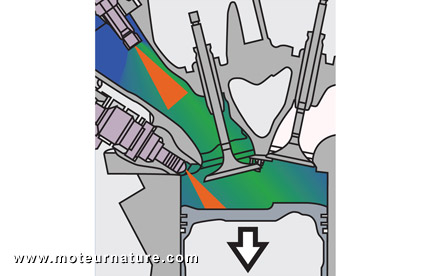
Here's a good picture that helps show where the two injectors for each cylinder live in a d4S system. In the 1GR that is in the 4Runner - only the upper injector exists. The valve you see on the left that is open - that's the intake valve. And the carbon buildup problem happens on the top of that valve and around where it seats. Eventually enough carbon and oil gunk can build up there if not cleaned that it won't seal anymore when it closes. And then you lose compression and have lots of engine problems. But you can see in the picture that the upper set of injectors (orange spray) will send fuel with detergent through to clean it. The lower (direct injector) alone would not work to clean it.

injection-directe-indirecte.jpg
 
Last edited:
No love for the ecoboost?
I wish our 4runners had that kind of power

Ford had teething problems with development and I think most are sorted but they weren't considered to be as reliable as the NA engines they replaced.

I think turbos CAN be great and a turbo in the 4Runner could solve one of its biggest issues: power lost at high elevations.
 
To give a little more explanation on why direct injection is an issue - in the USA gasoline cars have EGR (exhaust gas recirculation) and crank case ventilation systems. So both some exhaust gas during certain operating conditions and the air from the engine internal open space is pulled back through the intake and run back into the engine. When that happens a lot of dirt and mostly oil mist from the engine internal air is then run across hot intake valves. As you would imagine that hot valves and oil and particles from exhaust gas bake their way onto the intake valves.

This hasn't historically been an issue because the fuel comes into the system upstream of the intake valves in every engine fuel system from carbureted to port injection. The gasoline has detergents in it that are designed just for this. They break up the oil and carbon buildup and clean the intake valves. So it's a non-issue. That is until you switch to direct injection. By moving the injectors into the cylinder head - you can spray high pressure fuel directly into the combustion chamber. That allows a lot of benefits. It can cool the cylinder air temps. It can shoot more precise fuel volumes. And it can shoot multiple sprays or vary the timing for different characteristics. BUT - since that fuel no longer flows over the intake valves, there's nothing going through to clean them. And the carbon builds up.

Toyota solved this a long time ago with its D4S system. It just used two injection systems. And when you start the car or run during certain operating conditions - it will inject the fuel in the intake runners or the intake plenum and the result is to clean the valves. That's why carbon buildup hasn't been an issue on Toyotas for a generation of vehicles. They figured out the problem and solved it. But there were some early ones that didn't work as well. I owned an IS250 and it only had direct injection and a single 7th injector in the intake that only ran on cold starts (you have to run rich initially to get enough fuel to the catalytic converter to begin the reaction properly). So in cold weather climates that engine didn't have issues - but in warm climates where it rarely needed to run the 7th injector, then there were carbon issues. I never had an issue and the Lexus dealer ruined the car at a service visit (long story - don't go to Larry Miller Lexus in Utah if you don't want someone there to strip your car for parts)- so I didn't own it out to higher mileage.

I think newer generations of direct injection engines from other manufacturers including Ford have finally mostly adopted the D4S design and added intake injection. The newer EB engines I'm pretty sure have done this. I'd guess the only DI engines you'll find anymore without dual injection systems are the very cheap economy cars that aren't expected to last a long time.

The 4Runner engine is so old that it doesn't even use direct injection. It still only runs port injection. It's basically a 90's engine design and doesn't have the problems associated with direct injection. Intake carbon buildup should never be a problem. All fuel sold in the USA at gas stations should have detergent in it that is good enough to clean the intake valves.

Edit:
Here's a good picture that helps show where the two injectors for each cylinder live in a d4S system. In the 1GR that is in the 4Runner - only the upper injector exists. The valve you see on the left that is open - that's the intake valve. And the carbon buildup problem happens on the top of that valve and around where it seats. Eventually enough carbon and oil gunk can build up there if not cleaned that it won't seal anymore when it closes. And then you lose compression and have lots of engine problems. But you can see in the picture that the upper set of injectors (orange spray) will send fuel with detergent through to clean it. The lower (direct injector) alone would not work to clean it.
injection-directe-indirecte.jpg

Thanks for your time with this. Guess I was mistaken. I thought the 4Runner had the D4S engine.
Regarding the EcoBoost, I hear they've made several improvements since my 2013. Overall the truck ran well, although there were some difficult repairs Evap Core, Coolant leak @ the Turbo, Fluid accumulation in the Inter cooler. Drilling the hole was easy. Park Sensor switch went out. And of course the electronics have a mind of their own.

Oh well that will all be history this Friday Afternoon.
 
They're ok but as with all modern small displacement turbo engines, they lag off boost and the ECU will cut timing if the planets aren't aligned.

Mine's been a ripper. Even at 265K miles. Although the water pump did decide to go at 240k. Its for sure a low rpm engine though I've noticed. No need to take it to 6000rpm
 

Members online

No members online now.

Forum statistics

Threads
278,309
Messages
3,554,068
Members
248,016
Latest member
Advally Service

Trending content

Back
Top