
Need help with failed smog test

locovino

New member
Hi All,

I've got a great '93 4Runner that I picked up used a year ago. It runs really well and I love driving it. When I purchased it last year it just barely passed the CA emissions test but now a year later it fails and I can't re-register it.

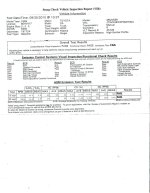
I've cleaned it up as well as I can (new oil, filter, air filter, fuel cleaning additive, run for an hour or so before the test to make sure the engine is warm) but still no luck. Next step may be to have the Catalytic Converter replaced as suggested by the test only mechanic but that will of course be rather expensive. Just wondering if anyone out there can take a look at my test results and let me know if a new cat looks like a good bet or if there is something else I should try. I've attached it here. As a summary the failures are the following:

HC FAIL MAX AVE MEAS

15 mph 62 28 44
25 mph 37 17 52


NO FAIL MAX AVE MEAS

15 mph 356 113 549
25 mph 533 150 1060


Thanks in advance for any help!
 

Attachments

  • smog.jpg
    smog.jpg
    127.7 KB · Views: 9,008
Register to hide this ad
Your vehicle has really high NOx levels. That usually occurs after very high combustion chamber temps (around 2500 deg F and higher). The first thing I'd check is the EGR valve....if it's not working correctly, you can definitely experience higher than normal combustion chamber temps.

I can take a closer look at all the numbers and probably give you better advice when I get a chance. In the meantime, don't jump on a new cat without eliminating less costly items first. If you know how to read the numbers on the test result page, you can pretty much narrow your problem down considerably.
 
Thanks Jed, I'll take a look at the EGR valve. It doesn't look like that would be too difficult to replace if it is not functioning properly. If you have a chance, take a look at the scan of the report I attached since all the numbers are there.
 
Okay, I took a good look at all of your numbers. Unfortunately, nothing jumps out at me. Your numbers aren't really that bad at all.

O2 - a high reading here indicates a lean mixture. Your reading is right where it should be (between 1-2%)

CO2 - this is your engine's combustion efficiency. Your reading is again on target and not at all a problem

HC - this is unburned fuel (hydrocarbons). Your readings are slightly high, but I've seen dramatically higher numbers (around 2000), so it's not all that bad.

CO - a high number here indicates a rich mixture. Your reading is okay, but it may be a bit higher than it should be...but still within the allowable limits.

NOx - This is your big problem. Elevated NOx levels are almost always caused by excessively high combustion chamber temps. The reason I said you should check your EGR valve is because the whole purpose of EGR is to lower combustion chamber temps. So I'd still start there. However, there are a ton of other things that can cause your NOx readings to be elevated. Here are a few of them:

Check the cooling system. Has the vehicle been running hot or hotter than normal? Is the radiator in good shape? Is the thermostat opening at the correct temp?

Check the PCV valve. If you pull it out and it makes a rattling sound, it should be just fine.

Check for any vacuum leaks. If your engine is running lean, this can also cause very high combustion chamber temps. But your numbers don't indicate a lean running engine.

Check your ignition timing. If it's not where it should be, adjust it. In fact, if you ret@rd it a degree or two, you NOx levels should drop. This isn't really a fix for your problem, but it might help get you over the hump and pass the test.

That's all I can think of off the top of my head for now.... but it should give you a start. I'd definitely avoid replacing the cat because the odds are that the cat is operating just fine. Your problem is much more likely to be in a sensor or somewhere in the ignition system.
 
Last edited:
Hey thanks for the suggestions Jed.

I'll start running down the list of items you note to try to lower the NOx levels. Good to hear that it may be just high combustion temps.

With respect to the over limit HC levels, I had read in another thread that it may be better to fill the tank with 87 Octane fuel before test to allow for full combustion. Does this make any sense? I have been using 89 Octane fuel for the testing so far.
 
Hey thanks for the suggestions Jed.

I'll start running down the list of items you note to try to lower the NOx levels. Good to hear that it may be just high combustion temps.

With respect to the over limit HC levels, I had read in another thread that it may be better to fill the tank with 87 Octane fuel before test to allow for full combustion. Does this make any sense? I have been using 89 Octane fuel for the testing so far.

It might help. Lower octane fuel does burn "easier" than higher octane fuel. But still, your HC levels are only slightly elevated. Once you fix whatever it is causing your NOx levels to be high, there's a good chance the HC levels will drop down quite a bit.
 
I recently passed my CA smog test. Here is what I did to give me the best odds of passing...though it may not have done anything to help pass:

Seafoamed the engine a few times and added some to the fuel.

Did oil and filter change shortly before test

Added a 'Smog test pass' fuel additive to fuel tank

Made sure all components and hoses in good working order

Filled tank with premium fuel

Make sure put on at least 700-1000 miles AFTER you Seafoam and add fuel additives to ensure you don't have any left in your fuel tank. You will need many miles to burn off that stuff.

Good luck,
 
Similar results on my first try at the smog test. NOx was 2082. Changed the cat(looked ok when I examined it after cutting it out) . The retest NOx was 60. This was on the high speed test. The cat I removed was not an original. Used a Magna Flow 51006 cat
 
Last edited:
NOx is kept low by recirculating exhaust gas back into the combustion chamber to dilute the mixture and keep combustion temperatures low by the EGR system that consists of an EGR Valve, EGR Vacuum Modulator and BVSV, a temperature sensing valve that opens a vacuum valve to turn on the system when the engine warms up. If there's a problem with one of the valves the EGR will never turn on and the NOx will stay too high. You need to check and possibly clean or replace one of those valves although it might just be a cracked rubber hose. It's easy to check by following the procedures in the service manual.
 

Members online

No members online now.

Forum statistics

Threads
278,307
Messages
3,554,050
Members
248,016
Latest member
Advally Service

Trending content

Back
Top