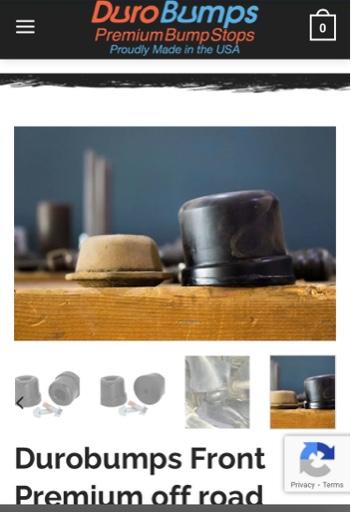
Perry parts front bumps

Register to hide this ad
I have not tried the AB3F but I've been running Energy Suspension bumps with no problems for less than $50. I had no idea that Durobumps were so expensive or why they are.
 
Interesting! Nice to see DuroBumps get some solid competition. They have a great product but once they got well known they just tacked on the "premium parts" tax and have ceased to innovate.
 
I bought Durabump's when Plasticsguy popped up here introductory price thinking 2017.
Good product holding up fine not worth the current price.
 
Last edited:
They look interesting. I wonder if they are any good?

My durobumps have been amazing. Probably one of my favorite mods. It absolutely transformed my 4Runner when diving hard and fast off-road. Great bolt on solution for bottom out control.
 
Well I'm biting the bullet for everyone, wen't ahead and ordered them. Looking at their main page the construction looks really neat. They are 3d printed and multidensity. They are taking advantage of 3d printing to create a complex interior structure too. I'm excited to try them. They also have rear bumps but I'm fine with my pick n pull blazer bumps for right now.
 
Well I'm biting the bullet for everyone, wen't ahead and ordered them. Looking at their main page the construction looks really neat. They are 3d printed and multidensity. They are taking advantage of 3d printing to create a complex interior structure too. I'm excited to try them. They also have rear bumps but I'm fine with my pick n pull blazer bumps for right now.
I can't imagine how a 3D printed part would hold up to so much flexing - but it is a great concept if the reliability is real.

-Charlie
 
I can't imagine how a 3D printed part would hold up to so much flexing - but it is a great concept if the reliability is real.

-Charlie

As long as the rubber is properly bonded it should work fine. It does have a 1 year no questions warranty so I'm okay with being a guinea pig. Worst comes to worse I swap in my OEM bumps while it's being warrantied.
 
As long as the rubber is properly bonded it should work fine. It does have a 1 year no questions warranty so I'm okay with being a guinea pig. Worst comes to worse I swap in my OEM bumps while it's being warrantied.
I took a (small? medium?) risk on Durobumps myself before these were an option... Even with the cast design, it is still a challenge to get co-molded metal to work long term in this kind of design. I hope these work! As others have said, more options is generally better.

Longer and softer bumps front and rear definitely help crashing over water bars at speed, etc. Maybe someday I'll get some hydraulic bumps...

-Charlie
 
As long as the rubber is properly bonded it should work fine. It does have a 1 year no questions warranty so I'm okay with being a guinea pig. Worst comes to worse I swap in my OEM bumps while it's being warrantied.

Thanks for your business! Our warranty is actually 2 years no questions asked now (I still need to update it on a few places on the website.) Having the ability to get feedback from our customers has let me iterate super quickly on the design and constantly improve our design.

A bit more about our process: we've started using a pellet extruder on our printers, which lets us directly 3D print injection molding materials. The awesome part of this is that it let us move away from typical 3D printing filament and toward engineered polymers, purpose built for bushings and bumpers. I worked with Covestro (a US polymer supplier) to choose the best material possible for the product.
 
Thanks for your business! Our warranty is actually 2 years no questions asked now (I still need to update it on a few places on the website.) Having the ability to get feedback from our customers has let me iterate super quickly on the design and constantly improve our design.

A bit more about our process: we've started using a pellet extruder on our printers, which lets us directly 3D print injection molding materials. The awesome part of this is that it let us move away from typical 3D printing filament and toward engineered polymers, purpose built for bushings and bumpers. I worked with Covestro (a US polymer supplier) to choose the best material possible for the product.

I'm really interested to hear more about how your process works if you can share it. I think a lot of us have been picturing someone with a desktop printer farm making TPU parts, but it sounds like it's more industrialized.
 
[MENTION=158195]thezentree[/MENTION]

Thanks for asking! Happy to share more about my process.

The business started out with turn-key machines and off the shelf TPU. Early on I was running TPUs with elongation at break around 300-350%.

What I found is that a lot of the manufacturers of filament will either:
  • Cut their material to reduce their cost
  • Add stiffer compounds to improve printability (which reduces elongation at break)

I found a filament supplier that could provide higher quality material, but they couldn't keep up with our demand (months long delays with no promise date in sight)

Eventually as Perry Parts grew, I realized I had to do something to fix my material supply. I found a project that manufactured micro injection molding screws, and coupled it with some laser cut parts to build an extruder. I tried that out, and with [literally] hundreds of hours of tuning, was able to stabilize material flow and build good parts.

Then I contacted a friend who works at Covestro. (I wanted to have my material supply in the US, and they do a good job of connecting you with an applications engineer) They helped me try out several different materials and we eventually landed on one with nearly 600% elongation at break (far more durable) and with the right durometer.

Where we're at now:

  • We only print injection molding pellets, no more filament
  • We build all our new machines in-house, based on the RatRig project platform, with modifications to support our (very heavy) pellet extruder (each machine takes about 40h to build up)
  • These materials are a league above most materials that are printable with filament based printers

Sorry for the wall of text! I'm a manufacturing engineer by background, and am really proud of how far the business has come. The material and machines have been a huge focus for me as we're still dialing in reliability and maintenance intervals on them.

 
Last edited:
[MENTION=158195]thezentree[/MENTION]

Thanks for asking! Happy to share more about my process.

The business started out with turn-key machines and off the shelf TPU. Early on I was running TPUs with elongation at break around 300-350%.

What I found is that a lot of the manufacturers of filament will either:
  • Cut their material to reduce their cost
  • Add stiffer compounds to improve printability (which reduces elongation at break)

I found a filament supplier that could provide higher quality material, but they couldn't keep up with our demand (months long delays with no promise date in sight)

Eventually as Perry Parts grew, I realized I had to do something to fix my material supply. I found a project that manufactured micro injection molding screws, and coupled it with some laser cut parts to build an extruder. I tried that out, and with [literally] hundreds of hours of tuning, was able to stabilize material flow and build good parts.

Then I contacted a friend who works at Covestro. (I wanted to have my material supply in the US, and they do a good job of connecting you with an applications engineer) They helped me try out several different materials and we eventually landed on one with nearly 600% elongation at break (far more durable) and with the right durometer.

Where we're at now:

  • We only print injection molding pellets, no more filament
  • We build all our new machines in-house, based on the RatRig project platform, with modifications to support our (very heavy) pellet extruder (each machine takes about 40h to build up)
  • These materials are a league above most materials that are printable with filament based printers

Sorry for the wall of text! I'm a manufacturing engineer by background, and am really proud of how far the business has come. The material and machines have been a huge focus for me as we're still dialing in reliability and maintenance intervals on them.

Thanks for typing all that. Sounds like a neat system.
 
Figured I would post up some initial impressions. The product seems nice and solid and were very easy to install. Just had to jack up each end a little bit, get channel locks on the old bumps, take them off and screw the new ones in I think with a 14mm. It was hard to tell exactly how much to tighten them but since there was no real baseplate in there I just got them good and snug. Maybe should have put some blue loctite on them but so far they haven't budged, I'd imagine the tension of the polymer helps keep them tight. Just realized though that he does have install instructions that detail how to know when they are tight enough and I might want to tighten mine a tad bit more. I doubt I've gotten deep into them but so far on street driving I don't even feel the first part of them (and it shouldn't take much to get into them with the modest lift I have). I'll hopefully have a chance to get some speed on some washboards soon and will hopefully get deeper into them. A+ product so far and A++ value.
 
So durobump, and their supporters, tout the importance of the angled design of their front bumps… anything to it?

a8f3a8d6defbeb24facc838f4e1cd689.jpg


Sent from my iPhone using Tapatalk
 
So durobump, and their supporters, tout the importance of the angled design of their front bumps… anything to it?

a8f3a8d6defbeb24facc838f4e1cd689.jpg


Sent from my iPhone using Tapatalk

At least with the perry bumps it doesn't matter. I can see the spots where it's contacting the frame and it's not slipping off when compressing. I got to run a dirt road with some washboards pretty fast the other day and these things performed great, I'm used to my front feeling pretty harsh on these roads (I would assume I would hitting my OEM hard bumps a lot) but my front end is softened up now. If only my rear was this soft.
 
At least with the perry bumps it doesn't matter. I can see the spots where it's contacting the frame and it's not slipping off when compressing.
The concern is not about it slipping off, the taller bump stops can have shear forces on them (the top bending) which isn't necessarily how the material should be used. I have vague memories of one of the other more universal bump stops used in the same way as these and the Durobumps bending way over under full compression, but I can't find the picture right now.

-Charlie
 
Anyone replaced both forward and rear bumps on the front? Wondering if more is better. :)
Also- regarding durability- they ran it through 100k compression cycles over 2k pounds and it held up great. (YouTube video) It did deform/squash down a bit by the end. Still "worked" though.
 

Members online

Forum statistics

Threads
278,310
Messages
3,554,080
Members
248,016
Latest member
Advally Service

Trending content

Back
Top