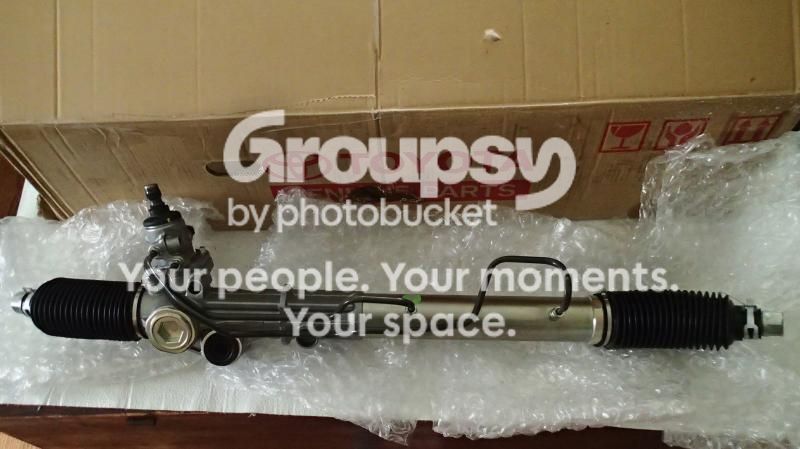
Oh man, I don't mean to sound like a dick on a broken record, but there is alot of invalid reasoning going on here... (hold your shock at there being bad engineering on the internet...)
I promise I mean nothing personal in any of what follows, I'm just commenting on the vilidity of some of the comments to point out logical fallacy.
Anyone below 75k without failures is bringing nothing to the table in terms of comments on quality. Racks should easily be tight for that long. If anyone had one fail in that time, then post it up and that
maybe says something about quality (assuming it didn't fail because you screwed up the install or abused it somehow...). Holding up for 20k isn't "saying something". As far as the hitting a ditch goes, that doesn't necessarily say much about the rack, it says something about the suspension and suspension bushings, but unless the ditch tried to force the wheel to turn and the driver held super tight to the wheel, or the rack bottomed out, then I don't think the rack got that stressed by it (unless he physically hit the rack of course). Remember, the rack can only see force in the axial direction as long as the TRE's haven't bottomed out.
You won't get enough datapoints to gauge reputation changing over time unless someone like Safari just started crapping the bed in terms of quality. That hasn't happened with anyone (that I have heard at least...), so just go with what is out there for general opinions. People are just going to re-hash the old opinions anyway; it'll sound like you're getting new ones, but they really aren't.
are Safari's ITR's OEM quality? or has others needed to replace those?
I'd imagine they are OEM quality.
No, they aren't OEM quality. Since they have changed the bushing, they are no longer "OEM quality" even if they started from a brand new OEM rack. I work for an OES (original equipment supplier), so I am very familiar with the OEM approval process. The disassembly and bushing swap invalidates the original qualification, so the "seal of approval" is gone.
To be clear, as an automotive engineer, the way that I define "OEM quality" is "Has had the $h!t tested out of it". No aftermarket has the resources ($$$) to "test the $h!t out of it" the way the OEM does, so "OEM quality" is a BS marketing ploy. Ignore it.
That said, best to just get over this idea of OEM quality. If it isn't OEM, then it isn't OEM quality. The Safari may be stronger, but it hasn't been vetted out to nearly the extent that the OEM design has. That's not saying its worse, there's just more risk. Also, stronger may not be better.
Now I don't want to pick on Taylor, 'cause I like him, but I am going to dissect his post to point out a few things...
Yes they are. At least according to Safari they are.
According to the guy selling it to you... glad you gave that caveat
Ive been running the Safari rack for just over 5k miles now, and heres what I can tell you...
So at time=0... "It's good out of the box", that's all the rest of the words meant.
The difference between the Safari rack and every other brand (including oem) is in the internal bushings. The oem rack, along with every other rack out there most likely, includes nylon polymer bushings, while the Safari rack has brass bushings I believe. This is why they claim their rack is stronger, and should last longer. These would be the main bushings that slide horizontally within the rack as you turn it.
Yes, this came I think from someone who called Safari and talked about it. Accurate as to their claims.
Basically, brass bushings will resist corrosion from that friction better than nylon, and will maintain their tolerance longer.
Incorrect. Brass corrodes more than Nylon. Corrosion may or may not be an issue since much of the rack is protected by the ATF. The brass I believe is claimed to be better due to perhaps higher stiffness or higher UTS of brass, but those aren't necessarily the cause of failures in a bushing. "maintain their tolerance" is irrational. I think you mean that brass will deform less easily. That is maybe true; depends on the application.
I can tell you that the rack is fantastic so far. Its very tight, so much so that the wheels struggle to return to straight on their own when you let go of the steering wheel after going around a turn. I have to force the steering wheel to get the wheels pointing straight again. Over bumps the rack does not allow the wheels to pull at all. They just point exactly where you direct them. I had a crappy remanufactured oem rack (actually went through 2 of them, plus the original rack) before installing the Safari. So I cant compare this rack to a brand new Toyota rack. But I can tell you the rack made the single most noticeable improvement in handling of all the front end parts Ive changed, by far. It was a WORLD of difference from the two remanufactured racks I tried.
That sounds too tight... Also, other components affect the "tightness" of the steering, which is just an overall feeling, not a technical term. I had extremely "loose" steering when I first got my 4runner; turns out it was bad front shocks, had nothing to do with the rack.
So to make this long story short, most of the opinions here are not particularly valid. Just make your decision and place your order. There's no opinion better than how people actually spent their money (unless you're getting the opinion of and engineer that designs steering racks... then how does he spend HIS money!). If I had to do it again and had time to order off the internet, then yeah, I'd probably get a Safari. I didn't have time for that, so I got Napa as it was (I felt) the best one I could get my hands on that day and is returnable. You know what people have bought. The rest of the opinions are just minutia that will only serve to confuse you and make you over complicate the decision. You can do it, so do it; don't wait for more opinions.

One last point, stop leak is bad. I'll admit I used it on mine just to limp my way to the weekend. It's like putting gravy in your PS. I was leaking about a quart a day by thursday, so I was desperate. I also replaced both the rack and the pump and the pressure lines, so I effectively completely flushed the stop leak out.