RE: Suspension.Is this really true?

comtn4x4

Senior Member
RE: Suspension.Is this really true?

I have been getting advice and prices on a new suspension for my rig. (Replacing my existing lifted suspension) With the new rear bumper it's not going to handle it anymore. I was e-mailing with a very well reputed suspension "guru" about what setup he advised for a set of Kings front and rear.
He advised no more that 2.5" lift in the front. I already understand the why of this so that's not in question. However, I am lifted 3" now and my 34's just barely don't rub so I mentioned this and could we set everything up for 3" lift.

This is what he replied:
"As for lift height, as long as the UCAs and LCAs are mounted to the factory positions, ride height (“lift”) does not determine how large of a tire you can fit as the suspension will still cycle along the same arch and hit the same full compression and full extension positions. If your 34” tires fit now at 3” they will fit at 2” or 1” of lift."

Is this accurate? I was always of the understanding that the only reason we lifted our rigs at all was to fit bigger tires??!!
 
Last edited:
Register to hide this ad
no guru

As far as normal driving and what not, I no longer rub after my lift. Granted driving a 3rd gen and street driving gave me clearance for 33x12.5 tires. When I'm fully compressed obviously it rubs but not until then. A body lift would definitely help if you still rubbed during street driving.

I only came up 2.5" in front and 3" in back.
 
RE: Suspension.Is this really true?

His statement is half right. He’s correct about travel positions and articulation provided you haven’t changed to long travel shocks.

He’s wrong about tire sizes fitting. I have seen people jam 285s on their stock suspension, but the premise behind doing suspension lifts is to do two things...improve approach angle with a slightly higher front end, and to accommodate larger tires. That’s really about it. Maybe he’s referencing this specific vehicle and the fact that some people can get away with larger tires on stock suspension but the general rule is contrary to this statement and not true, I believe, across all platforms.

Edit: Maybe there’s confusion on body lifts vs suspension lifts???

Sent from my iPhone using Tapatalk
 
Last edited:
His statement is half right. He’s correct about travel positions and articulation provided you haven’t changed to long travel shocks.

He’s wrong about tire sizes fitting. I have seen people jam 285s on their stock suspension, but the premise behind doing suspension lifts is to do two things...improve approach angle with a slightly higher front end, and to accommodate larger tires. That’s really about it. Maybe he’s referencing this specific vehicle and the fact that some people can get away with larger tires on stock suspension but the general rule is contrary to this statement and not true, I believe, across all platforms.

Edit: Maybe there’s confusion on body lifts vs suspension lifts???

Sent from my iPhone using Tapatalk

It's certainly possible there could be confusion. I thought I clearly communicated my current suspension setup and outfitting of my rig as well as having a new rear bumper added soon. He does regularly reference 33" tires when I have reminded him a couple times I'm on 34's.

I see what you're saying about travel positions, although I would believe that this is somewhat affected by an aftermarket UCA and the ability to increase the caster on a vehicle with a front bumper. Is that not accurate?
 
I've heard this also and have seen it posted in this forum.

what I know is, my 295s rub at 2.5" and are perfect at 3". I am also able to adjust my alignment differently based on the size of lift. ie: obtain different caster numbers.

Curious to see how this plays out.

Edit: I feel like this topic goes well with need/not need diff drop?
 
Yes. He is correct. If your tires fit with any lift using the stock control arms in stock locations they will fit with no lift too. That's just how IFS works. The range of motion is dictated by the control arms. Lifting only changes the static height - it doesn't change the range of motion. Some long travel shocks will give you about 1" more down travel, but they also would do the same thing at stock height.

So... for example if you have a range of motion of 8 inches. And stock is right in the middle. If you put a 3" lift on - you now have the same 8 inches of travel, but you're static height is 3" higher. So you'll only have 1 inch of down travel and 7 inches of up travel. The tires will rub at the same spots.

If you never compress the suspension you might get a slightly taller tire with a lift. But you can't expect to go off road in that scenario. As soon as you start using the suspension it'll put the tire right back to where it was with no lift. When you read that someone's doesn't rub once they lifted it - that means they don't flex the suspension, so they're probably only driving it on the highway.

So - if you want to change the suspension geometry, not just starting position, you need either different control arms (long travel), or move the mounting points (bracket lift).
 
Yes. He is correct. If your tires fit with any lift using the stock control arms in stock locations they will fit with no lift too. That's just how IFS works. The range of motion is dictated by the control arms. Lifting only changes the static height - it doesn't change the range of motion. Some long travel shocks will give you about 1" more down travel, but they also would do the same thing at stock height.

So... for example if you have a range of motion of 8 inches. And stock is right in the middle. If you put a 3" lift on - you now have the same 8 inches of travel, but you're static height is 3" higher. So you'll only have 1 inch of down travel and 7 inches of up travel. The tires will rub at the same spots.

If you never compress the suspension you might get a slightly taller tire with a lift. But you can't expect to go off road in that scenario. As soon as you start using the suspension it'll put the tire right back to where it was with no lift. When you read that someone's doesn't rub once they lifted it - that means they don't flex the suspension, so they're probably only driving it on the highway.

So - if you want to change the suspension geometry, not just starting position, you need either different control arms (long travel), or move the mounting points (bracket lift).

Ok I think I see. So ultimately by lifting we are changing not only starting position but also how the travel of the wheel is used. (7" up travel and only 1" down travel) That's why when driving and going over a hole in the road the front can feel like it is pulling down? Because it has no down travel to allow the wheel to reach down to the bottom?

So what is the the difference in only lifting 2.5" vs 3". There's not much difference there. Part of my discussion with the "guru" was getting the right size coil on the front coil over. I feel I have my front coil over over compressed to compensate for my front bumper/winch/battery/everything else. When I had to crank the coil over up to compensate for adding my front bumper and winch the ride got much stiffer. I was hoping to resolve that.

And all this being said now I want my stock suspension back to see if my 285/75's will fit! It's hard to imagine that they would
 
Your ride became stiffer upon cranking the collars on your coilovers because you were putting that much more preload on the coils to compensate for the additional weight.

Ideally, you would purchase a taller spring and lower the spring perches so as not to preload your front springs.


Sent from my iPhone using Tapatalk
 
So - if you want to change the suspension geometry, not just starting position, you need either different control arms (long travel), or move the mounting points (bracket lift).


Anyone know of any 4th Gens with bracket relocation??


Sent from my iPhone using Tapatalk
 
Your ride became stiffer upon cranking the collars on your coilovers because you were putting that much more preload on the coils to compensate for the additional weight.

Ideally, you would purchase a taller spring and lower the spring perches so as not to preload your front springs.


Sent from my iPhone using Tapatalk

Yes I totally get this. What I was trying to establish was the correct size spring to achieve this
 
Anyone know of any 4th Gens with bracket relocation??


Sent from my iPhone using Tapatalk

Usually bracket lifts are basically show truck type stuff, not really built for harder offroad use. That doesn't inherently mean they're bad. But if you're wanting larger tires - usually either a solid axle swap or long travel suspension is a better choice to go offroad with. It's also a lot more expensive. If you just want bigger tires to drive around town with - bracket lifts are fine.

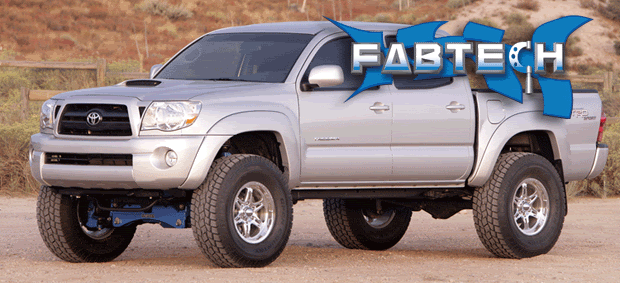
If you search for 6" lifts you'll find quite a few.

This gives a pretty good idea of the difference.

2006tacoma6fabtech.gif


zuo3yr_1c0fbec1f21a61bb093038b20230adcba9556121-jpg.2190274
 
Last edited:
I disagree. As you lift it, it's pushing the uppers and lowers down... typically you also install a bigger bump stop so you don't bottom out the shocks (limiting "bump" aka compression travel). so everything is pushed down allowing a bigger tire.

and yea I've seen the "guru's" post on here saying lifting doesn't help clearance. don't get triggered lol.
 
Ok I think I see. So ultimately by lifting we are changing not only starting position but also how the travel of the wheel is used. (7" up travel and only 1" down travel) That's why when driving and going over a hole in the road the front can feel like it is pulling down? Because it has no down travel to allow the wheel to reach down to the bottom?

So what is the the difference in only lifting 2.5" vs 3". There's not much difference there. Part of my discussion with the "guru" was getting the right size coil on the front coil over. I feel I have my front coil over over compressed to compensate for my front bumper/winch/battery/everything else. When I had to crank the coil over up to compensate for adding my front bumper and winch the ride got much stiffer. I was hoping to resolve that.

And all this being said now I want my stock suspension back to see if my 285/75's will fit! It's hard to imagine that they would

Yep. You got it. A longer spring with the same spring rate will ride exactly the same. You'll just have a different spring collar location. Within the range of travel a 600lb spring moves 1 inch for 600lbs of additional force. Unless you're bottoming out your springs, longer won't offer a better ride. A stiffer spring also won't ride better unless your springs are too soft.

Preload is often misunderstood. It doesn't change spring rate. It changes the ride height. Since you have a limited range of travel - let's say 0-8" let's say you start with your 600lb springs and you preload them so the static ride height is right in the middle - 4". It will take 2,400lbs to hit the bump stop. If you start with a longer spring by 1" and the same collar position, now you're starting position is 5" from bottoming out. It would then take 3,000lbs to bottom - but if you set it at the same 4" ride height as it was originally - it still takes 2,4000lbs to hit the bump stop. You won't be able to tell the difference. The only thing you changed is moving the collar up an inch. The spring rate through the cycle is the same.

Changing ride height with the SAME spring does make a difference in some instances. If you took your original 600lb spring and then moved the collar 1 inch, it still takes 600lbs to go up an inch, but to reach the bump stop would take 3,000lbs because there's another inch of travel to get there. In that case it probably would feel rougher because you'd have less down travel and require more force to use the entire up travel range. So the ride is likely harsher. But it's because of the choice of ride height, not really a result of making the spring stiffer.

Hope that makes sense. Longer springs aren't going to help ride quality unless you're bricking your existing spring. Changing spring rates depends on what you're starting with and what you want when you're done.
 
I disagree. As you lift it, it's pushing the uppers and lowers down... typically you also install a bigger bump stop so you don't bottom out the shocks (limiting "bump" aka compression travel). so everything is pushed down allowing a bigger tire.

and yea I've seen the "guru's" post on here saying lifting doesn't help clearance. don't get triggered lol.

You can disagree. But it's still correct physically. It's just geometry. Everyone tells you the same thing because it's just a physical property of the system. If we could change it we would.

If you add a longer bump stop you can have less suspension travel and possible keep from rubbing in some cases - but that makes it worse off road. I'm not sure why you'd want to do that. You'd be better off with a smaller tire and full suspension travel.
 
Last edited:
Usually bracket lifts are basically show truck type stuff, not really built for harder offroad use. That doesn't inherently mean they're bad. But if you're wanting larger tires - usually either a solid axle swap or long travel suspension is a better choice to go offroad with. It's also a lot more expensive. If you just want bigger tires to drive around town with - bracket lifts are fine.

If you search for 6" lifts you'll find quite a few.

This gives a pretty good idea of the difference.

2006tacoma6fabtech.gif


zuo3yr_1c0fbec1f21a61bb093038b20230adcba9556121-jpg.2190274


I always wondered how they got those trucks so damn high lol


Sent from my iPhone using Tapatalk
 
Yep. You got it. A longer spring with the same spring rate will ride exactly the same. You'll just have a different spring collar location. Within the range of travel a 600lb spring moves 1 inch for 600lbs of additional force. Unless you're bottoming out your springs, longer won't offer a better ride. A stiffer spring also won't ride better unless your springs are too soft.

Preload is often misunderstood. It doesn't change spring rate. It changes the ride height. Since you have a limited range of travel - let's say 0-8" let's say you start with your 600lb springs and you preload them so the static ride height is right in the middle - 4". It will take 2,400lbs to hit the bump stop. If you start with a longer spring by 1" and the same collar position, now you're starting position is 5" from bottoming out. It would then take 3,000lbs to bottom - but if you set it at the same 4" ride height as it was originally - it still takes 2,4000lbs to hit the bump stop. You won't be able to tell the difference. The only thing you changed is moving the collar up an inch. The spring rate through the cycle is the same.

Changing ride height with the SAME spring does make a difference in some instances. If you took your original 600lb spring and then moved the collar 1 inch, it still takes 600lbs to go up an inch, but to reach the bump stop would take 3,000lbs because there's another inch of travel to get there. In that case it probably would feel rougher because you'd have less down travel and require more force to use the entire up travel range. So the ride is likely harsher. But it's because of the choice of ride height, not really a result of making the spring stiffer.

Hope that makes sense. Longer springs aren't going to help ride quality unless you're bricking your existing spring. Changing spring rates depends on what you're starting with and what you want when you're done.

Ok this is really insightful. So if you don't mind let's talk the specifics of my situation. I started with my truck lift 2.5" in the front and very little extra weight. (650# Coil) As time went on, more weight was added. Sliders, aluminum bumper winch etc. You can see in my signature. So after the bumper and winch the front was too low. I cranked up the adjustment collar significantly to get back to the same lift height. The ride became much harsher. Now I am ready for new suspension front and rear. What coil should be used to better account for the additional weight that was added?
 
I pretty much agree.

Lifts alone don't clear more tire on IFS trucks. They can if you extend the bump stops, but that is really pretty rare up front on a toyota 120/150 since there is such limited travel to start with and you can't add much droop.

The main reason to limit the lift it to keep your CVs alive and to have a reasonable amount of neutral sag. If you lengthen the control arms.. you can run a bit more lift...

People often think they clear more because they never actually go offroad and full compress or deflect. When they do... self clearance takes place and it is sometimes expensive and ugly.
 
Last edited:
Ok this is really insightful. So if you don't mind let's talk the specifics of my situation. I started with my truck lift 2.5" in the front and very little extra weight. (650# Coil) As time went on, more weight was added. Sliders, aluminum bumper winch etc. You can see in my signature. So after the bumper and winch the front was too low. I cranked up the adjustment collar significantly to get back to the same lift height. The ride became much harsher. Now I am ready for new suspension front and rear. What coil should be used to better account for the additional weight that was added?
700# if you are that nose heavy. 650 is usually enough for aluminum bumper.. but I guess it all depends on what parts you have on it.
 
Last edited:
700# if you are that nose heavy. 650 is usually enough for aluminum bumper.. but I guess it all depends on what parts you have on it.

The 650# isn't cutting it now. 700# is what I was thinking also. Thanks for all the help. I really appreciate you taking the time
 
#700 gets stiff real quick when you start adjusting preload. At first I thought they were, of all things, too soft.. but a few twists ramped up the front fast. I’m running a steel bumper, steel winch rope, and two batteries, if that helps. I’m not a fan of the valving I’ve got, but 700# coils seem right.

If you want it truely dialed in have your truck weighed and let the suspension shop, whichever one you’re going with, calculate the appropriate spring rates.
 

Members online

Forum statistics

Threads
278,309
Messages
3,554,075
Members
248,016
Latest member
Advally Service

Trending content

Back
Top