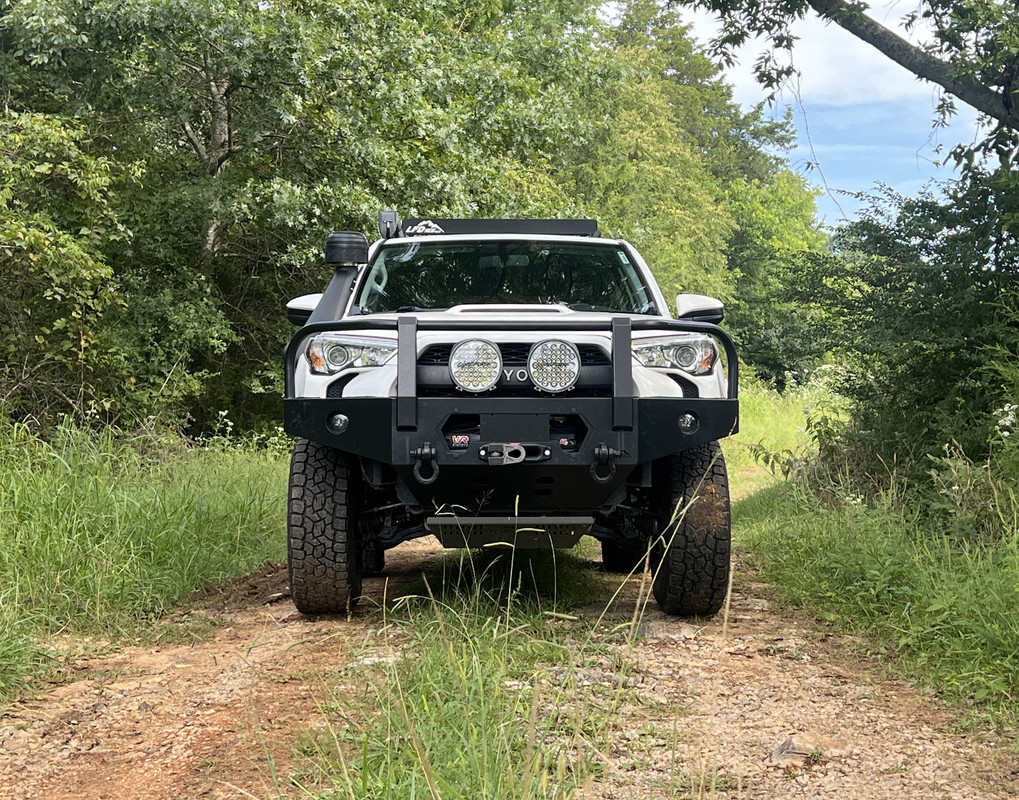
Rock armor: different grades for different locations?

scfw0x0f

Member
I'd like to do this build trying to keep the weight down a bit, so we don't wind up a 7,000 pound armadillo (great phrase [MENTION=215540]Easyrider18[/MENTION] !). I'm very much a measure 2/3/4/5 times, cut once type.

It seems like we could select different armor grades--thin/thick, steel/Al--for different locations based on likelihood of damage and the severity of cost/risk for damage. The difference between (for example) a full set of Bud Built skids in 3/16 steel with a diff skid, and 1/4 Al without the diff skid, is 97 pounds, which is 6% of the total cargo capacity of the 4Runner.

Has anyone done this or looked into it?

My thinking so far. This is really just to get the decision process started.
  • Rock sliders: very high priority, because the downside is very expensive repairs.
  • Front skid: low priority, because with a front-facing camera we should be able to avoid most damage.
  • Mid-skid: medium priority, proximity to oil pan.
  • Tranny/transfer case: low priority, they are pretty sturdy.
  • Fuel tank: high priority, catastrophic failure modes.
  • Rear differential: medium priority.
  • KDSS components: low/medium, not critical but expensive to fix.
  • ABS sensors: low/medium, same as KDSS.
  • Something else?

Comments? Once I get these priorities worked out, and I'm looking to all of you for advice on that, I can look at the specifics of protecting each location.

Thanks!
 
Register to hide this ad
It would be helpful if you provided information about the frequency of your off roading, type of terrain, and examples of trails you frequent.


Sent from my iPhone using Tapatalk
 
It would be helpful if you provided information about the frequency of your off roading, type of terrain, and examples of trails you frequent.


Sent from my iPhone using Tapatalk

Let's assume we're trying to construct a general model for a variety of tasks. While driving trails in Indiana (for example) may generally be lower risk than attempting high-risk technical trails in Utah or Colorado, is the risk profile for a specific location on a 4Runner substantially different relative to the risks to other systems? That is, for example, is the fuel tank always at the same level of relative risk vs. the rear diff, or are there operational modes that shift the relative risk among the various systems?
 
What kind of trails are you planning on doing?

I have bud's skids with some extra gusseting and modifications over the years to strengthen them.

To your list:
I would say the transfer case skid is probably highest priority - there isn't one stock, just a flimsy piece of sheet metal bolted to the transfer case and it is right at the break over angle where you are going to get high centered on rocks all the time. Bud's skids also add a frame cross member here, which is critical.
Rear diff is pretty low priority. Protection for the pinion and e-locker motor are nice, but the rear axle can take a good bit of abuse. Eventually it sucks when you can't remove the drain plug as the ring around it becomes one with the drain plug.
KDSS and ABS sensors don't need anything, they are well protected.
Rear LCA mounts are high priority, they will get chewed up in no time. Also, rear LCAs will bend when you drop on them.

Honestly, unless you are planning on doing 5+ rated rock trails, the stock 4runner protection is pretty good and better than most give it credit for, much better than some aftermarket skids.
 
Last edited:
Let's assume we're trying to construct a general model for a variety of tasks. While driving trails in Indiana (for example) may generally be lower risk than attempting high-risk technical trails in Utah or Colorado, is the risk profile for a specific location on a 4Runner substantially different relative to the risks to other systems? That is, for example, is the fuel tank always at the same level of relative risk vs. the rear diff, or are there operational modes that shift the relative risk among the various systems?

WTF.... Are you trying to be dense for the sake of being dense?


Better idea: go take your vehicle offroading and find out what kind of offroading you like before you end up with a instagram build.
 
Last edited:
Better idea: go take your vehicle offroading and find out what kind of offroading you like before you end up with a instagram build.


Yeah break it then prevent it from getting broke again if possible.


IMHO the longer I wheel the rig the more I'm willing to risk. And honestly the more trail time you put in the greater the odds become of breaking something. You can't plan for everything.
 
I'd like to do this build trying to keep the weight down a bit, so we don't wind up a 7,000 pound armadillo (great phrase [MENTION=215540]Easyrider18[/MENTION] !). I'm very much a measure 2/3/4/5 times, cut once type.

It seems like we could select different armor grades--thin/thick, steel/Al--for different locations based on likelihood of damage and the severity of cost/risk for damage. The difference between (for example) a full set of Bud Built skids in 3/16 steel with a diff skid, and 1/4 Al without the diff skid, is 97 pounds, which is 6% of the total cargo capacity of the 4Runner.

Has anyone done this or looked into it?

My thinking so far. This is really just to get the decision process started.
  • Rock sliders: very high priority, because the downside is very expensive repairs.
  • Front skid: low priority, because with a front-facing camera we should be able to avoid most damage.
  • Mid-skid: medium priority, proximity to oil pan.
  • Tranny/transfer case: low priority, they are pretty sturdy.
  • Fuel tank: high priority, catastrophic failure modes.
  • Rear differential: medium priority.
  • KDSS components: low/medium, not critical but expensive to fix.
  • ABS sensors: low/medium, same as KDSS.
  • Something else?

Comments? Once I get these priorities worked out, and I'm looking to all of you for advice on that, I can look at the specifics of protecting each location.

Thanks!


Like others have said, really depends on the level of offroading one plans to do. If people plan to rock crawl at all steel over aluminum is a must. My 2 cents

Rock sliders: One of my first purchases, sliders are a must.
Front skid: Stock skids provide good enough protection for most, mine took a few hard hits if you are gonna touch any skid in the front its gonna be those
Mid-skid: Most people don't need it unless you are crawling, turtling and dragging ass
Tranny/transfer case: Most people don't need it unless you are crawling, turtling and dragging ass
Fuel tank: Mine have taken a few good hits, most won't need an upgrade unless you are in a very technical trail
Rear differential: medium priority.
KDSS components: Sliders and stock KDSS module skid plate will suffice for most people
 
Let's assume we're trying to construct a general model for a variety of tasks. While driving trails in Indiana (for example) may generally be lower risk than attempting high-risk technical trails in Utah or Colorado, is the risk profile for a specific location on a 4Runner substantially different relative to the risks to other systems? That is, for example, is the fuel tank always at the same level of relative risk vs. the rear diff, or are there operational modes that shift the relative risk among the various systems?


Uhhh…. It matters because if you’re trying to save weight, stock armor is more adequate in many situations too. Lots of trails people consider off roading or overlanding are nothing more than overgrown fire roads that don’t really need armor at all. Context matters.


Sent from my iPhone using Tapatalk
 
Front skid was my top priority. Ground clearance is not good and compound that with the hump in the middle of the dirt trail and the hump often has firmly planted rocks. Bud Built has done me well.
 
Front skid is a must

IMG-6476.jpg
 
It very much depends on your use. Different terrain will damage different stuff. For example Moab slick rock is going to be mostly big round rocks and ledges. So sliders, bumpers, and belly (transfer case). California rocks are more loose rock that will go into more places, so you really need the transmission, fuel tank, rear control arms, and rear frame mounts.

I don't think the rear diff needs a skid at all in most cases, nor does the front lower control arms. And the KDSS skids are solid. No reason to change them.

If you want to optimize for weight, Toyota did a really good job with the OEM steel front skid. It's thin and light but can take shit ton of abuse without failing. It'll look terrible after a weekend in the rocks. But it'll hold. The aluminum TRD pro skid looks strong, but is pretty weak. If you want to take abuse repeatedly over the years, then the heavy steel is what you need. It's the only thing that will handle constant rocks.

So you gotta pick what you want to do with it and go from there.
 
Last edited:

Members online

Forum statistics

Threads
278,310
Messages
3,554,079
Members
248,016
Latest member
Advally Service

Trending content

Back
Top