[Tip] Protecting Brake Lines

gookies

New member
Likely more applicable to ones living in the rust belt, but could also be useful to others to protect against abrasion. I noticed that the weak point of Toyota brake lines ends up being the exposed ends where there isn't any rubber coating and this is where it ends up corroding and leaking, then you have to replace the line. The factory rubber coating does an excellent job of protecting the line, I cut and peeled away the line I removed and it looks brand new underneath.

With the installation of the new lines, I wanted to protect the weak points (exposed parts) and ended up finding shrink tubing for wires that works very well and is thick. Several are available on Amazon (search for 3:1 or 4:1 shrink tubing), I used 3:1, 1/2" in order to slide the fitting through, it still shrinks down enough for the 3/16" line, but I might've went with the 4:1 shrink tubing just to have more flexibility down the road if I used it for another item. I also plan on covering the fitting after installation.

I purchased brand new OEM lines and I had to apply the shrink tubing in sections due to all the loops and bends (shrink tubing would not slide on that easily). It would be way easier if you made your own lines, apply the shrink tubing first and then bend (changes the diameter so you'll need another brake tubing bender, but many are using NiCopp lines now which are very easy to bend by hand).

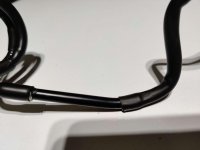
1st picture is where I cut the rubber coating on the old OEM line to show what's underneath

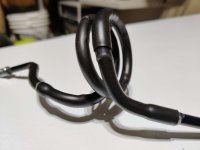
2nd picture shows the OEM coating in the middle flanked by the shrink tubing

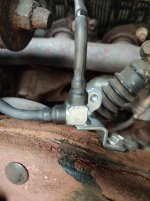
3rd picture is where I had to do the shrink tubing in sections due to the loop, but it worked out fine.

Shrink tubing I used - 1/2 Inch 55 Ft XHF 3:1 Waterproof Heat Shrink Tubing Roll Marine Grade Adhesive Lined Heat Shrink Tube, Insulation Sealing Oil-Proof Wear-Resistant Black: Amazon.com: Industrial & Scientific
 

Attachments
  • rn_image_picker_lib_temp_f4213880-c7a0-4320-ac9f-8c17561e2394.jpg
    rn_image_picker_lib_temp_f4213880-c7a0-4320-ac9f-8c17561e2394.jpg
    31.1 KB · Views: 646
  • IMG_20221001_213325.jpg
    IMG_20221001_213325.jpg
    44.5 KB · Views: 628
  • IMG_20221001_213302.jpg
    IMG_20221001_213302.jpg
    49.4 KB · Views: 630
Last edited:
Register to hide this ad
Interesting idea. One has to weigh the pros and cons of doing it though since it requires the removal and reinstallation of the brake lines - which requires bleeding of the brake system. And we've all heard the stories of folks having to go back to a dealership to have the brakes bled properly with a laptop due to issues with the ABS system.

Personally, I've lived in the rust belt my whole life and I've never had a brake line rust out yet. You do have me thinking though.
 
Interesting idea. One has to weigh the pros and cons of doing it though since it requires the removal and reinstallation of the brake lines - which requires bleeding of the brake system. And we've all heard the stories of folks having to go back to a dealership to have the brakes bled properly with a laptop due to issues with the ABS system.

Personally, I've lived in the rust belt my whole life and I've never had a brake line rust out yet. You do have me thinking though.


Oh yeah, I only did this since I'm replacing lines, but if you want some protection on the exposed ends without removing the lines, this self-fusing silicone tape would likely do the trick (I would've gone this route if I wasn't replacing the entire line). That's likely only an issue if their master cylinder went dry, I don't think everyone goes to the dealership here after replacing their calipers (I never have and have replaced calipers a few times). There's also a process you're supposed to follow that's in the manual, IIRC, you're supposed to pump the brakes with the ignition off for 40 times or something after you're done bleeding.

Self Fusing Silicone Tape for Pipe Repair (1 Inch x 26 Ft, Black): Amazon.com: Industrial & Scientific


Also have lived in the rust belt for the majority of my life, 03' 4Runner, the exposed lines were pretty corroded when I took a look at them, one of my rear lines started to leak first, but I decided to replace the majority of them when I noticed the weak points.
 
Last edited:
So it looks my brake like corroded through going front the front to the rear. I came out to the parking lot after work and found my muffler and rear axle covered in brake fluid. I had to have it towed and hopefully I'll hear more about this tomorrow. Usually I hear of brake like issues at the caliper, not in the middle of the car/ truck

FYI - Im in rochester too now
 
So it looks my brake like corroded through going front the front to the rear. I came out to the parking lot after work and found my muffler and rear axle covered in brake fluid. I had to have it towed and hopefully I'll hear more about this tomorrow. Usually I hear of brake like issues at the caliper, not in the middle of the car/ truck

FYI - Im in rochester too now


Yep, it's pretty much inevitable and a matter of 'when' in the rust belt. The two rear hard lines join in the middle of the axle that connects to rubber hoses and then another set of hard lines that runs on the side of the gas tank. That connects to a union in the middle of the vehicle on the frame rail, then two more lines then connect to the master cylinder. I'm currently in the process of replacing all of that.
 
Last edited:
Interesting idea. One has to weigh the pros and cons of doing it though since it requires the removal and reinstallation of the brake lines - which requires bleeding of the brake system. And we've all heard the stories of folks having to go back to a dealership to have the brakes bled properly with a laptop due to issues with the ABS system.

Personally, I've lived in the rust belt my whole life and I've never had a brake line rust out yet. You do have me thinking though.

You're either lucky or don't keep the cars long enough. I've replaced them on at least 5 cars. Seems to be the 15+ year range is when they go.
 
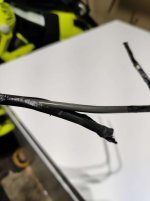
Finally replaced all my brake lines a couple weeks ago and wanted to test drive it for awhile to check for any leaks before sealing the ends up. I did that this weekend. I'd definitely suggest this to others living in the rust belt, the ends of the lines where there isn't a factory rubber coating applied is what fails.

Also, replaced all brake components and ended up getting some vacuum caps to cover the entire bleeder screw (these get corroded easily) and added Fluid Film inside it.
 

Attachments

  • rn_image_picker_lib_temp_3cfbe3fa-f14c-4526-8b6b-82d3f27eec4f.jpg
    rn_image_picker_lib_temp_3cfbe3fa-f14c-4526-8b6b-82d3f27eec4f.jpg
    71 KB · Views: 557
Last edited:
By doing this, are you increasing the likelihood that moisture will actually get trapped inside the shrink tube and accelerate the rust? Isn't there a copper alloy tubing that would be more moisture/rust resistant?
 
By doing this, are you increasing the likelihood that moisture will actually get trapped inside the shrink tube and accelerate the rust? Isn't there a copper alloy tubing that would be more moisture/rust resistant?

It's shrink tubing for wire, there's an adhesive/glue on the inner layer, so when it shrinks down and cools, it oozes out and creates a waterproof seal. The OEM line has a similar material applied from factory, in my initial post, you can see the line looks brand new after cutting it off. They didn't go all the way to the end from factory because there wouldn't be any space to remove the fitting if needed. All the lines I ended up covering have never been touched til now. I left the hard lines connecting to the front calipers alone, since that's something that gets removed more often. If I ever need to replace one of the other lines, the shrink tubing can be easily cut off with a utility knife.

That was my first attempt before saying forget it and buying all OEM lines. It's called NiCopp, Nickel Copper. I did not want to deal with some of the bending involved.
 
Last edited:
I would be concerned with the melting temperature on the tubing.

From what I looked at, operating temps are up to ~257F. I'm not too concerned. I'd be surprised if any of the brake lines experienced that kind of temperature during operation. I'll definitely update this post in the future if something fails before the brake lines (frame likely) and I have to scrap it, just to show the condition of the lines I shrink tubed.
 
Last edited:

Members online

No members online now.

Forum statistics

Threads
278,306
Messages
3,554,044
Members
248,016
Latest member
Advally Service

Trending content

Back
Top