Tire Pressure for New Rubber?

FourT6and2

New member
'21 TRD Pro. Replaced OEM Nitto Terra Grappler (not the G2) P-265/70/17 113S with Falken Wildpeak AT4W P-285/70/17 116T standard load. Using online calculators and tables, seems like they're all spitting out 26-28 PSI. That seems a bit low, so just asking here. I could do a chalk test I suppose. But since it's such a popular size, I figured I'd ask. My 4Runner is stock weight, except for Prinsu rack and light bar.
 
Register to hide this ad
'21 TRD Pro. Replaced OEM Nitto Terra Grappler (not the G2) P-265/70/17 113S with Falken Wildpeak AT4W P-285/70/17 116T standard load. Using online calculators and tables, seems like they're all spitting out 26-28 PSI. That seems a bit low, so just asking here. I could do a chalk test I suppose. But since it's such a popular size, I figured I'd ask. My 4Runner is stock weight, except for Prinsu rack and light bar.

Tire Rack has chart that shows what tire pressure you should run when you change the tire size. Generally speaking, when you have larger tires, you need a bit lower tire pressure than shown on the drivers door jam.

The tire pressure monitor does not control the tire pressure, only reports what the pressure is. You don't need new ones when you change the tires.
 
Tire Rack has chart that shows what tire pressure you should run when you change the tire size. Generally speaking, when you have larger tires, you need a bit lower tire pressure than shown on the drivers door jam.

Right. Like I said, the charts are saying as low as 26 psi, which just seems odd to me, but if that's what works, so be it.
 
Last edited:
use the front axle weight, now the tire rating. some quick maths will give you the front PSI needed. repeat for the rear, itll be less unless youre loaded up/towing.
 
use the front axle weight, now the tire rating. some quick maths will give you the front PSI needed. repeat for the rear, itll be less unless youre loaded up/towing.

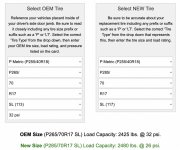
Not sure how to do this. GAWR of front end is 3000 lbs. OE tire rating is 113 (2535 lbs.). New tire rating is 116 (2756 lbs). But at 32 psi, 113 rating = 2425 lbs. So for 116 rating, to get about the same weight (2425), I would need 26 psi. But it depends on the chart I reference. Nitto refers to a third-party pdf. Falken's load/psi data doesn't match.

https://www.nittotires.ca/sites/default/files/2017_load_and_inflation_tables.pdf
https://www.falkentire.com/load-inflation

So I'm still asking the same question. Does this seem right? 26 psi is pretty low...
 
Last edited:
I bet most people just use the sticker on the door still. anywhere from 28 to 32 will be fine. start with 32 - if too harsh then reduce 2 PSI and call it good
 
I run my at 38.

Do the chalk test

I'll do a chalk test. But a larger tire with more volume requires less pressure. I know I need to go down in pressure from the stock tires, just trying to determine how much. Chalk test is the way to do it I suppose.
 
Last edited:
.... But a larger tire with more volume requires less pressure. ...

What ?????? :wow:

Don't know where you heard that, but no.

Start out at the pressure at what Toyota put on the doorjamb sticker, and go from there. 32 psi is a good place to start.
 
What ?????? :wow:

Don't know where you heard that, but no.

Tire Rack, Toyo, Nitto, Falken, BFG, Michelin, and every other tire manufacturer. This is what I mentioned in my OP.

To maintain the same load handling, using tire manufacturer load tables and even the online tire pressure calculator, going from the standard load P265/70/17 @ 32psi to standard load P285/70/17 requires a lower pressure. I just thought 26psi seemed pretty low, but that's what the tables/calculators spit out. Might not be the best for tire wear, though. So I'll do a chalk test to confirm.
 

Attachments

  • Screenshot 2024-06-12 at 6.13.50 PM.jpg
    Screenshot 2024-06-12 at 6.13.50 PM.jpg
    119.1 KB · Views: 918
Last edited:
I'll do a chalk test. But a larger tire with more volume requires less pressure. I know I need to go down in pressure from the stock tires, just trying to determine how much. Chalk test is the way to do it I suppose.

I find a gravel road or a sandy parking lot or something like that. Drive slow so the tires pick up dust and dirt then find a smooth straight stretch of road to drive about 1/2 mile and stop. The dirt/dust/gravel dust will be wiped off the tire where the tire makes contact with the road. You will typically start high like 35psi and then lower the pressure down about 2psi at a time until the whole face of the tire is wiped clean. This means the entire face of the tire tread is touching the ground. This gives the longest tire life.

For example:
My 4th gen with 18" limited wheels, i have 285/60-18 General Grabber ATX and to get the tires to lay down perfect and flat i am like 27ish up front and about 22ish in the rear unloaded and if i tow for any real distance i bump the rear up around 26.
My 5th gen with 20" limited wheels, i have 305/50-20 General Grabber ATX and to get the tires to lay down perfect and flat i am at 24 up front and 19-20 in the rear. This vehicle is the wifes daily driver, the tires are wider than the narrow 20x7" wheels like so to get the tire to lay out flat we are quite low on pressure. Good thing the sidewalls are tough, we have run this combo probably 250,000+ miles already and never had a tire failure.
I had this same tire and wheel combo on my 2008 tacoma, my 2012 4R Limited, my 2005 Tundra, and our current 2023 4R. I really like this tire and wheel combo, it looks bangin.

ALSO.....
My 2005 Tundra Double cab 4wd has the same tire and wheel combo, but requires a fair bit different pressure due to weight of the vehicle.
Up front i have 34psi and in the rear i am at 22psi. This is what it takes to get the tires to lay out perfectly flat and have the entire tread face touching the road surface.

This method is what i have used forever, and i have a set of general ATX on my 2008 4th gen 4R with 102,000+ miles now and they still have tread left.

 
Tire Rack, Toyo, Nitto, Falken, BFG, Michelin, and every other tire manufacturer. This is what I mentioned in my OP.

To maintain the same load handling, using tire manufacturer load tables and even the online tire pressure calculator, going from the standard load P265/70/17 @ 32psi to standard load P285/70/17 requires a lower pressure. I just thought 26psi seemed pretty low, but that's what the tables/calculators spit out. Might not be the best for tire wear, though. So I'll do a chalk test to confirm.

It's not about load handling, it's about the sidewall flex. If you drive too long at speed at a too low of PSI the tire will fail. You're better off going higher then lower on that.

** correction, you went with regular P tires... you might be right. Most people go with C or E LT tires--those tend to need higher PSI then stock.
 
Last edited:
It's not about load handling, it's about the sidewall flex. If you drive too long at speed at a too low of PSI the tire will fail. You're better off going higher then lower on that.

** correction, you went with regular P tires... you might be right. Most people go with C or E LT tires--those tend to need higher PSI then stock.

Correct. Standard load P tires, just like stock.
 
Quote:
Originally Posted by FourT6and2 View Post
.... But a larger tire with more volume requires less pressure. ...

What ?????? :wow:

Don't know where you heard that, but no.

Start out at the pressure at what Toyota put on the doorjamb sticker, and go from there. 32 psi is a good place to start.

As far as the force provided by the air pressure in the tire this is true (if you change out volume for Effective Area).

Pressure = Force / Area. So, Force = Pressure * Area. So, if the effective Area of the air “column” increases then less pressure is required for the same Force.

The effective area is hard to calculate due to too many dependent variables. Generally it’s determined through testing (empirical data) and back calculated and then a formula generated for that specific tire design.

Belt stiffness and ply (if not radial) both play a role too.
 
Last edited:

Members online

Forum statistics

Threads
278,312
Messages
3,554,085
Members
248,016
Latest member
Advally Service

Trending content

Back
Top