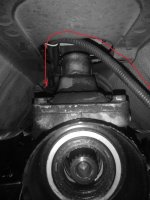
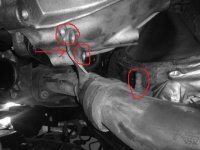
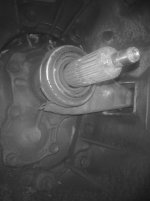
Tool to back transmission away from engine

sae10w30

Banned
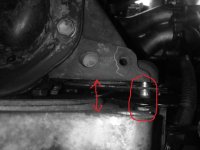
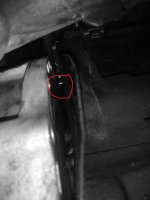
I must be skipping a step or missing a tool that I need.
What backs the transmission away from the engine?

It's in neutral. I'm positive all the bolts are out (7 on the bell housing + 2 for the starter).

I'm only somewhat sure that it's level because you can't really easily tell, but it's close enough as I can wiggle it back and forth and the weight does seem to be on the transmission jack when I jack it up a bit.

If the transmission is hanging up on something, I don't see what as the shift funnel is free and the harness is loose and the starter motor is hanging down to the side.

The rear crossmember is out. The front swaybar is out.

I need a tool to get rearward force on the transmission.
If you've never done this (I haven't), you won't know what to do.
I don't.

The lower dowel on the driver side seems to be out.
The upper dowel on the passenger side seems to be almost out.

I must be skipping a step or missing a tool.

How do I back the transmission away from the engine.

(I realize this seems to be a simple question, but if the answer is just make sure it's level and then push, well, I've been doing that for an hour or more already.)
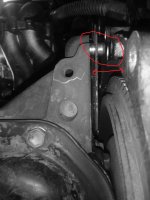
 

Attachments

  • bellhousing01.jpg
    bellhousing01.jpg
    107.8 KB · Views: 523
  • bellhousing02.jpg
    bellhousing02.jpg
    57.9 KB · Views: 450
  • bellhousing03.jpg
    bellhousing03.jpg
    60.4 KB · Views: 442
Register to hide this ad
You never mentioned that you unbolted the torque converter from the flywheel. Unless you have a manual trans.

You shouldn't hang the starter on the wire harness.

Look for a small bolt anchoring the harness the the trans.


Sent from my iPhone using Tapatalk
 
You never mentioned that you unbolted the torque converter from the flywheel. Unless you have a manual trans.
It's the 2WD manual 5 speed.

You shouldn't hang the starter on the wire harness.
I'll wrap that up. It seems to be secure, but you are right that I should support it with a hanger wire.

Look for a small bolt anchoring the harness the the trans.

Maybe it's the harness, but I was pretty sure that I got them all out, but I'll look again as I can get about 3/4 inch but no more.

I though of bottle jacking it but then I got scared I'd bend something so I didn't try further. And besides there isn't any convenient spot to push it away anyway.

I'm just trying to figure out what tool I need to push the transmission away from the engine since I had expected it to just slide out easily with it leveled on the transmission jack.
 
Assuming you have the wire harness free, etc, the only thing left is the transmission input shaft into the clutch disc. Make sure the transmission and engine are still parallel with each other. If they are tipped (gap on one side larger than another) you can bind up on the clutch disk/input shaft splines.

-Charlie
 
To SAE10W30, thanks for all these posts because I'll be doing a clutch job at some point in the future and I'm sure this will come in handy.
 
Assuming you have the wire harness free, etc,

Thanks for offering help as I'm so frustrated right now. It's so close and yet so far.

The harness seems to be as free as can be though (I'll see if I can snap a photo for you).

the only thing left is the transmission input shaft into the clutch disc. Make sure the transmission and engine are still parallel with each other. If they are tipped (gap on one side larger than another) you can bind up on the clutch disk/input shaft splines.
It must be that. It has to be. All the bolts are out (7+2) as I wouldn't have the gap that I have.

Mainly I need to know from experienced people what it "should" be like.
If I had everything lined up, "should it just slip right out?"

You did unbolt the clutch slave and the pipe clips?
Thank you for that question.

It's a reasonable question, where "something obvious" has to be wrong, but to answer your question, yes. I unbolted the clutch slave cylinder, and the exhaust bracket and the shift lever is pulled out, and the speedometer is removed, and the reverse sensor is out, and the driveshaft and sway bar and cross member, and the starter, and the three harness connections on top of the transmission.

Do you think jacking up the engine will make any difference?

How much FORCE is needed, normally, to push the transmission away from the engine?

Maybe I have the transmission jack too far back?
(It's on the waist.)

To SAE10W30, thanks for all these posts because I'll be doing a clutch job at some point in the future and I'm sure this will come in handy.

To be helpful, I already sent to your PM the complete multipage log I have been keeping and updating. You can post here what you think of it and what I need to add to it to be useful to you, as I always try to help others as payback for them helping me.

That log will be text so it won't have pictures but it should help you with each step in turn where I described the bolts and tools I used and needed plus the order I did things, and the order I wish I had done things (like I should have done the swaybar earlier and I should have put the jack stands further forward on the frame).

These may also help you.
DIY 5VZ
5vz clutch job
clutch maintenance
clutch replacement

3RZFE:
clutch help
 

Attachments

  • stuck01.jpg
    stuck01.jpg
    47 KB · Views: 401
  • stuck02.jpg
    stuck02.jpg
    51.3 KB · Views: 401
  • stuck03.jpg
    stuck03.jpg
    67 KB · Views: 411
It needs to be in line with the engine/crankshaft, otherwise it won't slip out.
There is no tool, and you don't want to force them apart. I have pulled several, and I believe your issue is actually the trans jack. I'm betting the jack is causing wrong pressure on the trans, causing it to not be in a neutral state. I know that sounds weird, and I don't know how else to say it.
I've always pulled them by hand- sometimes with the aid of a floor jack, sometimes without.
I support the trans with the jack, and wiggle it side to side while pulling rearward. It is important the gap is equal on the top vs the bottom. Jack too high or too low, and the trans will not separate. It will be in a bind.
 
I've never pulled a manual trans but I have pulled a couple autos. Make sure (like Tyler said) that the gaps are equal on the top and bottom otherwise you are not pulling it straight out and it will bind up.

I doubt its a wiring harness holding it up but it doesn't hurt to double check everything.

If you can get someone to give you a hand, sometimes it just takes another person/perspective to see what the problem is.
 
I have only done my 5-speed once, but it wasn't that hard to separate all by myself. I don't think I used any tool. I'm 65 and no Superman. I used a Harbor Freight trans jack. Make sure all four wheels are pointed fore-and-aft. Just one sideways and it's going nowheres. It won't spin on its own. (That may be obvious, too, but I'm sure the eventual solution will also be obvious, so forgive me.)
 
Last edited:
Not the same trans here, but I always found the trans binding on some portion of the frame or other component. Make sure its straight and adjust the level/angle of the jack and take your time so that you don't get too frustrated and cause more issues. crawl around all sides and see if its hung up. Even binding against 1/8' of steel will make it feel like its bolted in solid.
 
Not the same trans here, but I always found the trans binding on some portion of the frame or other component. Make sure its straight and adjust the level/angle of the jack and take your time so that you don't get too frustrated and cause more issues. crawl around all sides and see if its hung up. Even binding against 1/8' of steel will make it feel like its bolted in solid.

I'm embarrassed to admit what the binding was due to.

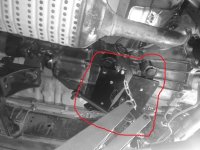
I couldn't find a DIY that covered my exhaust where all I knew was that most said you don't have to remove the exhaust bracket, but you MUST move the bracket! (You don't have to remove it but it can't stay where it was, even when unbolted from the bell housing!)

I had removed the two bolts holding the exhaust to the bell housing, but that wasn't enough as the bracket was preventing the bell housing from moving backward as TheDurk mentioned. A third bolt had to be removed and the bracket has to be slid down the pipe away from the bell housing.

I feel like an idiot. But I'm moving on as I have more questions to ask since this is my first clutch job ever.
 

Attachments

  • sticking01.jpg
    sticking01.jpg
    40 KB · Views: 423
I have a couple more questions which, I think I would know had I done this job before, where the flywheel is the most important question.

1. The most important question is:
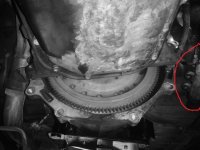
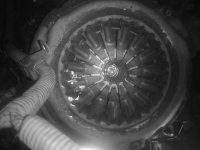
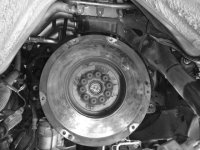
Please take a look at the flywheel photos below. How do I know if it needs to be machined or replaced? (I have measuring tools but I don't have the thickness spec.)

2. The next most important question is where's the oil seal? I suspect it's BEHIND the flywheel. Just so you know, those 14mm 12-point flywheel bolts are on TIGHT. I jammed a screwdriver in the flywheel teeth to immobilize it so I could spin the bolts off, but I only have 12-point chrome 3/8" sockets, as my 1/2 inch black sockets are 6 point. I'm sure I can break them, but do I need to? How do I know?

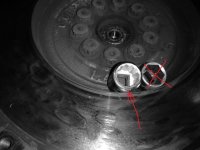
3. Less important than those two questions is where is the pilot bearing? I suspect it is behind the throwout bearing?

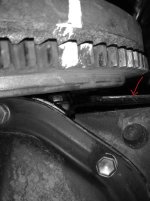
4. Even less important is the observation that in all my prying last night, I seem to have bent the 1/8th inch metal plate between the engine and the flywheel. I don't think it will matter though.

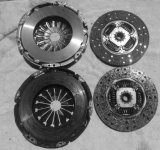
5. The shifter fork seems OK, which is good because the Aisin kit only came with the disc, the diaphragm, the two bearings, and the alignment tool.

6. It might be important to note that, with the engine jacked up a bit (I wasn't sure if I needed to support the engine), the engine seems off kilter to the pressure plate for some reason where the photo below is before I removed the pressure plate and there's definitely an alignment issue.

I did confirm beyond any doubt that the original disc has the springs that stick out most aimed toward the pressure plate.

The main most important question is what happens if I don't remove the flywheel and get it replaced or machined?
 

Attachments

  • sticking02.jpg
    sticking02.jpg
    41 KB · Views: 330
  • sticking03.jpg
    sticking03.jpg
    31.9 KB · Views: 321
  • sticking04.jpg
    sticking04.jpg
    72.4 KB · Views: 333
  • sticking05.jpg
    sticking05.jpg
    54 KB · Views: 319
  • sticking06.jpg
    sticking06.jpg
    71.9 KB · Views: 325
  • sticking07.jpg
    sticking07.jpg
    39.6 KB · Views: 317
I have a couple more questions which, I think I would know had I done this job before, where the flywheel is the most important question.

1. The most important question is:
Please take a look at the flywheel photos below. How do I know if it needs to be machined or replaced? (I have measuring tools but I don't have the thickness spec.)

2. The next most important question is where's the oil seal? I suspect it's BEHIND the flywheel. Just so you know, those 14mm 12-point flywheel bolts are on TIGHT. I jammed a screwdriver in the flywheel teeth to immobilize it so I could spin the bolts off, but I only have 12-point chrome 3/8" sockets, as my 1/2 inch black sockets are 6 point. I'm sure I can break them, but do I need to? How do I know?

3. Less important than those two questions is where is the pilot bearing? I suspect it is behind the throwout bearing?

4. Even less important is the observation that in all my prying last night, I seem to have bent the 1/8th inch metal plate between the engine and the flywheel. I don't think it will matter though.

5. The shifter fork seems OK, which is good because the Aisin kit only came with the disc, the diaphragm, the two bearings, and the alignment tool.

6. It might be important to note that, with the engine jacked up a bit (I wasn't sure if I needed to support the engine), the engine seems off kilter to the pressure plate for some reason where the photo below is before I removed the pressure plate and there's definitely an alignment issue.

I did confirm beyond any doubt that the original disc has the springs that stick out most aimed toward the pressure plate.

The main most important question is what happens if I don't remove the flywheel and get it replaced or machined?
My answers/opinions:

1. You should basically always machine or replace the flywheel when doing the clutch. The only time I wouldn't is if there was an early failure with some part of the clutch/pressure plate that didn't damage the flywheel. The colors you see on the flywheel is heat damage that needs to be taken care of before a new clutch is installed.

2. The rear main is behind the flywheel, of course. To replace it, you need to remove the flywheel. The flywheel bolts may have loctite or thread sealant helping to keep them in place. If you immobilize the flywheel, you should be able to use the 12-point socket you have. Check the manual to see if you should be getting new flywheel bolts (they may be one-time use bolts). Also check if you need loctite or thread sealant on the bolts when installing them.

3. The pilot bearing is right there on the center of the flywheel. Visible in at least 2 of the photos.

5. Shifter fork is not considered a wear item. Clean it, grease the pivot points and reuse.

-Charlie

PS. Everyone welcome back mom/foo
 
Hey, glad to see you got it out. It's often the dumb little things that get us.
1- Get it machined. Don't worry about the flywheel being too worn down at all. Unless the clutch disk was so bad that it was really damaging the flywheel, it's got plenty of material to resurface.
2- Which oil seal? The rear main seal is behind the flywheel. I've read on here that guys have had issues with leaks after they replace them, so some guys like to just not mess with them if they aren't leaking. I can't remember exactly what the deal is, but I think Toyota only sells the rear main seal with the seal housing, which opens the door for another potential leak spot. I used an aftermarket seal, didn't touch the housing, and have no leaks. As always, YMMV.
3- The pilot bearing is in the bearing pocket at the end of the crank. It's on the engine, not the transmission. The throwout bearing is on the transmission.
4- Straighten it as best as you can, and send it. If there is a spot bad enough that it causes your trans to not mate perfectly to your engine, I would address that. Either use a flap wheel to gently clean up the high spots, or just replace the plate all together. I doubt that will be needed, and am confident you can straighten it out with a hammer and some creativity just fine.
5- You must be referring to the clutch fork; the shift forks are internal to the trans, and ride on the synchros. There was a post where a guy had the fork bend in half, but I have to think there was something else wrong that caused it to fail. Under normal clutch operating conditions, I do not believe you shouldn't have to replace that fork. Maybe someone can chime in and let us know otherwise.
6- What do you mean "off kilter"?

Finally- I don't know.
This is my best guess- if you don't get it machined, it will not be optimal for the performance and longevity of your clutch. By that, I mean the material that would get taken off the flywheel- during machining- could cause the clutch disc to not be able to "bed in" properly, and not allow optimal grabbing. I believe it could also cause the clutch to potentially not operate smoothly- think "warped rotor" effect. Again, this is my best guess, and I'm sure the clutch would work just fine if you don't machine it- but "fine" is not the same as optimally.

Edit- Charlie got in first, and made a good point about lubricating the contact points of the clutch fork. With that, don't get crazy with the lube around your fresh clutch [emoji6]
 
Last edited:

Members online

Forum statistics

Threads
278,309
Messages
3,554,071
Members
248,016
Latest member
Advally Service

Trending content

Back
Top