NoDak
Senior Member
The landmark Trans Pacific Partnership trade agreement got signed today and it could mean the end of the most restrictive tariff in the American auto industry. But it’s only the start of a difficult and secretive process.
I am talking about the Chicken Tax, implemented by LBJ as some cold-as-ice revenge on France and Germany back in the ‘60s. France and Germany had the nerve to put a tariff on American chickens going into their countries, so LBJ and the UAW’s Walter Reuther hit them with a 25% import duty on potato starch, dextrin, brandy, and small pickups.
**** with our chickens and we shut down the sales of your Volkswagen Microbus, we told the world.
But that was half a century ago. In the meantime, the Chicken Tax has done much more to mess with the American auto market than anything else. Automotive News, interviewing former head of Hyundai in the U.S. John Krafcik, explains how the tax helped dumb down this country’s biggest car segment.
To sell a pickup truck in America while avoiding the Chicken Tax, a truck has to be built in the America, too. And for a foreign carmaker, that means building a new factory to build the truck. That’s not cheap. Krafcik puts the cost in the billions. With such a big investment, the foreign carmaker has to be sure it can recoup that initial cost, and that means they play things safe and avoid risk. So they invariably choose to build full-size trucks, as full-size trucks are the most common, profitable trucks in the U.S. They are the safest bet.
Krafcik elaborated, stating, “I think what is lost the most is low-volume experimentation and innovation in pickups. As soon as you get to that level of investment, the risks become so great that the solutions become fairly mainstream.”
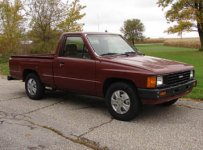
That’s what Nissan did when they redoubled their efforts in the American truck market with the Titan, that’s what Toyota did with the Tundra. Both companies had made names for themselves in the U.S. with little trucks like the HiLux and the Datsun King Cab.
So you can see that the Chicken Tax has had two key influences in the U.S.: it has kept foreign truckmakers who build exclusively small trucks from importing into the U.S., and it has encouraged those companies that do actually build trucks in the U.S. to keep them large, and simple, and unadventurous.
And now the Trans Pacific Partnership may do away with all of that.
As the New York Times reported today, one of the final sticking points of the agreement was “a slow phaseout—-over two to three decades—of the tariffs on Japan’s autos sold in North America.”
In another article published today, Automotive News also noted that “the deal includes provisions to eliminate U.S. import tariffs of 2.5 percent on cars and 25 percent on trucks” from Japan, again with a two-decade timeframe. AN went further, explaining that there was a push to allow foreign carmakers building cars and trucks in the U.S. to source more parts from back home in Asia without incurring the 25% tariff. That would again make life easier for anyone wanting to get a small, imported truck into the U.S.
The trouble is we don’t know the specific wording of the partnership because it’s secret. So we don’t know if the Chicken Tax will only get cut for states that have signed on to the partnership or not. If that’s the case we’re still left with a big hole in the range of trucks we could get. We’re still leaving out all kinds of weird little trucks from even smaller markets. The European truck market, home of the VW Amarok, would get left off, for instance. Even worse, we’d miss out on tiny compact El Camino-esque trucklets like the Chevrolet Montana, based off of an old Opel and built in Brazil and South Africa.
Uruguay gets the Montana and America does not! It’s madness.
Surprisingly, not even all Asian trucks would get a break in a deal only involving members of the Trans Pacific Partnership. Thailand has not signed on, and their truck production is staggering. They build the Ford Ranger, the related Mazda BT-50, the Mitsubishi Triton, and the Toyota HiLux. Not that any of those trucks are really small. The HiLux is actually longer and taller than the Tacoma.
And even if all of these vehicles were suddenly allowed entry into the U.S. without a 25% tariff, they’d still have to comply with the America’s unique emissions and safety requirements. Ask Volkswagen’s diesel department if you’re wondering how much of a hurdle that can be for success in the U.S.
So this might be the end of the Chicken Tax. It’s just probably a bit more complicated than Obama signing a lease on a new Ford Ranger tomorrow.
original article : The Trans Pacific Partnership Is A First Step To Cheap, Small Pickups In The U.S.
I am talking about the Chicken Tax, implemented by LBJ as some cold-as-ice revenge on France and Germany back in the ‘60s. France and Germany had the nerve to put a tariff on American chickens going into their countries, so LBJ and the UAW’s Walter Reuther hit them with a 25% import duty on potato starch, dextrin, brandy, and small pickups.
**** with our chickens and we shut down the sales of your Volkswagen Microbus, we told the world.
But that was half a century ago. In the meantime, the Chicken Tax has done much more to mess with the American auto market than anything else. Automotive News, interviewing former head of Hyundai in the U.S. John Krafcik, explains how the tax helped dumb down this country’s biggest car segment.
To sell a pickup truck in America while avoiding the Chicken Tax, a truck has to be built in the America, too. And for a foreign carmaker, that means building a new factory to build the truck. That’s not cheap. Krafcik puts the cost in the billions. With such a big investment, the foreign carmaker has to be sure it can recoup that initial cost, and that means they play things safe and avoid risk. So they invariably choose to build full-size trucks, as full-size trucks are the most common, profitable trucks in the U.S. They are the safest bet.
Krafcik elaborated, stating, “I think what is lost the most is low-volume experimentation and innovation in pickups. As soon as you get to that level of investment, the risks become so great that the solutions become fairly mainstream.”
That’s what Nissan did when they redoubled their efforts in the American truck market with the Titan, that’s what Toyota did with the Tundra. Both companies had made names for themselves in the U.S. with little trucks like the HiLux and the Datsun King Cab.
So you can see that the Chicken Tax has had two key influences in the U.S.: it has kept foreign truckmakers who build exclusively small trucks from importing into the U.S., and it has encouraged those companies that do actually build trucks in the U.S. to keep them large, and simple, and unadventurous.
And now the Trans Pacific Partnership may do away with all of that.
As the New York Times reported today, one of the final sticking points of the agreement was “a slow phaseout—-over two to three decades—of the tariffs on Japan’s autos sold in North America.”
In another article published today, Automotive News also noted that “the deal includes provisions to eliminate U.S. import tariffs of 2.5 percent on cars and 25 percent on trucks” from Japan, again with a two-decade timeframe. AN went further, explaining that there was a push to allow foreign carmakers building cars and trucks in the U.S. to source more parts from back home in Asia without incurring the 25% tariff. That would again make life easier for anyone wanting to get a small, imported truck into the U.S.
The trouble is we don’t know the specific wording of the partnership because it’s secret. So we don’t know if the Chicken Tax will only get cut for states that have signed on to the partnership or not. If that’s the case we’re still left with a big hole in the range of trucks we could get. We’re still leaving out all kinds of weird little trucks from even smaller markets. The European truck market, home of the VW Amarok, would get left off, for instance. Even worse, we’d miss out on tiny compact El Camino-esque trucklets like the Chevrolet Montana, based off of an old Opel and built in Brazil and South Africa.
Uruguay gets the Montana and America does not! It’s madness.
Surprisingly, not even all Asian trucks would get a break in a deal only involving members of the Trans Pacific Partnership. Thailand has not signed on, and their truck production is staggering. They build the Ford Ranger, the related Mazda BT-50, the Mitsubishi Triton, and the Toyota HiLux. Not that any of those trucks are really small. The HiLux is actually longer and taller than the Tacoma.
And even if all of these vehicles were suddenly allowed entry into the U.S. without a 25% tariff, they’d still have to comply with the America’s unique emissions and safety requirements. Ask Volkswagen’s diesel department if you’re wondering how much of a hurdle that can be for success in the U.S.
So this might be the end of the Chicken Tax. It’s just probably a bit more complicated than Obama signing a lease on a new Ford Ranger tomorrow.
original article : The Trans Pacific Partnership Is A First Step To Cheap, Small Pickups In The U.S.


 )
)