Transmission Temperature Spikes

I installed a Hayden 679 bypass. only time i saw it get close to 200 was when I was wheeling slow steep grade in 4 high. Normally I would be in 4 lo for that. I wanted to see How it handled it. even when it got that high it quickly came down to 170-180 ish.

With that big cooler and bypassing the radiator cooler, what kind of temps are you running in colder weather? Now, I know San Diego doesn't get all that cold but I'm curious what kind of numbers you're seeing in the winter. I know these coolers have a thermal bypass which lets the thicker cold fluid run straight through the cooler and back to the transmission until the fluid warms up and thins out to run through the cooling channels of the cooler. But, I wonder how effective the thermal bypass is.

Running a cooler in-series helps in colder weather bring the fluid to an optimum temp because the radiator trans cooler is bathed in the radiator coolant which is at 180-190 degrees. ATF has an optimum operating temp around 170 degrees. It actually isn't good to run way under the optimum temp range all the time. The reason why you feel hard shifts when the trans is cold is because the fluid is thick and not lubricating as well as it would when it's at operating temps. Also, low consistent temps in the trans can allow moisture to accumulate in the trans which isn't good.

Even with my smaller B&M 70264 cooler ran in-series with the radiator cooler, I quite often see relatively low temps, 130s-140s doing mellow around town driving. It's not until I get on the highway for a longer trip or drive in the mountains that I see my trans temp get into a more optimum temp range. So, I'm really curious what temps you're running with your set-up. If you've driven your rig to the mountains with snow on the ground, what kind of temps have you seen then? I'd like to hear from [MENTION=95040]Cree[/MENTION] too since he's running the same set-up.
 
Last edited:
With that big cooler and bypassing the radiator cooler, what kind of temps are you running in colder weather? Now, I know San Diego doesn't get all that cold but I'm curious what kind of numbers you're seeing in the winter. I know these coolers have a thermal bypass which lets the thicker cold fluid run straight through the cooler and back to the transmission until the fluid warms up and thins out to run through the cooling channels of the cooler. But, I wonder how effective the thermal bypass is.

Running a cooler in-series helps in colder weather bring the fluid to an optimum temp because the radiator trans cooler is bathed in the radiator coolant which is at 180-190 degrees. ATF has an optimum operating temp around 170 degrees. It actually isn't good to run way under the optimum temp range all the time. The reason why you feel hard shifts when the trans is cold is because the fluid is thick and not lubricating as well as it would when it's at operating temps. Also, low consistent temps in the trans can allow moisture to accumulate in the trans which isn't good.

Even with my smaller B&M 70264 cooler ran in-series with the radiator cooler, I quite often see relatively low temps, 130s-140s doing mellow around town driving. It's not until I get on the highway for a longer trip or drive in the mountains that I see my trans temp get into a more optimum temp range. So, I'm really curious what temps you're running with your set-up. If you've driven your rig to the mountains with snow on the ground, what kind of temps have you seen then? I'd like to hear from [MENTION=95040]Cree[/MENTION] too since he's running the same set-up.


I have not been up to colder climates with it yet, or the snow.

Initially when I installed it I ran it in series, did a ton of research on it and thought it was the better way to go.
After install I had the truck into a shop for major engine work (Toytoa specialist), the ran it in bypass when putting the engine back together. Said it was leaking from the fitting. I asked about it running too cold and they said we don't live in a cold enough climate to worry about it.

All the points you bring up make alot of sense. I agree and have the same temps.. quick around town it really doesn't warm up 130-140 ish. even with freeway driving/non demanding it will be 150-165.
I don't have hard shifts, actually way better than before the cooler.


Really I only go to the mountains/snow 1 time a year if I'm lucky. that may change in the future as my kids get older.

you think having thicker/colder fluid will effect MPG?
 
With that big cooler and bypassing the radiator cooler, what kind of temps are you running in colder weather? Now, I know San Diego doesn't get all that cold but I'm curious what kind of numbers you're seeing in the winter. I know these coolers have a thermal bypass which lets the thicker cold fluid run straight through the cooler and back to the transmission until the fluid warms up and thins out to run through the cooling channels of the cooler. But, I wonder how effective the thermal bypass is.

Running a cooler in-series helps in colder weather bring the fluid to an optimum temp because the radiator trans cooler is bathed in the radiator coolant which is at 180-190 degrees. ATF has an optimum operating temp around 170 degrees. It actually isn't good to run way under the optimum temp range all the time. The reason why you feel hard shifts when the trans is cold is because the fluid is thick and not lubricating as well as it would when it's at operating temps. Also, low consistent temps in the trans can allow moisture to accumulate in the trans which isn't good.

Even with my smaller B&M 70264 cooler ran in-series with the radiator cooler, I quite often see relatively low temps, 130s-140s doing mellow around town driving. It's not until I get on the highway for a longer trip or drive in the mountains that I see my trans temp get into a more optimum temp range. So, I'm really curious what temps you're running with your set-up. If you've driven your rig to the mountains with snow on the ground, what kind of temps have you seen then? I'd like to hear from [MENTION=95040]Cree[/MENTION] too since he's running the same set-up.


I wonder if Toyota has published Min and Max operating temps for the Transmission.

I was reading up on a Jeep forum and for the JK they are saying the min operating temp is 80.
Obviously each vehicle is different. and Toyota wants it higher than that if it comes from the factory connected to the radiator.
 
I wonder if Toyota has published Min and Max operating temps for the Transmission.
They may, but easily accessed information says this (checking trans fluid level in the FSM):

Code:
10. AUTOMATIC TRANSMISSION FLUID LEVEL
(a) Park the vehicle on a level surface.
(b) With the engine idling and the parking brake applied, shift the selector
into all positions from ”P” to ”L”, and then shift into ”P” position.
(c) Pull out the dipstick and wipe off the fluid with a clean rag. 
Re−insert the dipstick and check that the fluid level is in the HOT range.
(d) Do this check with the fluid at normal driving temperature (70−80°C, 158−176°F).

HINT:
Wait until the engine cools down (approx. 30 min.) before 
checking the fluid level after extended driving at high speeds, 
in hot weather, in heavy traffic or pulling a trailer.

So, normal (I'd read that as 'ideal') operating temperatures are 70-80*C / 158-176*F.

Also of note - the coolant temperatures at the bottom of the radiator should be well below normal operating temps of the engine. I'd guess generally ~20*F or more cooler than the engine. Otherwise, the thermostat wouldn't have any 'cool' water to use to cool the engine - and the thermostat generally isn't open all the way.

-Charlie
 
I have not been up to colder climates with it yet, or the snow.

Initially when I installed it I ran it in series, did a ton of research on it and thought it was the better way to go.
After install I had the truck into a shop for major engine work (Toytoa specialist), the ran it in bypass when putting the engine back together. Said it was leaking from the fitting. I asked about it running too cold and they said we don't live in a cold enough climate to worry about it.

All the points you bring up make alot of sense. I agree and have the same temps.. quick around town it really doesn't warm up 130-140 ish. even with freeway driving/non demanding it will be 150-165.
I don't have hard shifts, actually way better than before the cooler.


Really I only go to the mountains/snow 1 time a year if I'm lucky. that may change in the future as my kids get older.

you think having thicker/colder fluid will effect MPG?

Would thicker fluid affect gas mileage? Maybe I guess. I'm not so much worried about gas mileage as much as having the trans fluid at an ideal temp to properly lubricate the trans.
 
Yeah I know it's off for sure. When towing it very easy to tell if its on or off. Tranny temps go up fast if OD is on, dash light is showing. RPM's are high, 3000-3500 and sometimes past 4000 when I'm struggling on the really steep inclines. This is even with my supercharger. I hate how much I have to push the engine to maintain any respectable speed on the roads when towing. I've started to look at 4th gen 4.7 V8, but I can't bring myself to buying another vehicle for the soul purpose of towing. I can't bare to get rid of my 3rd gen since I've dumped so much money into it. Other than the slow crawling high tranny temps and crappy towing, I love this runner.
if you're going to be towing that weight consistently, get the v8 4runner. save your 3rd gen for playing.


just for reference sake, this is the cooler I ended up putting on my v8 truck. its HUGE, but keeps the trans cool in all conditions. its rated at 45,000 BTU's, and 40,000 GVW. I installed mine with the thermal bypass, since I use the truck quite often for snow wheeling. could be an upgrade for you, if you insist on making the 3rd gen work for towing...


https://smile.amazon.com/gp/product/B00803CTDA/ref=ppx_yo_dt_b_search_asin_title?ie=UTF8&psc=1
 
With that big cooler and bypassing the radiator cooler, what kind of temps are you running in colder weather? Now, I know San Diego doesn't get all that cold but I'm curious what kind of numbers you're seeing in the winter. I know these coolers have a thermal bypass which lets the thicker cold fluid run straight through the cooler and back to the transmission until the fluid warms up and thins out to run through the cooling channels of the cooler. But, I wonder how effective the thermal bypass is.

Running a cooler in-series helps in colder weather bring the fluid to an optimum temp because the radiator trans cooler is bathed in the radiator coolant which is at 180-190 degrees. ATF has an optimum operating temp around 170 degrees. It actually isn't good to run way under the optimum temp range all the time. The reason why you feel hard shifts when the trans is cold is because the fluid is thick and not lubricating as well as it would when it's at operating temps. Also, low consistent temps in the trans can allow moisture to accumulate in the trans which isn't good.

Even with my smaller B&M 70264 cooler ran in-series with the radiator cooler, I quite often see relatively low temps, 130s-140s doing mellow around town driving. It's not until I get on the highway for a longer trip or drive in the mountains that I see my trans temp get into a more optimum temp range. So, I'm really curious what temps you're running with your set-up. If you've driven your rig to the mountains with snow on the ground, what kind of temps have you seen then? I'd like to hear from [MENTION=95040]Cree[/MENTION] too since he's running the same set-up.

I don't have that data yet. We've had a few 60 degree mornings since install. It popped up to 120/130 fairly quick and topped out around 140 on my 10 mile drive to work. 2 stop lights, no hills.

Im going to bet that I'll have to do the old cardboard trick in the winter here. BUT. I would much rather do that then have it hot. I've thought about making a bypass back to the radiator for the winter time, but more likely is if it's that big of a problem I'll swap to the 699 since it's internally bypassed. Had I known Id see the drops I did I might've done that from the start.

I also think it drives and shifts better than before the install.
 
Swap out for a bigger cooler. Bigger is always better unless you live a in a climate with brutally cold winters (may not reach optimum running temp).

The Tru Cool 4490 is bigger with a BTU rating of 22,000 and has a cold bypass system to help fluid warm up quicker on cold starts. The B&M 70264 transmission cooler only has a BTU rating of 14,400, that's an increase of over 50% more cooling capacity. Your overheating issues will be over.

And use 4LO when you can.

Yeah that's what I'm thinking, go up in size or get another one that will double my capacity.

if you're going to be towing that weight consistently, get the v8 4runner. save your 3rd gen for playing.


just for reference sake, this is the cooler I ended up putting on my v8 truck. its HUGE, but keeps the trans cool in all conditions. its rated at 45,000 BTU's, and 40,000 GVW. I installed mine with the thermal bypass, since I use the truck quite often for snow wheeling. could be an upgrade for you, if you insist on making the 3rd gen work for towing...


https://smile.amazon.com/gp/product/B00803CTDA/ref=ppx_yo_dt_b_search_asin_title?ie=UTF8&psc=1


I'm seriously considering the 4.7 4th gen and keeping it basically bone stock. I dont think my 3rd gen will ever tow comfortably. I never really intended to tow anything with it so I set it up for more of an overland vehicle. The pop-up trailer is great to have for trips that the fam doesn't venture too far from the pavement. In the mean time, maybe I'll make a few adjustments to see if I can get my temperatures down a bit.

Thanks for the link, I'm thinking regardless I need to go up in size or get another one like I have already.
 
Would thicker fluid affect gas mileage? Maybe I guess. I'm not so much worried about gas mileage as much as having the trans fluid at an ideal temp to properly lubricate the trans.

I can answer the opposite question, does any thinner fluid increase gas mileage on a 4Runner? The definitive answer to that is no, been there done that. I can't imagine thicker would affect it much the other direction, if at all.

I honestly think that 3rd Gen's just were not made to tow anything of significant weight. Yeah, it has a tow rating of up to 5,000 lbs depending on the year and engine size but with a narrow wheelbase and only weighing 3950 dry (Toyota's published number anyway) it's just not that great at it. A V8 4Runner not only have more power but also more weight which makes a difference when towing but even that can't compare to a Tundra of similar year or something entirely different like an F-150. If you find yourself towing more than a utility trailer on a consistent basis, it might be time for a more dedicated vehicle that does it well.
 
I honestly think that 3rd Gen's just were not made to tow anything of significant weight. Yeah, it has a tow rating of up to 5,000 lbs depending on the year and engine size but with a narrow wheelbase and only weighing 3950 dry (Toyota's published number anyway) it's just not that great at it. A V8 4Runner not only have more power but also more weight which makes a difference when towing but even that can't compare to a Tundra of similar year or something entirely different like an F-150. If you find yourself towing more than a utility trailer on a consistent basis, it might be time for a more dedicated vehicle that does it well.

I'm looking at the 05-09 4.7 runners right now. I'm wondering how much the difference will be with my 3rd gen supercharged runner with 2.2 pulley vs the stock 4.7 v8? I know that my tires and extra weight certainly kill some power. I would hope there is a significant difference, especially if I kept the 4th gen completely stock. Like I said in the past, this popup loaded shouldn't be more than 3000-3300 pounds. Thankfully the popup has electric brakes and I'll installed a brake controller. Really helps with braking. The 3rd gen doesn't feel like it gets thrown around too much with this load, just lack of power on steeper inclines.

Maybe I'll install a bigger cooler for the 3rd gen and see if that helps with slow speed off roading in combination with using 4lo more.
 
You can also switch out your fluid in the fan clutch to make it draw more air. Never done it, just know it's common in LC 80 forums.
 
I'm looking at the 05-09 4.7 runners right now. I'm wondering how much the difference will be with my 3rd gen supercharged runner with 2.2 pulley vs the stock 4.7 v8? I know that my tires and extra weight certainly kill some power. I would hope there is a significant difference, especially if I kept the 4th gen completely stock. Like I said in the past, this popup loaded shouldn't be more than 3000-3300 pounds. Thankfully the popup has electric brakes and I'll installed a brake controller. Really helps with braking. The 3rd gen doesn't feel like it gets thrown around too much with this load, just lack of power on steeper inclines.

Maybe I'll install a bigger cooler for the 3rd gen and see if that helps with slow speed off roading in combination with using 4lo more.

Oh, I forgot you are supercharged. Bigger tires make towing very cumbersome though for sure, I bet even being supercharged you have only a slight amount more rear wheel torque than a stock 4Runner with factory tires sizes. Gearing really would make a difference for you if you wanted to go that route. Trailer brakes really do make a difference too, the stopping part can be very scary in a 4Runner without even towing anything! The brakes definitely have room for improvement.

A V8 4Runner has a towing capacity of up to 7,300 pounds. It's a heavier vehicle too by over 500 lbs, which makes a difference since it will be less likely to sway like the lighter 3rd Gens and also has a wider wheelbase than a 3rd Gen. There is some improvement in the power dept though since a V8 4Runner makes more power as a stock pulley supercharged 5VZ-FE and has more torque. Really up to you though since it does have a different look and feel than a 3rd gen.
 
Oh, I forgot you are supercharged. Bigger tires make towing very cumbersome though for sure, I bet even being supercharged you have only a slight amount more rear wheel torque than a stock 4Runner with factory tires sizes. Gearing really would make a difference for you if you wanted to go that route. Trailer brakes really do make a difference too, the stopping part can be very scary in a 4Runner without even towing anything! The brakes definitely have room for improvement.

A V8 4Runner has a towing capacity of up to 7,300 pounds. It's a heavier vehicle too by over 500 lbs, which makes a difference since it will be less likely to sway like the lighter 3rd Gens and also has a wider wheelbase than a 3rd Gen. There is some improvement in the power dept though since a V8 4Runner makes more power as a stock pulley supercharged 5VZ-FE and has more torque. Really up to you though since it does have a different look and feel than a 3rd gen.

Yeah I'm geared at 4.88. I mean it's not the worst towing right now, but certainly steep inclines just kill it. Having to really get into it, really high rpms. I've also read that the torque curve on the 4.7 is much different than the 3.4. I dont mind the look and feel of the 4th. I wouldnt get rid of my 3rd gen. Could use the 4th for towing, 3rd gen for offroad overland/crawling, and my scion for daily driving. 3rd and 4th gens wouldnt have a lot of miles put on them either. As is, I'm looking at towing once or twice a month for camping trips, ranging from 400-600 mile round trips with doing some trips to California or surround states from Utah. The more I think about it, the less I see the 3rd gen towing that far.
 
I'm looking at the 05-09 4.7 runners right now. I'm wondering how much the difference will be with my 3rd gen supercharged runner with 2.2 pulley vs the stock 4.7 v8? I know that my tires and extra weight certainly kill some power. I would hope there is a significant difference, especially if I kept the 4th gen completely stock. Like I said in the past, this popup loaded shouldn't be more than 3000-3300 pounds. Thankfully the popup has electric brakes and I'll installed a brake controller. Really helps with braking. The 3rd gen doesn't feel like it gets thrown around too much with this load, just lack of power on steeper inclines.

Maybe I'll install a bigger cooler for the 3rd gen and see if that helps with slow speed off roading in combination with using 4lo more.
what kind of power does a blown 3.4 make? the 06+ 4.7 all stock makes about 330ft/lbs. I cant think the 3.4 comes anywhere near that.


edit: a quick search found this.

My best dyno run supercharged without any fuel mods is
225 HP
238 TQ

so yeah, 100ft/lbs you will notice that.
 
Last edited:
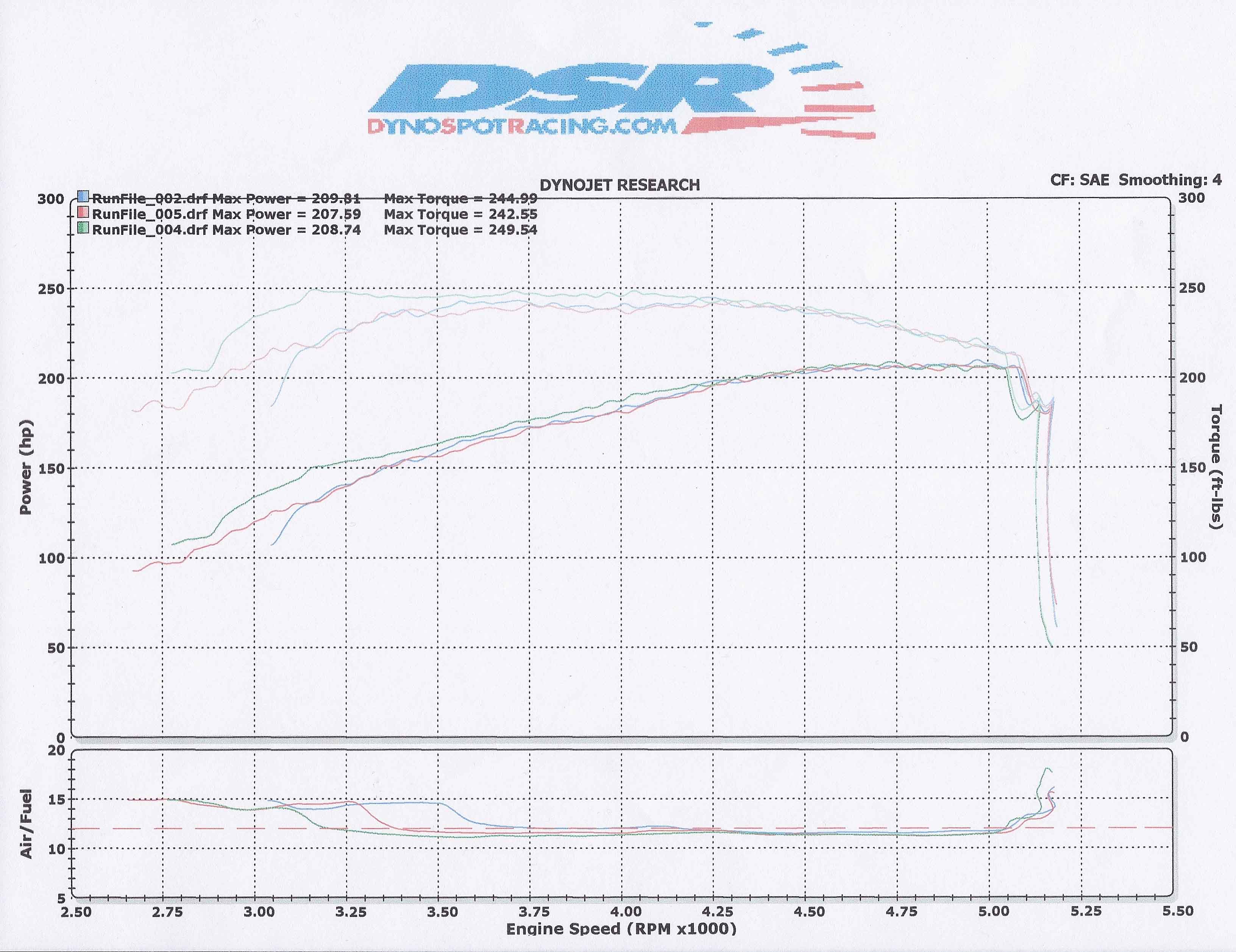
Some very sloppy comparisons. Surprisingly, the V8 doesn't make all that much more torque than a well tuned S/C V6 3rd gen. So maybe you wouldn't see a huge difference.

V8 4th Gen (with aFe intake)

54-82502_dc.1549668301.jpg


Supercharged 3rd Gen (with 7th injector):

93583d1375235803-2001-4runner-supercharged-w-trd-7th-injector-kit-dyno-dyno.jpg
 
Some very sloppy comparisons. Surprisingly, the V8 doesn't make all that much more torque than a well tuned S/C V6 3rd gen. So maybe you wouldn't see a huge difference.

V8 4th Gen (with aFe intake)

54-82502_dc.1549668301.jpg


Supercharged 3rd Gen (with 7th injector):

93583d1375235803-2001-4runner-supercharged-w-trd-7th-injector-kit-dyno-dyno.jpg

Hmm thats quite a bit off from what stock numbers are. Can it really be that low? I see that isn't for the 4th gen, but it is the 4.7 V8. I wonder if there are differences. Also I'm curious what the 4th gen runs as far as cooling for the tranny. I thought I saw a picture of an external transmission cooler, but I need to look it up before stating anything.
 
Hmm thats quite a bit off from what stock numbers are. Can it really be that low? I see that isn't for the 4th gen, but it is the 4.7 V8. I wonder if there are differences. Also I'm curious what the 4th gen runs as far as cooling for the tranny. I thought I saw a picture of an external transmission cooler, but I need to look it up before stating anything.

Yeah they have a small external. My buddy has a 2006 with a V8. Maybe head over to the 4th gen section and see if there is anyone that can help
 
Hmm thats quite a bit off from what stock numbers are. Can it really be that low? I see that isn't for the 4th gen, but it is the 4.7 V8. I wonder if there are differences. Also I'm curious what the 4th gen runs as far as cooling for the tranny. I thought I saw a picture of an external transmission cooler, but I need to look it up before stating anything.
yes they have an auxiliary cooler.


Transmission aux cooler flow direction


I haven't done much towing with mine, but have pulled some long steep grades at speed, in the middle of summer with the AC on. using the torque app to monitor the trans temps, I barely saw 200°.


as to that dyno chart, its a bit hard to believe. ive driven a few 3rd gens with factory SC's, and they were in no way comparable to my v8 as far as power goes. it wasn't even close.
 
Hmm thats quite a bit off from what stock numbers are. Can it really be that low? I see that isn't for the 4th gen, but it is the 4.7 V8. I wonder if there are differences. Also I'm curious what the 4th gen runs as far as cooling for the tranny. I thought I saw a picture of an external transmission cooler, but I need to look it up before stating anything.
There's a big difference between power/torque at the wheels and at the engine...

-Charlie
 
That dyno is from a 7th injector TRD S/C, which adds roughly 30 RWHP & 30 RWTQ over a stock supercharger. Was trying to find something comparable to Toy2Play's engine since it's got the 2.2" pulley.

Toyota's posted max Engine torque for the V8 is 320, so 260 is about right if you factor in ~20% drivetrain loss due to the 4WD components and transmission, since the original test is done on an engine dyno, not a chassis dyno (320*0.8=256). I did see it's on a Lexus GX470, which is the 4Runner's big brother so that might be part of it, I wonder if the 4Runner's numbers are bit higher.

On another note, don't buy that aFe intake unless you can flash the ECU lol. It leans out the AFR's to over 14!
 

Members online

Forum statistics

Threads
278,312
Messages
3,554,085
Members
248,016
Latest member
Advally Service

Trending content

Back
Top