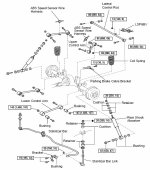
You can technically run it without a sway bar. None of my older cars had them, and some of them even handled reasonably well that way. That said, you probably want it.
A sway bar is part of your suspension that keeps the wheels in contact with the ground. As you turn a corner, the body rolls with inertia in the direction you were going prior to accelerating (a change in speed or direction) into the turn. As this happens, the down force on the inside wheels is diminished while the down force on the outside wheels in increased accordingly. Without a sway bar, this can be very pronounced to the point of the car rolling in a fast/tight turn. It's far more pronounced if there is a bump of any sort in the middle of said turn that might cause a wheel to loose additional traction (or in the case of old swing axled cars, "tuck and roll"; see "Unsafe at Any Speed" -Ralph Nader). Aside from the extreme case illustrated just above, the additional/reduced down force on a given tire can cause premature wear and squealing tires in corners.
The sway bar counteracts this tendency by linking the inside and outside wheels with a heavy spring steel linkage. As the more heavily weighted wheel is articulated up, the sway bar brings the less heavily weighted wheel up as well to a degree dictated by the amount of force transmitted through the sway bar according to its spring rate and other boring factors. By drawing the inside wheel up along with the outside wheel, instead of rolling it causes the vehicle to sort of squat and remain level and stuck to the ground.
Heavier sway bars can impart more force to the less loaded wheel, but this is done at the expense of ride quality as the stiffness of the spring links the suspension from side to side and bumps felt on one side will be transmitted to the other and amplified to some degree. A lighter sway bar will ride smoother, but at the expense of handling in corners.
Think of an old american muscle cars in corners versus a newer Porsche. The Porsche remains flat all the way through the corner (and actually gets lower to the ground, thought not really perceptibly so) while the old Mustang rolls and tires squeal and it oversteers like mad into the bushes on the side of the road. In our particular application, a car driven on the road daily is well served to have its sway bars in tact, while one limited to occasional off highway use is better served without the sway bars to allow better suspension articulation. If you, like the majority of Americans, drive only on straight highways, they may not seem as important as they do to someone like me who lives in the mountains and drives on windy, up and down, blind cornered, etc. roads every day (seriously, it's the most fun you can have behind the wheel!), however they are very important for emergency handling and would be strongly recommended.
There are sway bar linkages available on the market that allow for a quick disconnect once you've left the highway and get on the trail. I haven't seen any for 3rd gen 4Runners that don't require getting down on your hands and knees or back to disengage them, but I haven't looked too hard, it's better than nothing, and allows you to have your cake and eat it too.
To summarize, you'll run fine without them, but you're not doing yourself any favors unless you have a trail only rig. They're cheap (often removed and thrown away as they don't really break often), easy to install, and really not worth going without in my opinion save the sole application stated above.