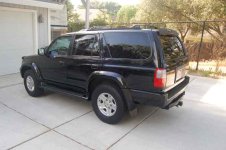
This is good info off of that site.
3. What about taller body lifts?
While a 1" body lift is considered mild, there are many folks running 2" and 3" body lifts. 3" is pretty much the maximum lift you should consider on the stock mounts. Above this and you should consider raising the mounting bracket on the frame to reduce the leverage caused by the taller blocks.
At 2" on most Toyotas, you will find that in addition to the items that a 1" lift affects, you will need to extend the hydraulic line to the clutch slave cylinder.
A stock front brake line works well for this.
At 1" the radiator shroud was probably OK as-is, but at 2", you should drop the radiator to re-center it on the fan.
Same story on the shift levers, while modifications are optional at 1", they will probably need to be done at 2" and for sure at 3"
You'll also need to let the steering shaft lengthen a bit and chances are the upper engine ground strap may need to be lengthened.
With a 1st gen. 4Runner, a 2" lift allows you to raise the gas tank 2" using the existing pickup mounting holes on the cross member.
At 3", in addition to the above items need attention as well as dealing with fuel lines at the gas tank. One option at the 3" stage is to also lift the entire drive train by a similar amount.
For example, the engine and transmission could be raised for additional break-over angle, the fuel tank could be raised, etc. This will restore many of the interference areas to their original position.
This is what I chose to do on my 4Runner and you can find out more on that project here.
Above 3" and you are asking for trouble and 4Crawler Offroad won't provide any components for that application. Best bet above 3" is to fabricate new body mount brackets raised up the desired amount and attach the body to the raised brackets without any lift blocks