Thai
Elite Member
Link:
FourWheeler Road Test of Disco II--in "The Ultimate 4x4" Test
Road Tests
Fourth Place
Land Rover long has been known for producing capable off-road vehicles. When you see pictures of folks exploring remote regions of the world where such luxuries as paved roads don’t exist, what you often see is a caravan of Land Rovers. Not until the last two decades has Land Rover gone the wine-and-cheese route and become an upscale luxury vehicle.
Lucky for us, though, Land Rover still has dirt in its blood and builds vehicles with off-road use in mind. As long as Land Rover buyers aren’t trying to outrun elephants in Africa. That’s ’cause we found that speed—speed anywhere—isn’t a Land Rover thing. We found our Disco’s suspension to be hopelessly soft in our high-speed test section. This section consists of a nasty desert road, and offers a difficult mixture of whoops, wash-outs, berms, and uneven terrain. It gives suspensions a real workout, which is exactly why we use it. The Disco did its best impression of a pogo stick on amphetamines over this section, as it would quickly blow through its travel, bottom out, and then leap skyward seemingly uncontrolled by shock rebound damping. Not helping was a set of extremely street-oriented tires that simply did not provide traction in the dirt at speed. The only solution was to slow way down and traverse the road at a very leisurely pace—which was not on the dance card for a section labeled, “high speed.”
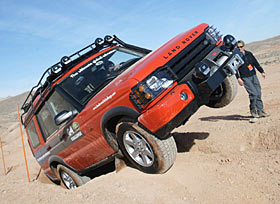
On rougher, slower trails the Disco fared better. Solid axles suspended by coils provided sufficient articulation, but more than one tester noted that the suspension was a tad soft even while creeping in low range. When articulation ran out, the Four-Wheel Electronic Traction Control (4ETC) system would kick in. This system works by detecting wheel slippage through a combination of sensors and then applies brake pressure to the wheels with the least traction, thereby transferring power to the wheels with traction. Got that? Good. Anyway, this system met mixed reviews by our judges, a bunch of picky whiners if there ever was. While it’s light-years ahead in terms of performance when compared to the other electronic traction control systems we have come across, the Disco still needed wheelspin to engage. This fact meant that the Rover would sometimes falter because the 4ETC system would do nothing until there was wheelspin—and by that time it was too late.
Another source of complaint from our judges was the power output of the 4.0L all-aluminum V-8. It produces 250 lb-ft of torque at 2,600 rpm and that was found to be sufficient. However, this device builds just 188 horsepower at 4,750 rpm, and with the Disco weighing in at 4,600 pounds, we were all left lusting for more. Yes, this is a competition, and yes, there are winners and losers. But just ’cause the Disco placed Fourth does not mean it is a bad vehicle. All of the vehicles in this test surprised us with their off-road abilities and the Discovery went everywhere the other vehicles did—though not with the same ease and aplomb. However, when compared to many of the other soccer-mom SUVs out there, the Disco will beat them silly with its off-road ability.
Check It Out If:
You need a luxo-ute that can still cruise the trails.
Forget It If:
Getting somewhere quickly is a priority.
In 25 Words or Less...
The Discovery is very comfortable, capable 4x4 that holds its own on the trail. However, it gets a little squirrely on high-speed bumps. —Michael Rudd
Rather odd but very sophisticated with its mix of beam axles and traction control. Too heavy, though, and not enough front suspension. —Jon Thompson
Lots of attention paid to creature comforts and less paid to off-pavement abilities. More at home in Beverly Hills than on the trail. —Trent Riddle
What hurt the Land Rover the most was its horrid high-speed handling. That, and not near-enough horsepower. —Craig Perronne
FourWheeler Road Test of Disco II--in "The Ultimate 4x4" Test
Road Tests
Fourth Place
Land Rover long has been known for producing capable off-road vehicles. When you see pictures of folks exploring remote regions of the world where such luxuries as paved roads don’t exist, what you often see is a caravan of Land Rovers. Not until the last two decades has Land Rover gone the wine-and-cheese route and become an upscale luxury vehicle.
Lucky for us, though, Land Rover still has dirt in its blood and builds vehicles with off-road use in mind. As long as Land Rover buyers aren’t trying to outrun elephants in Africa. That’s ’cause we found that speed—speed anywhere—isn’t a Land Rover thing. We found our Disco’s suspension to be hopelessly soft in our high-speed test section. This section consists of a nasty desert road, and offers a difficult mixture of whoops, wash-outs, berms, and uneven terrain. It gives suspensions a real workout, which is exactly why we use it. The Disco did its best impression of a pogo stick on amphetamines over this section, as it would quickly blow through its travel, bottom out, and then leap skyward seemingly uncontrolled by shock rebound damping. Not helping was a set of extremely street-oriented tires that simply did not provide traction in the dirt at speed. The only solution was to slow way down and traverse the road at a very leisurely pace—which was not on the dance card for a section labeled, “high speed.”
On rougher, slower trails the Disco fared better. Solid axles suspended by coils provided sufficient articulation, but more than one tester noted that the suspension was a tad soft even while creeping in low range. When articulation ran out, the Four-Wheel Electronic Traction Control (4ETC) system would kick in. This system works by detecting wheel slippage through a combination of sensors and then applies brake pressure to the wheels with the least traction, thereby transferring power to the wheels with traction. Got that? Good. Anyway, this system met mixed reviews by our judges, a bunch of picky whiners if there ever was. While it’s light-years ahead in terms of performance when compared to the other electronic traction control systems we have come across, the Disco still needed wheelspin to engage. This fact meant that the Rover would sometimes falter because the 4ETC system would do nothing until there was wheelspin—and by that time it was too late.
Another source of complaint from our judges was the power output of the 4.0L all-aluminum V-8. It produces 250 lb-ft of torque at 2,600 rpm and that was found to be sufficient. However, this device builds just 188 horsepower at 4,750 rpm, and with the Disco weighing in at 4,600 pounds, we were all left lusting for more. Yes, this is a competition, and yes, there are winners and losers. But just ’cause the Disco placed Fourth does not mean it is a bad vehicle. All of the vehicles in this test surprised us with their off-road abilities and the Discovery went everywhere the other vehicles did—though not with the same ease and aplomb. However, when compared to many of the other soccer-mom SUVs out there, the Disco will beat them silly with its off-road ability.
Check It Out If:
You need a luxo-ute that can still cruise the trails.
Forget It If:
Getting somewhere quickly is a priority.
In 25 Words or Less...
The Discovery is very comfortable, capable 4x4 that holds its own on the trail. However, it gets a little squirrely on high-speed bumps. —Michael Rudd
Rather odd but very sophisticated with its mix of beam axles and traction control. Too heavy, though, and not enough front suspension. —Jon Thompson
Lots of attention paid to creature comforts and less paid to off-pavement abilities. More at home in Beverly Hills than on the trail. —Trent Riddle
What hurt the Land Rover the most was its horrid high-speed handling. That, and not near-enough horsepower. —Craig Perronne


 However, "bits and pieces" of a Ford Explorer powered by a Peugeot engine does not sound very appealing to me