2004 Toyota Sienna

Thai

Elite Member
2004 Toyota Sienna (Finally!)

Hey all,

Here is the scoop so far on this redesigned Toyota minivan...looks to be the size of the Honda minivan:

3 models CE/LE/XLE
CE & LE have 7 or 8 passenger model

LE & XLE have AWD Option (7 Models)

XLE model has power back door like lincoln navigator

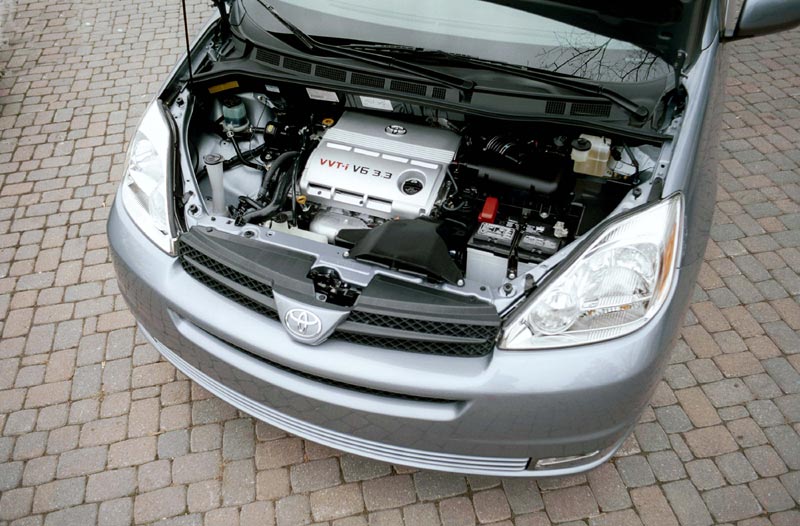
Engine is 3.3 litre, 6 cylinder DOHC 24 valve (all models): around 230-240 HP

Possible 5-speed automatic transmission

XLE has front/rear curtain airbags, along with VSC

XLE has power flip out rear windows and power roll down side windows

AWD option on LE and XLE models!

16" wheels

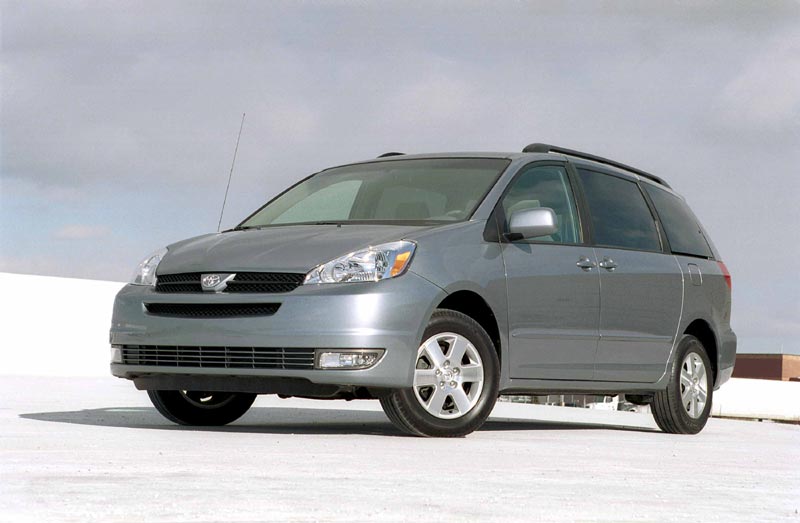
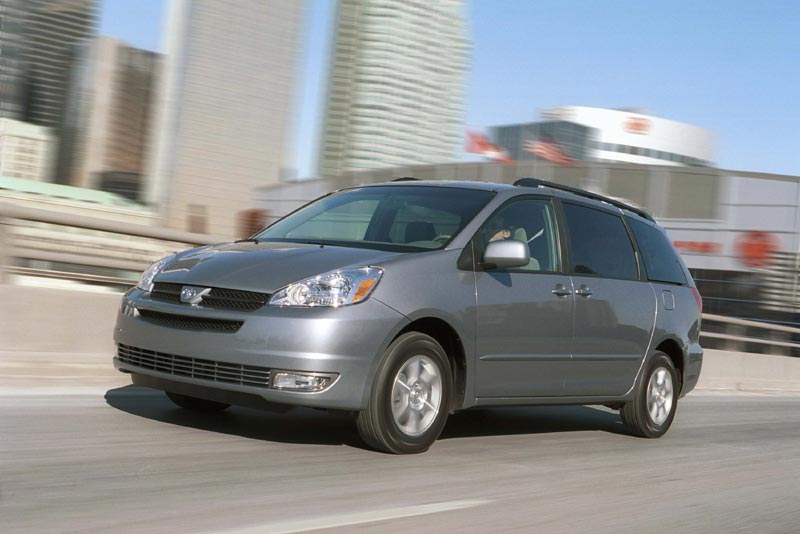
Pictures must be based on LE FWD 8 passenger

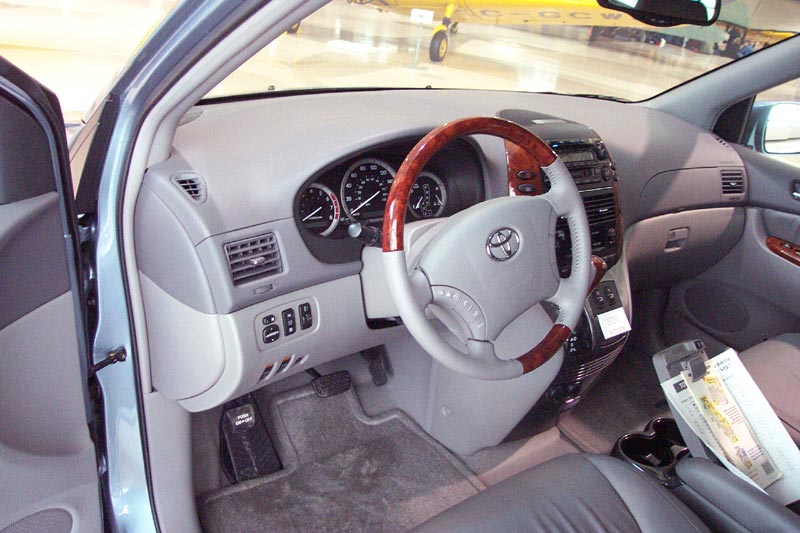
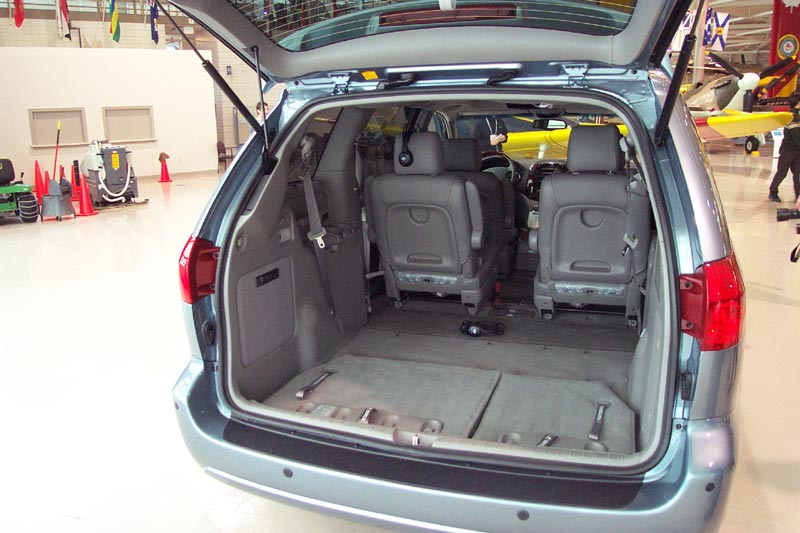
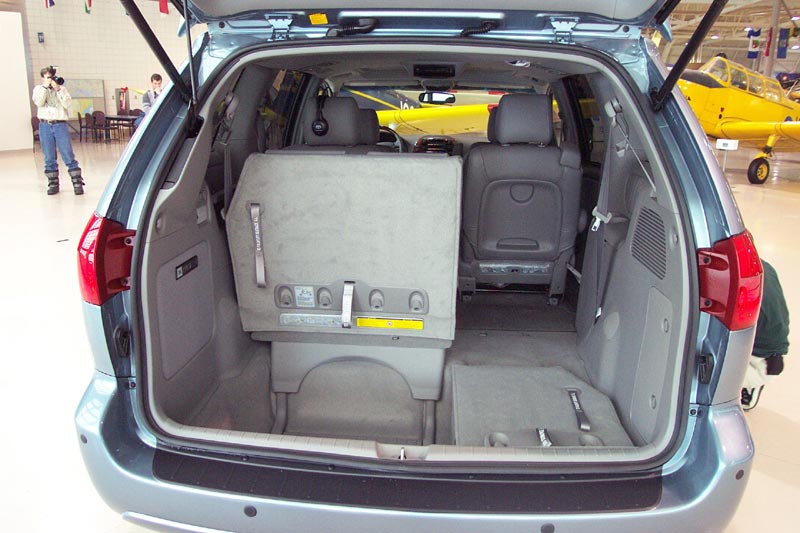
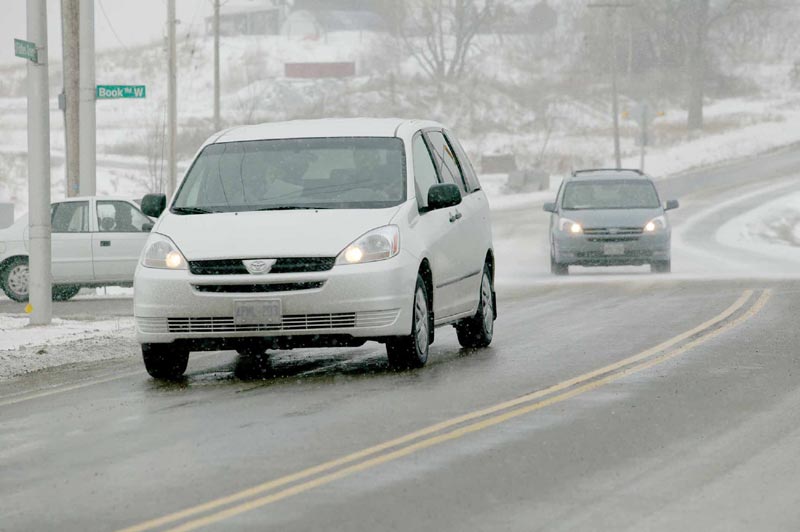
2004 Toyota Sienna Pictures

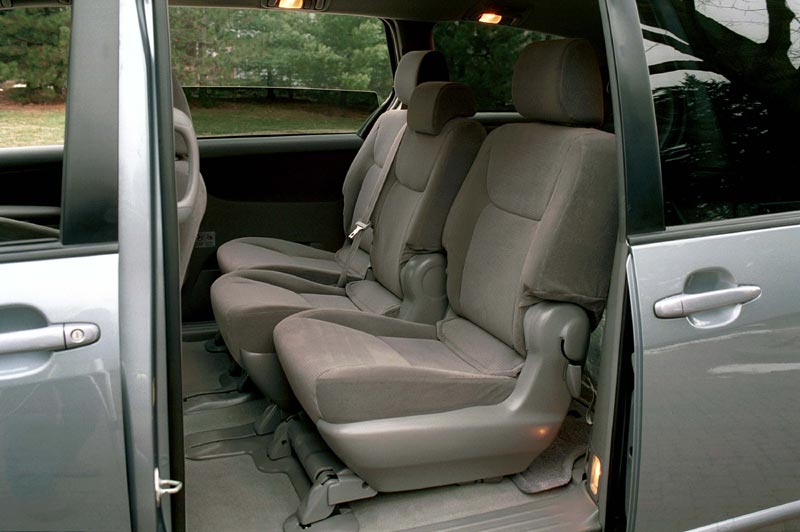
Take a look at the cool 3rd row seats!

Maybe i can get this for my fiance...sure looks nice!
 
Register to hide this ad
2004 TOYOTA SIENNA PRELIMINARY SPECIFICATIONS

Engine

3.3-liter V6 DOHC with VVT-i

Bore X Stroke 92.0 x 83.0

Horsepower 230

Torque 242

Fuel System EFI

Ultra low emission vehicle (ULEV-II)

Powertrain

Five-speed automatic transmission

w/ intelligence (ECT-i)

Suspension

Front:

Independent MacPherson struts

Rear:

Torsion Beam

Brakes

2WD:

Front Disc/Rear Drum

AWD:

Front and Rear Discs

Exterior Dimensions (inches)

Wheelbase 119.3

Overall Length 200.0

Overall Width 77.4

Overall Height 68.9

Front Track:

16-inch wheels 65.6

17-inch wheels 65.9

Rear Track:

16-inch wheels 66.9

17-inch wheels 67.3

Ground Clearance 6.9

Interior Dimensions (inches)

Head Room

WithoutMoonroof / Moonroof

Front 42.0/39.5

Second Row 40.2/38.6

Third Row 38.1/38.1

Interior Dimensions (inches) cont.

Shoulder Room

Front 63.8

Second Row 64.9

Third Row 61.1

Hip Room

Front 58.4

Second Row 67.5

Third Row 51.8

Leg Room

Front 42.9

Second Row 39.6

Third Row 39.5

Interior Volume (cu. ft.)

Passenger Volume:

7 pass. 177.5

8 pass. 176.6

Cargo Volume:

Behind Front Seats 148.9

Behind Second Row 94.5

Behind Third Row 43.6

Weights (lbs)

Curb Weight:

Grade 7 pass. 8 pass.

CE 4120 4175

LE 4120 4175

LE AWD 4310 N/A

XLE 4165 N/A

XLE AWD 4365 N/A

XLE LTD 4310 N/A

XLE LTD AWD 4365 N/A

EPA Estimated Fuel Economy

City/Highway

2WD 20/25

4WD 18/22
 
Link:

CanadianDriver.com Preview of '04 Sienna

Preview:
2004 Toyota Sienna

Toyota made a fairly tentative start in the minivan market years ago with its rather ungainly Van LE model, examples of which can still be seen on Canadian roads. The follow-up Previa was a more sophisticated product, but lacked power with its under-the-floor 4-cylinder engine. Toyota joined the minivan mainstream when it launched its Sienna, the second generation of which was unveiled at the recent North American International Auto Show in Detroit.

The Sienna has won an excellent reputation, mainly by incorporating those Toyota characteristics the market holds dear - first-rate build quality, unmatched dependability and strong resale value. Although the minivan market is bulging with products, Sienna buyers always knew they were getting "something special" and although the product lacked some of the flashiness of rivals, it boasted outstanding durability and practicality.

So how could Toyota create a better product than than its first-generation Sienna? One route taken by chief engineer Yuji Yokoya was to bring one of the old models to North America and drive it for fully 80,000 kilometres in all imaginable conditions. Yokoya went just about everywhere in the US and Canada to try and discover what needed to be improved when work started on the 2004 model. He drove from Alaska to southern California, from the Pacific to the Atlantic and in Canada, from Labrador to Vancouver Island. If an engineer from a rival automaker has ever completed such an odyssey, I've certainly never heard about it.

The result of Yokoya-San's wanderings should certainly translate into a benchmark minivan - one that rivals will be hard-pressed to match. Most of the engineering design and development was tackled at facilities in North America and much of the styling was handled by a Toyota design facility in Newport Beach, California. The product was conceived from the start for the vast North American minivan market.

The van sits on an all new low-slung chassis with a wheelbase 130 mm longer than that of its predecessor. Both front and rear tracks are almost 100 mm wider, so stability should be improved. One thing engineer Yokoya noticed on an exceptionally breezy stretch of American prairie was that crosswind stability could be better - hence the wider track. Despite its larger "footprint" the Sienna has a substantially tighter turning circle compared to the old model.

There's been something of a power struggle between minivan manufacturers in recent years and Toyota isn't ready to take a back seat when it comes to performance. Minivans aren't sports cars, of course, but usable power helps considerably when driving with a full load of passengers and cargo in hilly terrain. This is also an important factor for business users, who may be carrying weighty samples or equipment.

The 2004 Sienna engine is a 3.3-litre V-6 developing 230 horsepower. It provides snappy performance and Toyota in the US gives a zero to 60 mph time of 8.4-seconds, claimed best in class. The engine uses an aluminum block and has variable valve timing with intelligence (VVT-i). According to Toyota, the engine meets Ultra Low Emission Vehicle, Tier 2 regulations. The 5-speed automatic transmission uses a gated shifter, new to this model.

Safety features include anti-lock brakes on all versions plus brake assist and electronic brake force distribution. Two models in the lineup include vehicle stability control and traction control - additional electronic safety systems that contribute towards vehicle stability under demanding conditions. It's worth mentioning that the current Sienna was judged the safest minivan ever tested by the Insurance Institute for Highway Safety. The top XLE Sienna has front side air bags and curtain shield bags for protecting passengers in all three rows.

Standard equipment includes a rearmost seat that can be folded down flush with the floor and each seat in the middle row can be folded flat and tumbled separately. The van can be specified in seven or eight passenger configurations. All Siennas come with power windows and locks, keyless entry with hatch release, cruise control, dual zone climate control and other useful features. The top model can be ordered with a rear facing DVD entertainment unit that can also be very useful for business users demonstrating products or services using video.

Interestingly, the new Sienna is available with all wheel drive - a key sales point for buyers in snow belt regions of Canada.

The new Sienna goes on sale during the early part of 2003. No price has been announced yet, but most analysts expect it to be fairly close to that of its predecessor.
04sienna_1.jpg

04sienna_2.jpg

04sienna_4.jpg
 
Link:

Edmunds Preview of Sienna

First Drive: 2004 Toyota Sienna
The New Cadillac of Minivans

The Honda Odyssey has enjoyed a long run as king of the minivan hill. Edmunds.com named the Odyssey "Most Wanted" minivan every year since the current generation hit the market as a 1999 model, and consumers around the country reflect our editorial voting process by keeping the Odyssey perpetually on dealer order lists. While the Odyssey remains the one to beat for 2003 models, the early introduction of the 2004 Toyota Sienna could provide some stiff competition.

In order to fully appreciate the new Sienna's long list of improvements, we spent some time behind the wheel of a 2003 version just prior to our first experience in the 2004 model. Although still a capable minivan, the current Sienna showed signs of age in its interior design and was down on power compared to the competition.

The 2004 Sienna benefits from a new 3.3-liter V6 engine, increasing horsepower from 210 hp to 230 hp, and torque from 220 pound-feet to 242 lb-ft. We immediately noticed the difference around town and especially when moving into a freeway passing lane. The more powerful engine is coupled with a new five-speed automatic transmission — an improvement over the previous four-speed automatic version. This combination results in better fuel mileage with preliminary EPA figures of 19 mpg in the city and 27 mpg on the highway for two-wheel-drive models.

In addition to the larger engine and five-speed transmission, the new Sienna also offers an optional all-wheel-drive system, a benefit it claims over the Honda Odyssey and just about every other minivan on the market as well. This system not only provides peace of mind to families who live in areas where severe weather is a threat, but it's also an added safety benefit while driving on lightly dampened freeways. The all-wheel-drive system uses a center differential to divide engine power 50/50 to the front and rear wheels, so if one set of wheels begins to slip, power is automatically transferred to the wheels that have more grip. The standard 17-inch wheels that come on AWD-equipped models also feature run-flat tires for an added level of safety. All-wheel drive is available on the XLE and XLE Limited models, while the CE and largest volume seller, the LE, will be limited to the standard two-wheel-drive powertrain.

With a stretched wheelbase — nearly five inches longer than the current Sienna — and widened front and rear tracks, the new Sienna handles much better than the previous model. The overall length has been increased by 6.5 inches, and while you might think that a larger vehicle would make for poorer handling characteristics, we found the new Sienna to be more carlike than ever before, although the Honda Odyssey shows less body roll during cornering. Surprisingly enough, even with its expanded dimensions, Toyota still managed to cut the Sienna's turning radius by more than three feet — from 40 feet down to 36.8 feet, while the Odyssey is hampered comparatively at 37.7 feet.

By design, minivans are inherently used for transporting people, and therefore safety plays a big part in their design. The Sienna is no exception as it comes standard with antilock brakes, Electronic Brakeforce Distribution and BrakeAssist on all models. Vehicle stability control with traction control is optional on lower-end models, but standard equipment on XLE Limited trim and all-wheel-drive models.

There are airbags aplenty in the new Sienna, including front side and side curtain airbags that cover all three rows — yet another claim that the Sienna can now make over the Odyssey. The Sienna can also accommodate three child safety seats across the second row, since the LATCH (Lower Anchor with Tether for Children) system is standard in all second-row seating positions.

We were immediately impressed by the Sienna's spacious new cabin. Interior volume has increased by 45 cubic feet, making the Sienna the new class leader for cargo space at just under 149 cubic feet. The Sienna is available in both seven- and eight-passenger configurations, while the Odyssey maxes out at seven passengers. With the Sienna's seven-passenger configuration, the second-row captain's chairs can be pushed together to create a bench seat. The eight-passenger version uses a three-way split bench in the second row which allows you to pull the middle seat 13 inches closer to the driver to provide an easier reach to a pint-sized child safety-seat occupant.

One of the Odyssey's most heralded features has been its flat-folding third-row bench seat. While the Honda's seat is convenient to flip and fold into the floor, there's no doubt that it takes two hands and most of the body weight of a 120-pound woman to complete the action. The Sienna has improved upon the Odyssey's rear-seat function by engineering a 60/40-split third-row bench which can also be folded flat into the floor, either in halves or as the entire bench. Either way, flipping and folding that rear bench in two sections is much lighter and therefore easier than the Odyssey's one-piece bench. Toyota boasts that with the second-row seats removed and the third row stowed, 4-by-8 sheets of plywood can be transported flat on the Sienna's floor.

Most minivans now provide the convenience of dual sliding side doors, but not all have advanced to making them remote power doors. On the XLE and XLE Limited models, the Sienna takes the side doors, and also the rear hatch, all the way to remote power, allowing harried mothers and fathers to keep a hand on the kid and a hand on the grocery cart while the doors begin to open at the quick push of a button.

We found the Sienna's interior to be comfortable and pleasing with high-quality fabric and interior moldings on lower trim levels, and leather seating surfaces and wood trim on the high-end models. The center stack has been redesigned and sports simple stereo and climate controls, and a uniquely placed gated gearshift handle. Stereo controls work a standard AM/FM/cassette/CD unit with six speakers, or an upgraded 300-watt unit with 10 speakers and surround sound. Climate control comes in dual-zone on CE and LE models, and a new digitally operated tri-zone system on XLE and XLE Limited, allowing rear passengers to set the controls to their comfort level. While it took a few shifts between park, drive and reverse to remember that the quirky shifter was on the console instead of the steering column, we found it nothing to complain about.

Numerous storage compartments are placed throughout the Sienna's interior to secure small items that travel with you on a daily basis. We found the two gloveboxes, the large removable center console box and the 10 baggage hooks to be just the beginning of the hidden treasures found in the Sienna's nooks and crannies, and even noticed the handbag hook that designers placed on the side of the center stack in the passenger's footwell to prevent an unlatched purse from spilling its contents.

DVD rear-seat entertainment systems have been showing up on more and more family vehicles, and it was no surprise to find a DVD unit with a swing-down screen, remote control and two wireless headphone sets ready to entertain the little kids (and big kids, too) who travel as second- and third-row passengers.

The XLE model only offers Sienna buyers a GPS navigation system with a 6.5-inch touchscreen monitor and voice guidance. While we didn't travel any great distance using the nav system, we did allow it to guide us around town and found it easy to operate with simple controls. Combined with the nav system is a rearview camera monitoring system that shows a wide-angle view of the rear of the Sienna whenever the minivan is put in reverse gear. This feature will be much appreciated if you find that your kids' bikes often seem strategically placed in the driveway behind your rear tires.

The top-of-the-line XLE Limited model, a new trim level on the 2004 Sienna, gets the lion's share of the Sienna's new features. Standard on the XLE Limited is a park-assist system that uses a sonar range-finding system. The system uses two front sensors and four rear sensors with an audible beep that quickens as you close in on the obstruction in your path. Other standard equipment includes a laser cruise control system that can be set to conventional speed cruise control, or set as a time interval based on the car ahead of you, and pull-up sunshades for second- and third-row seating area windows.

There's no doubt in our minds that the 2004 Sienna will become a standout in the minivan world. Its carlike handling and innovative features will challenge all of its competition, and that's before pricing even comes into play. The Sienna CE will go on sale this spring with a price tag of $22,955 — that's nearly $1,000 less than the 2003 CE model. The new Sienna is truly the right mix of product and pricing, not to mention it has the proud Toyota reputation behind it.
 
Link:

CanadianDriver Review of Sienna

Test Drive:
2004 Toyota Sienna
by Grant Yoxon

Toronto, Ontario - Toyota Canada president and CEO Ken Tomikawa was making a joke when he suggested nicknaming the 2004 Toyota Sienna "My Big, Fat, Aerodynamic Minivan" after the recent popular movie with a similar title. Reporters attending the press briefing for the Canadian launch of the second generation Sienna laughed. Mr. Tomikawa has a good sense of humour. When he speaks, people smile.

He may have made the remark in jest, but the moniker fits well. The new Sienna is big. It is now as large as a Honda Odyssey, the target for this and other new minivans arriving this year. The new Sienna's wheelbase has been stretched 129.5 milimetres (5.1 inches) and it is 165 mm (6.5 in) longer, 99.1 mm (4 in) wider and 40.6 mm (1.6") taller than the previous model.

And it is fat in the sense of being well endowed with standard and optional features. You can load this new Sienna up to the level of a Lexus, with a price that is nearly, but not quite as weighty. More than $20,000 separates the base level CE model and the XLE Limited with all wheel drive.

The Sienna CE will start at $30,000, $655 less than the '03 model despite what Tony Wearing, Group Vice President Toyota Canada calls "a comparably equipped price advantage of $1,800." More for less, it's a refrain buyers like to hear. The mid-range LE also offers more for less compared to last year and starts at $34,750.

Fully equipped, with features like all wheel drive, rear seat DVD entertainment system, dual power sliding rear doors and power rear hatch, vehicle stability control and advanced traction control, high intensity discharge headlamps, dynamic laser cruise control, sonar rear parking assist, three zone automatic climate control and full three row side curtain airbags, as well as the usual assortment of leather, wood grain, chrome trim, premium sound and power everything, the Sienna XLE Limited can set you back $51,965 plus freight and taxes. It may sound like a lot, but compared to other top end minivans like the Chrysler Town & Country, it is well-equipped and well-priced.

Even in it leanest, trimmest configuration, the Sienna CE has a hefty complement of standard features. As well as power windows, door locks and mirrors, the CE offers sliding door power windows, keyless entry, one touch tilt and telescopic steering, tire pressure warning system, four wheel antilock brakes with electronic brake force distribution and brake assist, dual zone front and rear air conditioning, windshield wiper de-icer and enough cup and bottle holders to meet the needs of the thirstiest family of seven or eight.

With seating for seven or eight, the 2004 Sienna can accommodate even big families, maybe even overweight families. And the seats can be configured in 17 different ways. Centre row captain's chairs can be positioned with an aisle in the middle or together as a partial bench. They also flip forward or can be removed entirely. On 8-passenger models, the middle seat can be positioned closer to the front seats putting junior within reach of the driver or passenger. Or it can be folded down to use as a table.

The rear bench is split 60/40 and can be lowered independently - without removing the headrests - into a deep well in the floor, leaving a flat cargo surface. With the middle row seats removed, the Sienna can accommodate a 4 x 8 sheet of plywood or up to 4.22 cubic metres (148.92 cubic feet) of cargo.

In addition to 16 cup and bottle holders - two for every possible passenger - the new Sienna raises the bar on interior storage with a two level glove box, compartments under the front arm rests, a sunglass holder in the driver's door, a bin to store a garage door opener in the overhead console, wide, shallow door pockets, seatback pockets and, on LE and XLE models, a bin under the front passenger seat and a removable centre console that can be positioned between either the first or second row of seats.

All this added baggage would be excessive if the Sienna handled like a sumo wrestler, but despite gaining 95 kilograms (209 pounds), the larger Sienna is surprisingly light on its feet. The first generation Sienna felt heavy and dull at the steering wheel, but a new front suspension geometry improves steering feel and feedback from the road. Steering now feels as light and precise as some of its more svelte competitors like the Dodge Caravan and Mazda MPV.

A wider track - 99.1 mm (3.9 in) were added - improves cornering stability and, when combined with the Sienna's longer wheelbase, helps provide a comfortable ride. As well, Toyota engineers took more than three feet out of the Sienna's turning circle improving manoeuvrability significantly.

And with a new 3.3 litre engine that produces 230 horsepower at 5,600 rpm and 242 lb.ft. of torque at 3,600 rpm, the Sienna has plenty of power for on ramp acceleration, passing and towing (1587 kg/3500 lb). When pressed, the 3.3 litre V6 responds with a throaty growl and smooth acceleration.

Despite the increase in power, the Sienna has a much smaller appetite for fuel. Advanced technologies like variable valve timing and electronic throttle control combine with much improved aerodynamics - Mr. Tomikawa wasn't joking - to earn a fuel consumption rating, for two wheel drive models, of 12.2 litres per 100 kilometres (23 miles per gallon) in city driving and 8.1 L/100 km (35 mpg) on the highway. It is also a cleaner engine, complying with future Ultra Low Emission Vehicle-II regulations.

The Sienna is the first application for this aluminum alloy block engine. The same engine will appear in the Lexus RX330 which debuts next month and will likely appear in other Lexus/Toyota V6-powered vehicles in the future.

The first generation Sienna earned a top crash test rating from the Insurance Institute for Highway Safety and this is unlikely to change, although the new minivan has yet to be tested. However, advanced safety technology like vehicle stability control and traction control, seat mounted side air bags and a full length, three-row side curtain air bag are still extra cost items, available only on XLE FWD and AWD models.

The new Sienna - Mr. Tomikawa's big, fat aerodynamic minivan - offers much more to consumers than the model it replaces. Bigger, more powerful and better equipped, it is also nimbler, cleaner and more fuel-efficient. Perhaps you can have your cake and eat it too.

The 2004 Sienna goes on sale this Spring.

Sienna has competition
The 2004 Toyota Sienna is the first of three all-new minivans to hit showrooms this year. The Ford Freestar, expected to go on sale this fall, promises greater interior flexibility including fold-flat seats, improved ride and steering and a more powerful engine. The new 4.2 litre V-6 will offer best-in-class torque (265 lb.-ft. at 3,500 rpm), but less horsepower than the Sienna - 201 at 4,250 rpm. Ford revealed the Freestar at the recent Toronto and Chicago auto shows.

Nissan introduced the radically-designed - for a minivan, anyway - 2004 Quest at the Detroit show in January. The Quest will be the largest minvan in this corpulent class and will offer some unique features like "Skyview" glass panels in the roof. Powered by Nissan's 3.5 litre all-aluminum V-6, with at least 230 horsepower and 235 lb.-ft. of torque, the Quest promises to be a major contender in the long-wheelbase minivan category. Three-row head curtain air bags will be standard equipment.

 
Bigger Sienna steps into minivan field
Jim Mateja

While Toyota is considered a benchmark for knowing what to do and when to do it, history shows it has stumbled on occasion.

Consider its attempt to take on the full-size Ford and Chevrolet trucks with its T-100, a vastly undersized and underpowered midsize pickup.

And then it chose to take on the Chrysler minivans with Previa, a rear-wheel-drive hunk of ugly minus a power sliding door and that needed supercharging to eke power out of its 4-cylinder engine.

But Toyota tried again. Sienna replaced Previa for the 1998 model year and Tundra replaced the T-100 for 2000, though Tundra needed yet another try and this fall adds a larger DoubleCab to match the size of the Ford and Chevy rivals.

And that leads us back to the 2004 update of the Sienna, which epitomizes Toyota's try-again philosophy. Toyota made a list of Sienna shortcomings and acted to eliminate them one by one.

Sienna is offered in CE, LE, XLE and XLE Limited versions. We tested the '04 LE, which like all Siennas is built on a 5-inch longer wheelbase and is 6 inches longer, 4 inches wider and 2 inches taller than its predecessor. Those dimensions mean vastly improved ride and handling plus more cabin room for passengers and cargo.

While 2 inches taller, you don't feel top-heavy or wobbly in corners because those extra 4 inches of width give you a more sure-footed stance on the road. You don't sit as high as in a sport-utility vehicle, but the windshield is so huge, you still see far down the road, as you do in one of those tall SUVs.

Along with smoother ride and more stable handling comes more power. A 3.3-liter, 230-horsepower V-6 that delivers 242 foot-pounds of torque for more muscle at launch replaces the 3-liter, 210-h.p. V-6 that developed 220 foot-pounds of torque.

Pedal response is quick and quiet. No hesitation from the light, and no need to get a running start with a full load to get up the incline.

Yet, thanks in part to a 5-speed automatic replacing the 4-speed, mileage is 19 m.p.g. city/27 m.p.g. highway, a 3 m.p.g. increase on the highway. The 3.3 will replace the 3-liter in all vehicles with it, including Camry this spring.

Another change finds the front-wheel-drive Sienna offering optional all-wheel-drive for the first time, a feature the Honda Odyssey won't have until the '05 arrives in '04. AWD runs $3,615 in the LE, $3,205 in the XLE and $2,450 in the top-of-the-line XLE Limited.

While 16-inch all-season radial tires are standard in Sienna (15-inch for '03), with AWD you move up to 17-inch all-season run-flat tires because the AWD hardware eliminates the space for a mini-spare under the van.

With AWD you also get Vehicle Stability Control (VSC) with traction control for the first time along with rear disc brakes, windshield wiper de-icers and daytime running lights.

Traction control helps get you moving from the light on slippery surfaces; VSC helps keep you moving in the direction the wheel is pointed by applying the standard four-wheel anti-lock brakes when slippage is detected. VSC is standard on the XLE Limited, a $650 option on the XLE. It's $650 well spent.

Also new is an optional ($2,080) navigation system teamed with a rearview camera (similar to that on the Acura MDX sport-ute (Transportation, Jan. 19). A dash-mounted screen lets you see what's behind when backing up.

Yet another new item, Sienna comes with a standard 60/40 split third-row seat. Odyssey has a one-piece third-row bench that folds flat into the floor. Sienna's split third seat allows you to fold either or both sides flat into the floor. The cargo hold is a deep well that hides the seat when folded flat. Why not a power folding seat like on the Lincoln Navigator SUV? Cost and weight, Toyota says, but stay tuned.

Second-row seats fold and flip forward to create wide aisles to the third row or, if you'd rather not flip and fold, you can move the passenger side seat against the driver's side seat to create an aisle on the passenger's side to the third row. Or, you can opt for three second-row seats (CE and LE), in which the middle unit holds a child safety seat and slides forward so Mom or Dad can tend to the child if needed.

Other nice touches: A fold-down overhead mirror so driver/passenger can check on the kids; the front passenger seat back folds flat so you can haul a ladder inside; and a center tray table holds four cups and sandwiches or five cups, two juice boxes and a sandwich.

Also, there are plastic grocery bag holders in the front dash and along the backs of the third-row seat; a cupholder with built-in coin holder that pulls from the dash; bottle holders built into each side door; and stowage holders inside the front-door armrests.

The test vehicle came with an optional (part of the $2,645 LE package) passenger-side power sliding door with pinch protection (manual driver's side slider standard), meaning the door stops and retracts if someone is in its path when closing. We stood in the opening as it closed and the door delivers more than a gentle rap before retracting. The door is activated by the key fob or buttons in the dash and/or door pillar and disabled with a button on the dash.

Both sliding doors come with power windows for the first time. The glass doesn't motor all the way down so kids can't hang out while the vehicle is moving. When the vehicle is stopped, the door won't open all the way if the window is open to keep a child from being caught in its path.

Two gripes: third-row seat headrests flip down so as not to block the view out the rear window, yet second-row headrests have to be removed to keep from blocking the view; and the gearshift lever is in the center of the dash, not the steering column, and a bit awkward to use.

The LE starts at $24,260. Standard equipment includes multistage air bags, power locks/windows/mirrors (heated), power rear quarter windows, roof rack, privacy glass, cruise control, keyless entry, three 12-volt power outlets, AM/FM-cassette-CD player with six speakers and steering-wheel audio controls and front and rear air conditioning with rear control panel.

New options include side-impact air bags/side air-bag curtains (in the $2,645 LE package), second/third row seat sunshades (standard on the XLE Limited but packaged with leather interior for $1,630 on the XLE), and a DVD entertainment system ($1,680).

Sienna output has moved from alongside Camry and Avalon sedans at Toyota's Georgetown, Ky., plant to its Princeton, Ind., plant with the Tundra and Sequoia SUV.

Replacing the high-volume Sienna with the low-volume Solara coupe/convertible allows Georgetown to build more Camrys and Princeton to build more Siennas.

Sales totaled 80,915 last year. The forecast is 135,000 for '04 to bring Sienna closer to the 150,000 sold by Odyssey. To help sales increase, Sienna prices were reduced by $950 to $1,200 for '04 while new features and equipment were added.

TEST DRIVE
2004 Toyota Sienna LE
Wheelbase: 119.3 inches
Length: 200 inches
Engine: 3.3-liter, 230-h.p. V-6
Transmission: 5-speed automatic
Fuel economy: 19 m.p.g. city/20 m.p.g. highway
Base price: $24,260

Price as tested: $26,905. Includes $2,645 for LE package with trip computer, power passenger side sliding door, JBL audio system with cassette/CD and 10 speakers, rear-seat audio system, alloy wheels, side-impact air bags and side-curtain air-bag shield. Add $510 for freight.

Pluses: Redesigned and now longer, wider and taller with more cabin and cargo room for '04, along with more powerful, yet higher mileage V-6 with 5-speed automatic (replacing 4-speed). New options include AWD, stability control with traction assist, DVD entertainment system, navigation system with rearview camera to see what's behind when backing up, rear-seat audio system and 17-inch run-flat radials.

Minuses: If it looks like a duck ... despite all the amenities, it's a minivan in a world soon to be ruled by crossovers.
 
Toyota Announces Value-Driven Prices For All-New 2004 Sienna Minivan

Toyota Motor Sales (TMS), U.S.A., Inc., released manufacturer's suggested retail prices (MSRP) today for the all-new 2004 Sienna minivan, which arrives at dealer showrooms in March.

"The Sienna has been improved, refined and enlarged in nearly every metric comparison," said Don Esmond, Toyota Division senior vice president and general manager. "The new Sienna will be defined by class-leading interior comfort, convenience, and flexibility that will meet the everyday driving needs of the American family. And, with very affordable pricing it will set a new standard that will be hard to beat."

To accommodate increases in its size and roominess, the new Sienna will deliver a substantial boost in power, fuel-efficiency, and refinement, thanks to an all-new V6 engine and an all-new five-speed automatic transmission. The new 3.3-liter V6 with variable valve timing with intelligence (VVT-i) will deliver 230-horsepower at 5,600 RPM and 242 lb.-ft. of torque at 3,600 RPM. Fuel economy is improved with preliminary EPA city/highway gas mileage of 19/27 for two-wheel-drive models and 18/24 for all-wheel-drive models. At 27 miles-per-gallon, Sienna will have one of the highest highway mileage ratings in its class. The powertrain will be certified as a Level II Ultra-Low Emission Vehicle (ULEV-II).

The V6 is paired with an all-new five-speed automatic transmission with intelligence (ECT-i) that delivers improved shift quality and contributes to its improved fuel economy. The new transmission operates from a space-saving dashboard-mounted gated shifter. Both the engine and the transmission will be built at Toyota Motor Manufacturing, West Virginia's powertrain production facility.

Sienna has grown substantially in nearly every exterior dimension. With 6.5 inches in additional length, 5.1 inches in additional wheelbase, four inches in additional width, and larger wheels, the new Sienna presents a wider stance for improved ride and handling.

The larger dimensions of the new Sienna will carry over to the interior, with increased roominess in every dimension. Inside, Sienna offers class-leading cargo volume behind the third row, as well as the most passenger volume among front drive minivans. In total, its interior volume has increased by nearly 45 cubic feet.
Sienna's interior is as versatile and flexible as it is spacious and quiet. Sienna offers two distinctly different second-row seating options that are easy to adjust, tumble or remove. In its seven-passenger configuration, Sienna features second-row captains chairs with a passenger-side chair that can be moved side-to-side, offering either a bench or a bucket arrangement. In its eight-passenger configuration, Sienna features a second-row, three-way split/folding bench with a Front and Center™ middle seat that can be moved almost 13-inches closer to the front seat, making infants and toddlers in chil-seats more accessible.

Standard equipment on all models is a 60/40 Split & Stow 3rd Row™ bench seat that folds flat into the floor. Either side of the seat can be stowed separately with a low-effort, one-hand operation. With the entire rear seat stowed and the second row seats removed, four-by-eight sheets of plywood can be loaded flat onto Sienna's floor.

The new Sienna will come in four model grades, CE, LE, XLE, and the new top-of-the-line XLE Limited. All four grades will be available in a 4x2 configuration. The LE, XLE, and XLE Limited will also offer all-wheel-drive. The CE and LE will be available in both seven- and eight-passenger configurations.

A wide assortment of standard features on the CE grade include color-keyed front and rear fascias, color-keyed grip-type door handles and body side molding, ABS with electronic brake distribution and brake assist, 60/40 Split & Stow Third Row™ bench seat, second-row, three-way split/folding bench with Front and Center™ middle seat which can be moved closer to the front seat (eight-passenger models only), power windows, door locks and mirrors, sliding doors with power windows, second-row captains chairs with an indexing passenger-side chair for bucket or bench seat arrangements (seven-passenger models only), keyless entry system, Deluxe 3-in-1 AM/FM/Cassette/CD with six speakers, dual (front & rear) air conditioning with rotary dial controls, 16-inch steel wheels with 215/65R16 all-season tires, dual front captains chairs, folding tray table between the front seats, tilt/telescopic steering column, black lacquered interior trim, tire pressure warning system, variable intermittent front and rear windshield wipers, 10 cup holders and four bottle holders, three 12V power outlets and a heavy-duty rear window defogger with timer.

All of this standard equipment adds up to excellent value with a base MSRP of $22,955 for the seven-passenger model, which is $950, or 4.0 percent less than last year's model. The base MSRP for the eight-passenger CE will be $23,575.

In addition to, or in place of features on the CE grade, standard equipment for the LE includes an engine immobilizer, heated power mirrors, a roof rack, privacy glass, steering wheel-mounted audio controls, cruise control, driver's side power window with auto up/down and pinch protection, driver's seat manual-adjustable lumbar support, illuminated vanity mirrors, color-keyed license plate garnish, unique LE seat fabric and a fold flat front passenger seat.

The base MSRP for the Sienna LE will be $24,260, which is $1,495, or 5.8 percent less than last year's model. The base MSRP for the eight-passenger LE will be $24,410. The base MSRP for the all-wheel-drive LE will be $27,875.

Additional standard features on the XLE model includes power dual sliding doors and power open/close back door, tri-zone (front driver/passenger and rear) HVAC with air filter, 16-inch alloy wheels with 215/65R16 tires, eight-way power adjustable driver's seat, rear seat audio controls with wireless headphone capability, JBL Synthesis 360 watt AM/FM/cassette/CD with 10 speakers, overhead console with trip computer, outside temperature and HomeLink
 
Yeah, i agree...i just looked at one this past weekend. Very nice. It is also the only minivan that comes in AWD AND stability control. Of course, 3-row side curtain airbags are just icing on the cake.

After years of being #2 or #3, Toyota has finally produced a minivan class-leader.
 
2004 Toyota Sienna

PROS:
Bigger and roomier
Bigger, more powerful V6
Lots of new features

CONS:
Top model priced around $37,000
Awkward-to-move 2nd row seats
Mainstream styling

Overall rating is 9

Toyota's second-generation Sienna is a big improvement over the first generation, especially in size and handling. A bigger, more powerful V6 and lots of features add to the appeal of the 2004 Sienna.

Gosh, it took me a long time to wrap up my notes on the 2004 Toyota Sienna. This second-generation Sienna seems to have about everything offered except the kitchen sink.

Look down the list of features available in this new Sienna and you, too, may come to the same conclusion: Side curtain airbags for all three rows of seats, all-wheel drive, fold-into-the-cargo-floor third-row seats, laser cruise control, tire pressure monitor, power tailgate, navigation system, rear camera, front and rear parking sonar, windows that open on the sliding doors, a cargo floor that can accommodate 4-by-8-foot sheets of plywood, skid control, traction control, tri-zone air conditioning, DVD-based entertainment system with wireless headphones, a "conversation mirror" that allows parents to keep an eye on youngsters in back. Do I need to go on?

Bigger size
The previous Sienna, which dates back to the 1998 model year, didn't quite measure up in terms of passenger space and cargo room.

For example, according to automotive research firm J.D. Power and Associates, the first-generation Siennas had 154.1 cubic feet of room for occupants, while the Grand Caravan—which was longer and wider—had 164.9 cubic feet, and the Odyssey has 170.7.

The new Sienna is more competitive, with 6.5 inches of additional length and nearly 4 more inches of width. So the Sienna now is nearly as long, overall, as the Grand Caravan and is actually wider than the Odyssey.

And I noticed the more spacious feel immediately upon entering the test Sienna. Headroom in all three rows of seats in the Sienna is improved—and not just by fractions of an inch. For example, in the front seats, headroom has gone from 40.6 inches to 42 inches in vans without a sunroof.

Legroom and shoulder room are improved all around, too. I especially enjoyed the additional 3.1 inches of legroom in the second-row seats.

Cargo room is better, too, with 43.6 cubic feet available behind the third row seats. This compares with 26.6 cubic feet in the 2003 Sienna.

Pleasant ride
Riding on a new chassis, the front-drive 2004 Sienna handles better than its predecessor.

There was a controlled feel in the test front-drive van, even on twisty mountain roads where the Sienna managed curves well and without being sloppy. Drivers can notice some weight shift, however, in this tall people hauler.

The suspension is similar to what was in earlier Siennas, but suspension travel is increased for better ride and tires are upsized to 16- and 17-inchers. The Sienna has MacPherson struts up front, while a torsion beam handles duties at the rear.

This minivan's power-assisted rack-and-pinion steering responds more quickly and tracks more predictably than on earlier Siennas.

Inside the seven-seat test van all remained quite quiet, even at higher speeds.

New V6 engine
Power is improved, too.

The Sienna's old 210-horsepower 3.0-liter V6 is replaced by a 230-horsepower 3.3-liter V6 that generates 24 more lb-ft of torque at a lower rpm, for a peak of 242 at 3600 rpm. This provides better acceleration and it's noticeable.

The Odyssey has 242 lb-ft at 4,500 rpm and maximum horsepower of 240, while the Grand Caravan's up-level V6 can deliver 245 lb-ft of torque at 4000 rpm but has only 215 horses.

The new Sienna joins the Odyssey in having a five-speed automatic transmission. Shifts between gears here are smooth, and the new tranny also helps keep fuel economy in the front-drive, more-powerful Sienna on par with the 2003 Sienna.

Specifically, the front-drive '04 Sienna's estimated fuel economy rating is 19 miles a gallon in city driving and 27 mpg on the highway.

All-wheel-drive trims are rated lower—18 and 24 mpg, respectively.

Premium fuel is recommended for maximum performance, but the engine's management control system can tailor the engine workings for regular, too.

Note: In recent years, some Toyota owners have complained about an oil sludge problem with an earlier-generation Toyota V6. Toyota officials include an oil change reminder light in the new Sienna, and while they insist it doesn't have anything to do with the earlier sludge issue, they add that they want owners to realize there are things, like regular oil changes, that people can—and should—do to properly maintain their engines.

Comfort, convenience
The Sienna's seats now feel more upscale, with some decent cushioning and good support. Toyota officials insist that they spent more money on the new seats, just because they are so important for comfort.

If you're a comparison shopper, you'll no doubt recognize some of the new features on the Sienna. They debuted in other minivans.

For example, a power tailgate now is available. This feature was introduced on DaimlerChrysler vans.

Another DaimlerChrysler feature is here, too: A center console that can be moved from between the front seats to the second row.

The 2004 Sienna is the first with available navigation system. The Odyssey offers navigation, too.

Power windows on the Sienna's sliding doors go down part way to allow kids or pets in back to get fresh air. The Mazda MPV has this feature, too.

And the Sienna now has third-row seating that can fold into a cavity in the rear cargo floor, much like the feature pioneered by Honda.

But the mechanics to make the seating fold down are different, with the Sienna requiring a bit of "oomph" from me to get the seat down while the seat in the Odyssey gets help from gravity and sort of drops into place.

Another difference: The Sienna's third-row seat is split 60/40, so, if needed, a person can sit back there and there's still room for cargo on the side. In contrast, the Odyssey's third-row seat is a bench and so offers no such versatility.

And it sure looked as if there were a lot of fabric/carpet flaps attached to and around these third-row seats. The Odyssey's bench looks cleaner in comparison.

Second-row seats differ in these two vans, too. The Odyssey has sort of flat seats that slide together to act as a bench or slide apart as separate seats.

The Sienna offers together or separate locations, too, but there's no track for the seats to slide together. You must lift one, reposition it and lock it into place in the floor.

This caused me problems in the test Sienna. First, I tried to slide the seat and wound up scratching some plastic surrounding the seat latch points in the floor. When I attempted to move the seat back, I lifted it up and dropped it down to where I thought the latch points were. Well, I only had found the two rear latch points, and unfortunately, they had locked into place even though the two front latch points were out of position.

Try as hard as I could, I simply could not get the seat released and repositioned by myself. Neither could my passenger. In the end, it took two guys, working for a few minutes, to get the seat back in correctly.

After this experience, I never wanted to move the seat again.

Note: This was a seven-passenger model. An eight-seat version also is available and substitutes the two-seat second row with a three-seat arrangement.

Pricing changes
At introduction, the 2004 Sienna carries a starting manufacturer's suggested retail price of just under $23,000. This is nearly $1,000 less than its predecessor.

Starting price for the most popular Sienna, the LE, was set at introduction at just over $24,000. This also is a price cut from its predecessor.

But the newest Sienna trim level, the top-of-the-line XLE Limited, starts at just under $36,000 when all-wheel drive is included.

In comparison, the starting price for the top 2003 model, a front-drive XLE, wasn't even $30,000.

Minivan activity
Overall minivan sales have trended downward, to about 1 million annually, in recent years as American families found sport-utility vehicles and crossovers to be the latest and greatest people haulers.

But calendar 2003 is repositioning the spotlight on minivans as the 2004 Sienna is only the first of several new vans that are due in showrooms. Others include the 2004 Nissan Quest and 2004 Mercury Monterey.
 
Link:

NCTD.com Review of Sienna

Summary
The first in a parade of new minivan models, the 2004 Toyota Sienna is ahead of older designs and may be the new class leader. It's much larger than last year's model; it's better equipped and the engine is more powerful.

This is a big van with a roomy, comfortable interior that offers versatile seating configurations and a generous cargo bay. Sienna's new chassis offers an excellent combination of ride and handling and its bored out V6 delivers responsive acceleration performance.

The Sienna offers Toyota's reputation for quality, durability and reliability. It's equipped with the latest safety features, including curtain-style airbags. And it's aggressively priced.
 

Members online

Forum statistics

Threads
278,309
Messages
3,554,071
Members
248,016
Latest member
Advally Service

Trending content

Back
Top