2006 v8 4x4 with bad mpg

Similarly, "better technology to control fuel", shows that you do not understand fuel injector pulse width. Full throttle is full throttle, period. There is no "control" of the injectors at full throttle, they are simply open all the way for the longest duty cycle possible, in some cases 100%.

The injectors aren't necessarily running at 100% or the longest possible duty cycle at full throttle. Full throttle means that the throttle is open all the way, so the engine is getting as much air as it can take. Most engines will go to open loop control where they just look at the MAF and a fuel table to determine how much fuel to inject, rather than closed loop control where they get the air-fuel ratio exactly right for efficient clean burning using information from the O2 sensors. But they are still measuring the amount of air. They will also run richer than normal for additional cooling to prevent knocking or localized overheating. But there is definitely still some control of the amount of fuel going into the engine based on the amount of air. That's why my truck doesn't spew out smoke if I'm accelerating at full throttle at 12,000 feet at the Eisenhower Tunnel where there's about 36% less air than at sea level.
 
Actually, you are completely wrong. When ANY engine makes its peak horsepower, its fuel economy essentially drops to 0. Show me ANY high performance engine that gets better fuel economy at full throttle made now vs 30 years ago that has the same power. There aren't any and you don't have any data to prove otherwise. What may be confusing you is that engines do not always make their peak horsepower and it is VERY difficult to test the complete system efficiency of a vehicle while including all parameters. Wind resistance, rolling resistance, transmission drag, lubrication viscosity, gearing, powerband, temperature, fuel type, emissions restrictions and testing method all contribute to determining the system efficiency of a vehicle.

The "parameters" you mentioned are cursory at best and do not actually relate to anything you claim they do. For instance, pintle valve spring rate simply determines the maximum valve float rpm and not the maximum power. Similarly, "better technology to control fuel", shows that you do not understand fuel injector pulse width. Full throttle is full throttle, period. There is no "control" of the injectors at full throttle, they are simply open all the way for the longest duty cycle possible, in some cases 100%.

Please show me 2 motors of identical power that get different fuel economy at their maximum power whose only difference between them was the year they were made. It can be any engine of similar design and displacement from any manufacturer.

I'm not here to fight with you, but this will make you learn from the research you'll do. Because you are literally saying that more power isn't achievable without more fuel. Highly wrong. I want you to burn the mixture more efficiently.

I first want you to take a look at the most produced aircraft in the world, the Cessna 172. They have a flat 4 engine with 2 spark plugs per cylinder. Before flight, the pilot will do something called a magneto check; they'll run the engine to 1700 rpm, this will allow the propeller to gain pitch and create a load on the engine. The pilot is firing one set of spark plugs on one magneto and the other 4 plugs off the other magneto. At 1700 rpm, he'll turn off one of the magnetos to test them , this will kill spark to only one of the spark plugs per cylinder. This immediately drops rpm a couple hundred or so. Why? Because the engine is less efficient. It cannot efficiently burn fuel fast enough without the other plug. It's not using any more or any less fuel, it's simply less efficient. Power dropped off and a result of that, so did rpm.

I can run an engine on a dyno and retard the ignition timing 5* in real-time and make 20 ft lbs less power. Still injecting the same amount of fuel. Where did my potential power go??? It was burned inefficiency enough to cause the loss of power because peak cylinder pressure wasn't at the perfect timing to push that piston down its hardest.

Ok so, any engine when at peak torque will be very close if not at its highest efficiency. That could also mean fuel economy if you apply all that power to do work. Whatever you do with that amount of power is up to you, waste it, I don't care. 99% of the time the engine isn't seeing peak torque and is lower in rpm. Which is where less efficiency lives.

We've come a long way in tech for fuel control. First it was carburetion, then throttle body injection, then multi port injection, then sequential multi port, now direct injection. I wonder what's most efficient...the throttle body injectors or the direct injectors. Valve timing tech has come so far that anything that isn't overhead cam is ancient tech. Consistency in valve timing is key and will always lead to higher efficiency. Machine tolerance was much larger back in the day and this lead to valves being open and closed at slightly different times. This created some cylinders that are lean and some rich and some ok. However slight, it made a difference in efficiency.

Soon we'll have pyrometers after every exhaust valve and they will measure the egt and trim fuel and spark independently from cylinder to cylinder.

 
UGhh. I rather get an electric car. My gas savings will go up the roof so I don't need to think about how the engines work. 4runners were never very fuel economical vehicles to begin with since they weren't designed for that function. Thats why they have the Prius and hybrid vehicles for the fuel conscious and the anal retentive.
 
I'm not here to fight with you, but this will make you learn from the research you'll do. Because you are literally saying that more power isn't achievable without more fuel. Highly wrong. I want you to burn the mixture more efficiently.

I first want you to take a look at the most produced aircraft in the world, the Cessna 172. They have a flat 4 engine with 2 spark plugs per cylinder. Before flight, the pilot will do something called a magneto check; they'll run the engine to 1700 rpm, this will allow the propeller to gain pitch and create a load on the engine. The pilot is firing one set of spark plugs on one magneto and the other 4 plugs off the other magneto. At 1700 rpm, he'll turn off one of the magnetos to test them , this will kill spark to only one of the spark plugs per cylinder. This immediately drops rpm a couple hundred or so. Why? Because the engine is less efficient. It cannot efficiently burn fuel fast enough without the other plug. It's not using any more or any less fuel, it's simply less efficient. Power dropped off and a result of that, so did rpm.

I can run an engine on a dyno and retard the ignition timing 5* in real-time and make 20 ft lbs less power. Still injecting the same amount of fuel. Where did my potential power go??? It was burned inefficiency enough to cause the loss of power because peak cylinder pressure wasn't at the perfect timing to push that piston down its hardest.

Ok so, any engine when at peak torque will be very close if not at its highest efficiency. That could also mean fuel economy if you apply all that power to do work. Whatever you do with that amount of power is up to you, waste it, I don't care. 99% of the time the engine isn't seeing peak torque and is lower in rpm. Which is where less efficiency lives.

We've come a long way in tech for fuel control. First it was carburetion, then throttle body injection, then multi port injection, then sequential multi port, now direct injection. I wonder what's most efficient...the throttle body injectors or the direct injectors. Valve timing tech has come so far that anything that isn't overhead cam is ancient tech. Consistency in valve timing is key and will always lead to higher efficiency. Machine tolerance was much larger back in the day and this lead to valves being open and closed at slightly different times. This created some cylinders that are lean and some rich and some ok. However slight, it made a difference in efficiency.

Soon we'll have pyrometers after every exhaust valve and they will measure the egt and trim fuel and spark independently from cylinder to cylinder.


Of course any engine that is broken or not working at its designed potential makes less power...duh. You have not provided any good examples of a CORRECTLY OPERATING engine that is more or less efficient based solely on its manufacturing date. I can also make any engine generate less power by shooting it with a .50BMG round, that does not make your claim correct in any way.

Since you are into aircraft, you would probably realize that there have been no significant improvements in machine tolerances for jet engines since the 1980s. Jets made in 1985 by computer operated machinery have no better performance than jets made now with computer operated machinery. BTW -- I'm glad you mentioned pyrometers on individual cylinders. That is a very old school and low tech way to get individual cylinder efficiency numbers. That is a great idea you got there! too bad it was implemented in the 1970's on F1 engines. A better way to do this is with discrete FFT transform of the cylinder noise coefficient values with a block mounted transducer. Like what is currently being done in Lexus engine management systems. And those engines with all that fancy stuff on there (using your fancy 'new' idea btw) still only have 300hp and get 19mpg.

When you wondered "which one is most efficient", well, which one IS most efficient? According to your logic, a newer OHC engine with port fuel injection is more efficient at making power than an "old school" TBI injected engine with lifters? right? Wrong! It is factual that the 80's version chevy 4.3L engine makes more power and has better efficiency than a fancy Jaguar I6 with port fuel injection and electronic timing. Same displacement, worse technology...yet SOMEHOW the "old" chevy motor makes more power with better fuel economy using its outdated, junky parts. As I said before, it is difficult to measure the total system efficiency of a vehicle at any power other than full throttle. I actually don't think it would be possible to do that unless you could guarantee that no parameters other than the few you were measuring did not change. Arguing that efficiency is different at sub-maximum operating conditions is like arguing that there is or is not a god. Every person would be both right and wrong and nobody could prove anything either way.

It always makes me laugh when people think of "new ideas" to improve high tech industries Almost everything anyone thinks of nowadays has already been thought of, built, tested, patented and documented so that any poor sap who "invents" it again can get sued and has to pay attorney fees.

I don't want to start a fight with you either, but you have not provided any examples in the actual world which back up your claim. You sound like a marketing pamphlet for a manufacturing company: New! Improved! Pay us more! Don't ask questions!
 
The 4runner seems to be leveling out at 15mpg calculated by the on board comp. I'm keeping track of the fill ups and mileage to do some hand calculations. I do feel the slightest vibration at idle, not constant but definitely frequent. Its going in for a new timing belt, tensioner, and water pump tomorrow. It'll be interesting to see if the tensioner has anything to do with the slight vibration and mpg. I'll have them examine the breaks while its in there.

I realize that the 4runner isnt great on MPG but I was hoping for 18-20. I actually test drove 5 prius's when I was car shopping, I quickly came to my senses and got the 4runner. HA
 
The 4runner seems to be leveling out at 15mpg calculated by the on board comp. I'm keeping track of the fill ups and mileage to do some hand calculations. I do feel the slightest vibration at idle, not constant but definitely frequent. Its going in for a new timing belt, tensioner, and water pump tomorrow. It'll be interesting to see if the tensioner has anything to do with the slight vibration and mpg. I'll have them examine the breaks while its in there.

I realize that the 4runner isnt great on MPG but I was hoping for 18-20. I actually test drove 5 prius's when I was car shopping, I quickly came to my senses and got the 4runner. HA

18-20 with the V8? Maybe with the V6 that'd be realistic
 
You can see what I average if you look at my post above (#16), with essentially the same vehicle. I get about 17.5 in my local driving, which is a relatively even mix of 35, 45, and 55 mph driving, with a moderate number of stoplights on the slower roads.

OP, have you reset the onboard mpg computer? It basically does a running average from the last time it was reset, or at least from a very long time ago. Hit reset and give it a fresh start. Otherwise you're including data from the last guy who owned the vehicle.
 
You can see what I average if you look at my post above (#16), with essentially the same vehicle. I get about 17.5 in my local driving, which is a relatively even mix of 35, 45, and 55 mph driving, with a moderate number of stoplights on the slower roads.

OP, have you reset the onboard mpg computer? It basically does a running average from the last time it was reset, or at least from a very long time ago. Hit reset and give it a fresh start. Otherwise you're including data from the last guy who owned the vehicle.

yeah i reset the ECU by unplugin the battery while I did the Maf and spark plugs, is that resetting the onboard MPG comp?
 
yeah i reset the ECU by unplugin the battery while I did the Maf and spark plugs, is that resetting the onboard MPG comp?
I'm sure unplugging the battery would reset the mpg computer, but there's a reset button beside it on the dash that's easier. You might want to reset it again just to get a fresh set of readings now that you've made some tuneup changes.
 
My technique to reset the mpg computer improves mpg's dramtically. At the top of a high pass here in CO I hit reset and coast down the mountain. The 99 mpg becomes the base and it takes quite a while to lower with regular driving.

In other words the way to get good mpg readings is to cheat an already flawed reading.

:behindsofa:
 
On my setup I currently have average of 19MPG highway and 17.5MPG mix city/hwy

I have a 2005 Sport 4x4 V8 139k miles now. Gibson exhaust, 2.5 inch lift from bilsteins up front and spacer in rear. tires are 265/65/17. Smaller than I want but it came with the 4runner with only 5k miles on them. I replaced the calipers with 5th gens. Have a stock air filter and intake. no K&N crap. I plan on eventually getting the DT headers so I am hoping to crack 20 mpg with those on.
 
05 v8, 160,000 miles, K & N filter, 285s, 3" front 2" rear lift on 5100s and brand new FJ springs, all tires @ 35 psi, driver's side OE manifold leak

No armor yet other than factory. As a contractor I carry about 150lbs. around on a daily basis during the week.

I'm getting 10.5-12mpg city. Straight highway I get 14-15 mpg

These numbers are after compensating for my on board mpg display being .7 mpg over actual calculated mpg

My city and highway mpg honestly did not decrease after the lift and tires [MENTION=145110]JustinCG[/MENTION] how the hell are you getting such high mileage??? [emoji848]


Sent from my iPhone using Tapatalk
 
Last edited:
05 v8, 160,000 miles, K & N filter, 285s, 3" front 2" rear lift on 5100s and brand new FJ springs, all tires @ 35 psi, driver's side OE manifold leak

No armor yet other than factory. As a contractor I carry about 150lbs. around on a daily basis during the week.

I'm getting 10.5-12mpg city. Straight highway I get 14-15 mpg

These numbers are after compensating for my on board mpg display being .7 mpg over actual calculated mpg

My city and highway mpg honestly did not decrease after the lift and tires [MENTION=145110]JustinCG[/MENTION] how the hell are you getting such high mileage??? [emoji848]


First thing is I am easy on the throttle. don't go over 2500 rpms normally. I don't use a k and N filter, so my throttle body stays relatively clean. I don't carry but 50 pounds of extra weight in the vehicle.(subs/books/etc.) I also have new 5100's (even tho I hate them..lol) at the 2.5 inch setting. But I am thinking the biggest difference for me is tire weight/size. im using 265/65 Michelins. I am upgrading once there due, but that could be the biggest reason. I also have that manifold leak and cant stand the noise but I cant afford the DT's headers right now. I also use synthetic oil, but I don't think that helps with gas mileage.
 
I also use synthetic oil, but I don't think that helps with gas mileage.

I'd imagine it does -- if it reduces friction, then the engine can operate a little more efficiently. Of course I'm talking about fractions of a percent, but it does help.

I bet if one were to do all the "little things" that have been suggested like keeping things lubricated, removing the HC filter, switching over to synthetic when it's time, and so forth, one could gain an extra MPG or two. I say "when it's time" because if one ran around and spent money on changing fluids before the due date, that expenditure would cancel out the savings 1 mpg would offer. But if it's time to replace them anyway, it would make more sense to improve things.
 
Last edited:
2005 V8 2wd all stock except for HC filter removed and
always on synthetic oil

30% fwy / 70% city street 15mpg lately seems to have gone down 2 mpg since new
 
Interesting thread. Nice to know others experience with mpg. I get about 15 mpg on avg with about 75%-80% hwy driving. It's about what I expect with a lift, larger e rated tires, armour, and full length roof rack.

Not sure I saw it mentioned, so in case not .... OP have you checked your tire pressure lately? Low tire pressure can also sap mpg.....
 
This is something interesting I figured out by accident.

Driving *slightly* more aggressively will give a bit better MPG than granny-pedaling it. For a few days at work I had to do a lot of running around town. I topped off the tank and did what I had to do, then topped off again when I was done. (Made it easier for expenses this way) I use the Fuelly app to track MPG, and I've observed that the dash computer is optimistic by 2mpg.

I noticed that by putting a little more mustard on it, my MPG was actually up about 2 mpg than the usual. I'm guessing this was because I was spending less time in the lower gears.

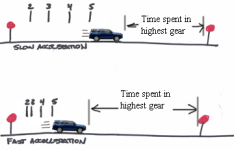
Makes sense to me... Consider this example with data harvested from what I remember while driving and thinking about other things and a highly scientific image to illustrate:

You're on a 45mph road, 50 miles long, with stop signs at evenly spaced intervals.

When driving granny-like, the engine is running slower, but it's spending more time covering distance in the lower gears. So the 2000 engine RPMs are being spent less efficiently until it works its way up to 5th gear.

When you accelerate a little harder, you get up to 45 mph quicker and the engine spends less time at higher RPM's with lesser output, and spends more time in 5th gear at a constant speed.

Just my theory with absolutely no math or science to go with it. One thing that always baffles me is the whole "You get better MPG on the highway going 45mph than 90mph" because I keep thinking "but the engine is running twice as long, so...."

Dutifully Submitted,
KC Murphy: Overthinking everything since 1972
 

Attachments

  • stupid picture.png
    stupid picture.png
    33.4 KB · Views: 281
Last edited:
Montego Murph summed the thread perfectly. LOL!

Ha! I'm just glad I'm aware of the neurosis!

Like many others have said elsewhere, if we wanted 50 mpg we should have bought Corollas and Echos. These trucks are gas hogs by design, however I see nothing wrong with trying to operate them as efficiently as possible. As I get older, I'm becoming aware that even though I'm making good money now and don't have to worry about 14mpg vs 19mpg, as technology advances my career may flat out disappear and that unspent money in my savings account might mean a whole lot more to me.

Or, I might just blow it on beer and women.
 
This is something interesting I figured out by accident.

Driving *slightly* more aggressively will give a bit better MPG than granny-pedaling it. For a few days at work I had to do a lot of running around town. I topped off the tank and did what I had to do, then topped off again when I was done. (Made it easier for expenses this way) I use the Fuelly app to track MPG, and I've observed that the dash computer is optimistic by 2mpg.

I noticed that by putting a little more mustard on it, my MPG was actually up about 2 mpg than the usual. I'm guessing this was because I was spending less time in the lower gears.

Makes sense to me... Consider this example with data harvested from what I remember while driving and thinking about other things and a highly scientific image to illustrate:

You're on a 45mph road, 50 miles long, with stop signs at evenly spaced intervals.

When driving granny-like, the engine is running slower, but it's spending more time covering distance in the lower gears. So the 2000 engine RPMs are being spent less efficiently until it works its way up to 5th gear.

When you accelerate a little harder, you get up to 45 mph quicker and the engine spends less time at higher RPM's with lesser output, and spends more time in 5th gear at a constant speed.

Just my theory with absolutely no math or science to go with it. One thing that always baffles me is the whole "You get better MPG on the highway going 45mph than 90mph" because I keep thinking "but the engine is running twice as long, so...."

Dutifully Submitted,
KC Murphy: Overthinking everything since 1972

You're on to something here, that is well known among the automotive engine designers. That is simply that your engine is most efficient at turning fuel into mechanical work at wide open throttle. At part throttle, it takes a surprising amount of energy to pull air past the partly open throttle - about 3-4 horsepower for a 4.7L V8 running at 2000 rpm. Given that the the rolling and air resistance of a 4runner only requires about 15-18 HP to overcome at 60mph, you can see that throwing away 4 HP at the throttle plate is a big deal. The losses are lower with smaller engines; thus the move over the years toward hi-rpm low-displacement engines. Also, things like variable valve timing (VVTi) and other such design changes can reduce those "pumping" losses.

So, when you accelerate briskly, you are actually using less fuel to get up to speed. That's somewhat offset by spending more time at the higher speed, where air resistance provides a greater loss. However, as you've found out, it is not necessarily always more efficient mpg wise to drive like a granny.

My 1994 with the 3.0 V6 gets slightly better mileage when I drive it aggressively (if you can use that term with a 3vze), wrapping it up to 4000 rpm before upshifting. The difference is slight, but measurable by carefully recording and summing up injector timing over a few miles.
 

Members online

Forum statistics

Threads
278,316
Messages
3,554,113
Members
248,016
Latest member
Advally Service

Trending content

Back
Top