2010 Trail or 2008 Sport Edition

but when you apply it to 4wd systems, if the slip isn't transferred to a differential, then it gets transferred to the transfer case and driveline. That's what should be avoided.

Not following the wording.The slip would happen on dirt, too, but I know you're not saying to avoid that.
 
Actually, you can run in a straight line forever if you wanted to...but since I don't know of any roads that go straight forever, then I guess that's not gonna happen either! LOL

yep the road ALWAYS turns somewhere, although a straight shot would be nice from time to time ya know.
 
You have a good suggestion. I have done this little bit ( only because I am an idiot ) and I can feel the differences, so from the stand still i change it back in 2wd then put it in the 4Hi again after it straight out. So Now I know. This is my 1st 4WD Truck I own.

Good, so now you know the difference and won't do the sharp turn again. I'm not sure recommending the tight turn test is a great idea, except if you've been there once, you won't go there again.
 
Not following the wording.The slip would happen on dirt, too, but I know you're not saying to avoid that.


Right, the only thing I'm saying is that when a tire "slips" under ANY circumstances, then that slip is transferred to the differential. There's no way for a tire to slip and not transfer that movement to a differential unless of course there is no differential to speak of. And if there's no differential, then that slip becomes absorbed somewhere in the drivetrain, which isn't an ideal situation.
 
From what I understand the manual says about drivertain damage if you drive on dry pavement with locked central differential on Limited or locked rear differential on Trail. And it's just not recommended for SR5 and Trail to use 4Hi on dry pavement. Correct me if I'm wrong but I got a feeling that transfer case is more forgiving that cental or rear differential and turning on dry pavement with 4hi on Trail or SR5 would just cause unnecessary wear for driveline and front tires, but it won't immediately damage drivetrain. Sort of like towing a heavy trailer or driving overloadrd truck. So it's not a good idea for Trail and SR5 to use 4hi on dry pavement (and there is no reason why to use 4x4), but it perfectly fine to use 4hi on wet pavement or on pavement with patches of snow in winter. As I said that what I got from everything I've read on the topic so far, please correct me if I'm wrong.

 
From what I understand the manual says about drivertain damage if you drive on dry pavement with locked central differential on Limited or locked rear differential on Trail. And it's just not recommended for SR5 and Trail to use 4Hi on dry pavement. Correct me if I'm wrong but I got a feeling that transfer case is more forgiving that cental or rear differential and turning on dry pavement with 4hi on Trail or SR5 would just cause unnecessary wear for driveline and front tires, but it won't immediately damage drivetrain. Sort of like towing a heavy trailer or driving overloadrd truck. So it's not a good idea for Trail and SR5 to use 4hi on dry pavement (and there is no reason why to use 4x4), but it perfectly fine to use 4hi on wet pavement or on pavement with patches of snow in winter. As I said that what I got from everything I've read on the topic so far, please correct me if I'm wrong.

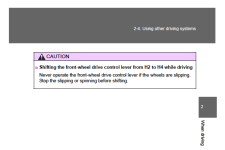
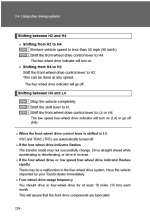
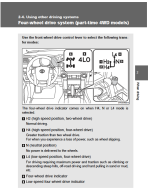
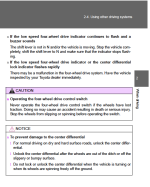
Here what it say in the User's manual on how to use 4wd System. I don't see they mention or warning anything about not to use 4wd HI on hard and dry road surface except the warning about central differential on the LT. see screen shots.
 

Attachments

  • Screen shot 2010-09-12 at 8.49.28 PM.png
    Screen shot 2010-09-12 at 8.49.28 PM.png
    23.6 KB · Views: 1,053
  • Screen shot 2010-09-12 at 8.49.44 PM.png
    Screen shot 2010-09-12 at 8.49.44 PM.png
    85.4 KB · Views: 1,075
  • Screen shot 2010-09-12 at 8.50.33 PM.png
    Screen shot 2010-09-12 at 8.50.33 PM.png
    107.5 KB · Views: 1,103
  • Screen shot 2010-09-12 at 8.51.29 PM.png
    Screen shot 2010-09-12 at 8.51.29 PM.png
    66.1 KB · Views: 1,101
Last edited:
Here what it say in the User's manual on how to use 4wd System. I don't see they mention or warning anything about not to use 4wd HI on hard and dry road surface except the warning about central differential on the LT. see screen shots.

It is obvious that you will need to go drive in 4hi on dry pavement and eventually break something before you decide that you shouldn't drive on dry pavement.
 
It is obvious that you will need to go drive in 4hi on dry pavement and eventually break something before you decide that you shouldn't drive on dry pavement.

Yeah, I agree.

Or better yet, he (or is it she?) should go drive around in circles in 4HI in a parking lot. It will only take about 2 seconds before it is completely obvious that something isn't right.
 
It is obvious that you will need to go drive in 4hi on dry pavement and eventually break something before you decide that you shouldn't drive on dry pavement.

I did not debate if you are write or wrong, all i say is, something that important, why doesn't state in the user's manual.
 
Whether its in the manual or not, don't do it. I speak from 20 years of off-roading experience with ten different four wheel drive vehicles.
 
Yeah, I agree.

Or better yet, he (or is it she?) should go drive around in circles in 4HI in a parking lot. It will only take about 2 seconds before it is completely obvious that something isn't right.

Hey hey be nice, I am maybe a little weak but i am still a man. :lmao:
 
Or better yet, he should go drive around in circles in 4HI in a parking lot. It will only take about 2 seconds before it is completely obvious that something isn't right.

That speaks to my point. The size of the circle matters hugely. A 1/2 steering wheel turn is a universe away from a steering wheel at full lock. That 1/2 turn on pavement can be less stressful than some tight turn, off road situations.

But, for the record, given a binary choice of answers on whether it should ever be done (center lock pavement), I agree, no is it.
 
Last edited:
I did not debate if you are write or wrong, all i say is, something that important, why doesn't state in the user's manual.

Your right about the owners manual Snow, I guess Toyota thinks everybody knows these things already. It's not very clear .

Here is some good reading on basic 4x4 do and don't's .
http://www.4x4abc.com/4WD101/def_turnpart.html

all 4WD/AWD on one page - a simple, easy to understand overview - all available 4WD, all wheel drive and 4x4 systems and their differences - 4WD concepts, their function, their layout, their purpose, their advantages
 

The funny thing is, yesterday I asked the dealer where i bought mine to address this issue, guess what they tell me......and i know........ if i say this they will jump me again. go figure.
 
I feel there is something wrong about the whole thing. 4x4abc.com says
"When traveling with part time 4WD on low traction surfaces like sand, gravel, mud, snow, etc. handling of the vehicle is unsafe (understeer) as well, but not as severe as on pavement." In the same time manual says that we can turn on 4Hi when speed it under 80 km/h (50mph). And it doesn't say that something is not safe or can cause damage. I wonder if 2010 T4R driveline is just that solid and doesn't afraid to be abused or Toyota really think that all 4Runner drivers are really knowlegable about this stuff?

I still think about rain or light snow situation - is it unsafe or/and can damage driveline to use 4Hi in such conditions? I doubt it, but maybe I'm wrong?
 
The picture of the cracked transfer case in a page link from the first link above is usually enough to make anyone instantly drop the idea of ever using a locked center on pavement. It sure had that effect on me for quite some time.
 

Members online

No members online now.

Forum statistics

Threads
278,316
Messages
3,554,120
Members
248,016
Latest member
Advally Service

Trending content

Back
Top