Can someone explain to me why we cant use the TRD supercharger on the 5th gen 4runners? are they not the same 4.0 V6 used in Tacomas? if this is an idiotic question to you please feel free to scroll on. No need to :fencing:
roller-rocker, dual VVTi 1GR-FE is not the same V6 as the Taco.Can someone explain to me why we cant use the TRD supercharger on the 5th gen 4runners? are they not the same 4.0 V6 used in Tacomas? if this is an idiotic question to you please feel free to scroll on. No need to :fencing:
Toyota canceling TRD supercharger program.
Toyota Discontinues TRD Supercharger Program
Good or bad?
Good because they are going to stop locking the ecru' sand let the aftermarket handle this area, or bad because they the aftermarket won't be there and now Toyota won't either?
Toyota canceling TRD supercharger program.
Toyota Discontinues TRD Supercharger Program
Good or bad?
Good because they are going to stop locking the ecu's and let the aftermarket handle this area, or bad because they won't allow unlocking of ecu's, and both the aftermarket and now Toyota won't be doing anything?
Doubtful this signals that Toyota is going to "unlock" their ECMs, it just means they no longer want to bother with superchargers because they have other goals/directions in mind and the TRD supercharger program was not worth the money invested vs. the return.
Because the fooking things were breaking left and right.
Is it that they were unreliable, was it installation error, or end user error?
I remember on the FJ Cruiser forums when the supercharger first came out there was one or two horror stories a month where a dealership that had never seen one of these things botched an install.
Doubtful this signals that Toyota is going to "unlock" their ECMs, it just means they no longer want to bother with superchargers because they have other goals/directions in mind and the TRD supercharger program was not worth the money invested vs. the return.
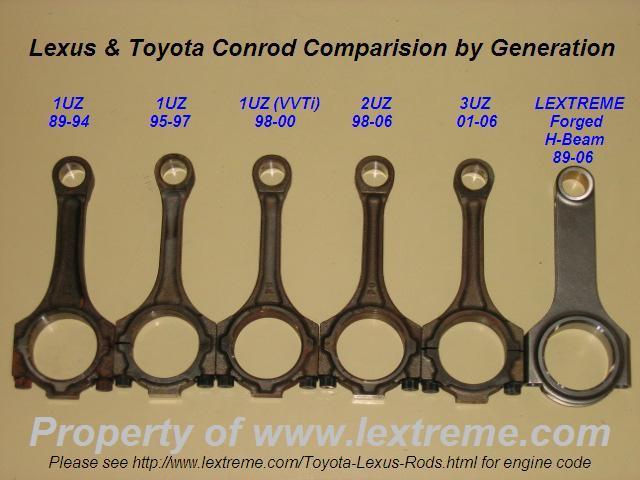
I imagine it was similar to the 2UZ-FE issues. Basically the engines are designed to be NA and when they started supercharging the 2UZ-FE they found that the connecting rods were too thin. This seems to be a common theme with Toyota engines today (I assume to reduce rotational mass and lighten the engines.) From what I have heard, just upgrading the rods makes the engines far more sturdy.
But based on the PANT bulletin, it just seems like not enough SC kits were being sold for how much investment went into them.
In the past Toyota stated they were going to pursue turbocharging to meet increasingly stringent fuel economy standards. We are starting to see that with vehicles like Lexus NX, could this point towards that becoming a reality?
If you plan on having your future vehicles turbocharged, then an optional supercharger becomes somewhat pointless.
This is all speculation of course, but we can't let this thread go...
I could see that, replacing the connecting rods wouldn't be a HUGE deal, but it'd change from being a "bolt on" installation to actual engine surgery.
Actually this I can somewhat confirm from chats with some people at HQ in passing. Toyota is planning on going with forced induction (most likely turbo-charging) and smaller displacement engines moving forward. The Lexus NX is a small stepping stone towards that goal. I would imagine that going forward we'll see heavier use of smaller displacement, Toyota's D4S GDI system, and turbo-charging.
Yeah, it does change it from a "bolt-on" affair I suppose (though really you're tearing the top half of the engine apart to install it anyways...)
Just to give you an idea with the 2UZ-FE:
![]()
From what I understand the 1GR-FE and 3UR-FE rods are similar in terms of weight shedding vs. stoutness (judging by the sheer amount of aftermarket "reinforced" rods out there, it's very well known also.)

this one?
A turbo 4Runner could be nice... down the road that is...
![]()
Sorry I had to.
How is that a bad comment... I used words like "could" and phrases like "down the road."