
You are using an out of date browser. It may not display this or other websites correctly.
You should upgrade or use an alternative browser.
You should upgrade or use an alternative browser.
2014 fuel mileage with 285s???
- Thread starter Bravo_25
- Start date
Register to hide this ad

thebwlife
Senior Member
whats the mpg lookn like ????
I average about 17.5 mixed driving.

wfo9
New member
whats the mpg lookn like ????
2014 should get the same as any other 5th gen. Most people would be lifted with 285s, which will hurt mileage more. MTs will generally be worse than ATs.
I have a 3" llift and a baja half rack and 285 ATs. I feel the rack and the lift really hurt on the freeway. I also find that mpg goes way down when diving into a head wind.
Anyway, right now with mixed city hwy I'm at 17.1. I've been as low as 15.8 and as high as 19 in the few months that I have had it. Seems to be getting better in the warmer weather (must be less ethanol in the fuel or something).

flying fuzz
Member
For the past year plus since I put on the 285's and OME lift I haven't gotten above 14.8, didn't buy it for the gas mileage tho so it doesn't bother me

STX4Runner
New member
I think the tires are the biggest factor. I went from the stock tires to stock size BFG ATs which weigh about 10 lbs more per tire than stock IIRC. My mileage dropped about 1 MPG. Then I got my lift, sliders and skids and didn't really lose any mileage.

arrogantbarber
New member
has anyone had poor mileage while breaking it in? i have 700 miles on my 2014 4rt and averaging 14ish. i dont remember paying much attention in the past with other new engines.
truck is stock. gobi rack and lift on order.
vince
truck is stock. gobi rack and lift on order.
vince

Speedy Gomez
Banned
whats the mpg lookn like ????
I don't know and I don't care. I just enjoy my 4Runner.
i have had mine for 2 weeks 900 miles and i have avreaged 17 mixed . first tank was 16 , i sold my 2007 fjc for this trail edition , my fjc had 285s loaded out all metaltech ect and best i got was 15 hwy . im looking to add tires and lift just asking i know the 4 runner has more hp . good to read what every ones is getting .

canadiansr5
New member
according to my road trip app....with 285s, billies, saw rear coils, and a gobi stealth on the roof i get about 16mpg average.

shaneotool
New member
I'm thinking about using lighter wheels like konig six shooters and P rated 285's to minimize the fuel hit...

1engineer
Moderator
I'm thinking about using lighter wheels like konig six shooters and P rated 285's to minimize the fuel hit...
It will help just not very much. If you only drove in they city then it could help more. In addition to creating more rotational mass you also have parasitic drag associated with wider tire and taller tire.
shaneotool
New member
It will help just not very much. If you only drove in they city then it could help more. In addition to creating more rotational mass you also have parasitic drag associated with wider tire and taller tire.
Looks like my lightest 285 option is around 66 lbs: 17" countersteers with P rated Cooper AT3s. 21lbs + 45lbs
My heaviest is 85 lbs: stock wheels and E rated Toyo AT2s. 29lbs + 56lbs
19 pounds has got to be worth a mpg or two, right? If not, I won't worry about the weight so much.
1engineer
Moderator
Looks like my lightest 285 option is around 66 lbs: 17" countersteers with P rated Cooper AT3s. 21lbs + 45lbs
My heaviest is 85 lbs: stock wheels and E rated Toyo AT2s. 29lbs + 56lbs
19 pounds has got to be worth a mpg or two, right? If not, I won't worry about the weight so much.
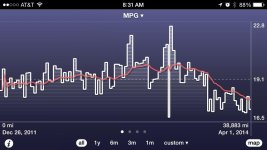
Unsprung weight savings really helps if most of your driving is stop and go or slow down and speed up. Why? Because in this scenario you are constantly having to accelerate that extra mass up to rotational speed over and over, say stoplight to stoplight. This takes a lot of power. On the interstate, once you get up to speed you basically are only using the HP to maintain that speed and not having to accelerate it. So, bigger tires cause you to lose efficiency in city driving because of weight and lighter wheels will help that a little. On the highway, the bigger tires will decrease efficiency because of increased width, which increases rolling resistance due to larger contact patch and being taller will decrease aerodynamic efficiency somewhat. All in all about a 10-15% decrease and that's just running bigger tires. Adding a rack, skids, sliders, bumpers and such will drop it another 10-15%. Lifting it will drop it about 3-5% more. [MENTION=45399]thebwlife[/MENTION] posted a good chart above. You can see with actual data he dropped about 10-15%.
thebwlife
Senior Member
Looks like my lightest 285 option is around 66 lbs: 17" countersteers with P rated Cooper AT3s. 21lbs + 45lbs
My heaviest is 85 lbs: stock wheels and E rated Toyo AT2s. 29lbs + 56lbs
19 pounds has got to be worth a mpg or two, right? If not, I won't worry about the weight so much.
Try what ever scheme you want to make up a way to get better gas milage. It's not going to matter. If you put non stock tires on it you will get worse gas milage period...
You not going to gain 10-15% efficiency from changing wheels. Maybe 1-3% - if you like them do it, but don't try to BS yourself.
I think the drag of a lift (to fit the tires) and the tires width and height will matter a whole lot more.
I have real data posted above to prove my point...
thebwlife
Senior Member
Unsprung weight savings really helps if most of your driving is stop and go or slow down and speed up. Why? Because in this scenario you are constantly having to accelerate that extra mass up to rotational speed over and over, say stoplight to stoplight. This takes a lot of power. On the interstate, once you get up to speed you basically are only using the HP to maintain that speed and not having to accelerate it. So, bigger tires cause you to lose efficiency in city driving because of weight and lighter wheels will help that a little. On the highway, the bigger tires will decrease efficiency because of increased width, which increases rolling resistance due to larger contact patch and being taller will decrease aerodynamic efficiency somewhat. All in all about a 10-15% decrease and that's just running bigger tires. Adding a rack, skids, sliders, bumpers and such will drop it another 10-15%. Lifting it will drop it about 3-5% more. [MENTION=45399]thebwlife[/MENTION] posted a good chart above. You can see with actual data he dropped about 10-15%.
But see if I think it will help enough times it becomes fact and true...
shaneotool
New member
But see if I think it will help enough times it becomes fact and true...
No need to be a jerk about it.
I'm just trying to figure out how much "weight" I should give wheel and tire weight. If it only makes a 2% difference going from one extreme to the other - I'll just slap some heavy mud tires on my stock wheels and call it good.

alphabeast
New member
So if my math is somewhat accurate, if you install a lift, run 285's, you should on average lose about 4 MPG. If you are averaging 18 MPG before lift and 285's, drive 15,000 miles a year, and the average cost of gas (US) is $3.50, this would roughly cost you between $500-$600 dollar a year... a lot of money but I am still going to do it :thumb3:

