2014 Toyota 4Runner Fails Frontal Crash Tests

Register to hide this ad
you have to take this with a grain of salt. govt standards don't require this but the IIHS tests for this.

plus when this new test came out, its not like everyone is going to change a vehicle generation biggest part to adjust for a test that isn't even mandated by govt standards.

now if you brought out a new gen after this, I can see this making a difference.

everyone on that list that sucked will come back with a PR spin saying they meet the govt standards.
 
"Fails" is a bit misleading. The 2014 4R is rated "Marginal" for front small overlap testing, but GOOD on all other tests.

From what I've seen, 2013 received all GOOD marks (front small overlap is new, I think, and 2013 was not subjected to this test - unless you have another link/report that says otherwise).
 
What are the testing methods? It looks like they are doing high speed (above 40mph probably) highly offset impacts that seem very implausible. What I mean by that is typically most accidents seem to be more inline with what the NHTSA is testing for, where as the IIHS is testing for what seems like if the driver decided to drive 60mph and hit a light pole directly inline with the driver's side fender almost to the edge of where the vehicle should conceivably glance off it.

I'm not saying vehicles shouldn't be made safer, but this seems almost like their trying to fail vehicles; I can't conceivably see where such an impact with an immovable object would at such high speeds, result in that clean a "glancing" blow.
 
[MENTION=95578]2013Trail[/MENTION] I thought you said fail? I read your linked article and I saw "marginal" for the 4Runner. Big difference. The only "fail" I see here was your choice of sensationalism thread titles. Here it is in case you didn't read it right:

"The Jeep Grand Cherokee, Toyota 4Runner and Ford Explorer were rated "marginal,"

Now,

"Introduced in 2012, the small overlap frontal crash test simulates a frontal collision on the driver's side that only involves 25 percent of the vehicle's front end. Vehicles crash into a 5-foot-tall rigid barrier at 40 mph, which the IIHS says is a proper indicator of real-world crashes with slim objects, like utility poles or trees, and with other vehicles when a car steps over the lane. The longer-running overlap test involves 40 percent of the car's front end."

The only way a vehicle that a vehicle designed before 2012 passes the test is luck. Wonder if you could take a 4th gen and pass it? Maybe, maybe not. I'm sure the JGC, 4Runner and others will do just fine in the next models.
 
I was in a front end collision in February in my 2011 and I was very happy with the way it took. I would buy another in a heartbeat.
 
1engineer, if you consider "marginal" to be a success, more power to you. I consider it to be a failure.
 
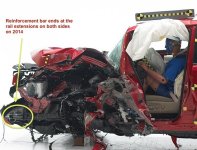
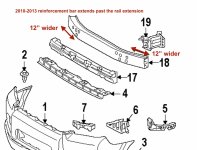
Can someone with a 2014 4Runner peak under the bumper cover to see if the reinforcement bar extends past the rail extensions? It appears from the IHS crash picture that the reinforcement bar on the 2014 model is narrower. If so, shame on Toyota... The wider reinforcement bar would have deflected a lot of the impact energy to the frame rails instead of the body. As you can see in the picture the frame suffered minimal deformation.
 

Attachments

  • 4R.jpg
    4R.jpg
    79.5 KB · Views: 3,664
  • bumper.jpg
    bumper.jpg
    114.1 KB · Views: 2,267
Take a look at the slow motion footage (starts at 34 seconds) and note the dummy head hits the airbag close to center. This is good since other models tested have the steering column shift to the right and the dummy head hits off center.

Note the side airbag extends forward and there is only a little marking on it. This is also good.

For comparison, take a look at the Pilot video. The dummy head slides off the airbag and goes between it and the side airbag (too short). That is bad! If I were considering a Pilot I would skip it for this reason and the high intrusion.

I have seen many of these crash test videos over the years and the 4Runner does pretty well, considering it is a NEW test.

Given the Highlander was just redesigned, it is not a good result for that model. I expected it to do MUCH better.
 
Very good find!
For all of you who have lifted it and are thinking about a body mount chop watch the LF wheel. Now imagine what would happen if that body mount was not there after being chopped.

From the top view it looks like a combination of the body mount and a-pillar push the vehicle away from the barrier. I'd say it's not advisable to keep you foot on the dead pedal if you're expecting a crash!
 
The 4Runner is obviously the worst vehicle ever made by the worst car manufacturer in the world :p Why even respond to this troll?
 
Very good find!
For all of you who have lifted it and are thinking about a body mount chop watch the LF wheel. Now imagine what would happen if that body mount was not there after being chopped.

The wheel would still go flying off on a tangent...looks like the UCA ball joint sheered off, should've upgraded to uniballs :becky:
 
Can someone with a 2014 4Runner peak under the bumper cover to see if the reinforcement bar extends past the rail extensions? It appears from the IHS crash picture that the reinforcement bar on the 2014 model is narrower. If so, shame on Toyota... The wider reinforcement bar would have deflected a lot of the impact energy to the frame rails instead of the body. As you can see in the picture the frame suffered minimal deformation.

The 2014 front bumper aluminum box does now end at the width of the frame rail. There is a square tube steel extension added to it that extends out another 8 - 10". That is the bar you see folded back in the circled area. I imagine this was done to allow the bumper to conform to the new shape of the 2014 nose without having to create a completely new bumper box. But at the impact speeds of the test I 'm not sure the full length aluminum box would have been any more helpful.

I also think part of what hurts the 4runner in this test is the very body on frame construction that we all prize. In that construction the main body tub starts at the firewall. There just isn't much that can be done forward of there to strengthen that area short of a complete redesign. And I'm willing to bet that left front wheel is designed to shear off and submarine like that so it has less of a chance to deflect into the driver's compartment. In a unibody construction like the Equinox/Terrain they had the entire length of the vehicle body structure to design in more crush/deflection zones. This is probably what allowed the Equinox to deflect to the right and away from the barrier after the impact.

I drive by several lighted highway signs between Houston and San Antonio on my way to work. They keep a running total of traffic fatalities just for the state of Texas each calendar year. As of the end of March it was already up to almost 500. In 2013 it ended up being nearly 3,000. Just in Texas. Until they can address something to remove the human element there is only so much the manufacturers can do to make cars safer and affordable. And anyone who has driven a 60's or 70's era car has to admit they have come a LONG way.
 

What I find amazing is the speed the airbag deploy! Watching it in slow motion and even then, pop their there. Also did everyone notice the knee airbags deploying, lower right hand side 35sec mark, you can just see it, then go back to the 29sec mark. In this crash that would be a VERY important airbag that a lot of the competitors don't have.

So cool to watch the details, great find and thanks! Ie. the airbag on the passenger side didn't go off, either it was a third row 4R or airbag extend all the way back, a secondary bag is deployed 'late(?)' from the left hand side of the drivers seat, just behind the shoulder.

I just watched the Jeep Grand Cherokee and MAJOR FLAW! I personally would goes as far as saying, near recall material!! Watch its video https://www.youtube.com/watch?v=k1NleeWH4_4 notice at the 37sec mark when the side airbag deploys, it DOES NOT expend forward enough to offer any protection and pause it on the 39sec mark, it looks as if the dummies neck could snap! Additionally, no protection from any secondary impacts, from this impact or a side impact on the drivers front quarter panel (a more common running red/stop sign impact.). Seriously, if you know a 2014 Jeep Grand Cherokee owner, I would have them complain!
 
Last edited:
Yeah, I like the head shaped gap between the side and steering wheel airbags on the Jeep! Why not extend that side airbag another 10 inches? Oh, that's right, you blew your design budget on the air suspension and 9 speed tranny!
 

Members online

Forum statistics

Threads
278,316
Messages
3,554,111
Members
248,016
Latest member
Advally Service

Trending content

Back
Top