3VZE Front Crank Sleeve Too Long?

itgogitrev

New member
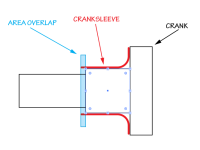
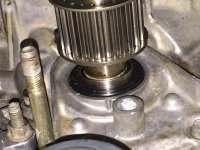
Hey guys, I just installed a Redi-Sleeve on the front of my V6 while I was replacing the crank seal. It sits about 1/8" over the edge and I'm afraid that it's going to conflict with the timing belt gear. What is the best way to trim this WHILE on the crank?

The sleeve is completely seated (no burrs or anything to catch on). I spent an additional 5 minutes tapping it in just to make sure it's as far as it can go; every hammer blow felt solid.

I'd rather not pull the sleeve off the crank to trim it, but i will if I have to.

If you have any ideas or suggestions on how to approach this, lemme know!
 

Attachments

  • IMG_1428.jpg
    IMG_1428.jpg
    132.2 KB · Views: 1,751
Register to hide this ad
I think i found a solution for it.

I'm taking parts from a copper pipe cutter and assembling them to hinge on the cadmium plated stud hanging off the front of the engine. If I attach a pry bar to the assembly and use the stud as a pivot point, I can rotate the engine by hand while keeping pressure on the cutting wheel.

Should only take a few rotations to get through. It'll be either a great success or a terrible failure. :)
 
I think i found a solution for it.

I'm taking parts from a copper pipe cutter and assembling them to hinge on the cadmium plated stud hanging off the front of the engine. If I attach a pry bar to the assembly and use the stud as a pivot point, I can rotate the engine by hand while keeping pressure on the cutting wheel.

Should only take a few rotations to get through. It'll be either a great success or a terrible failure. :)

might I suggest, to lower the blade below the level of the crank snout just slightly, anywhere between the end of the crank, and the seal will work. so the back side is supported and you are able to apply enough pressure to actually make it cut, without distorting the sleeve.
 
might I suggest, to lower the blade below the level of the crank snout just slightly, anywhere between the end of the crank, and the seal will work. so the back side is supported and you are able to apply enough pressure to actually make it cut, without distorting the sleeve.

Correct, it will be cut "on the crank". I won't really be trimming just the edge off, I'm going to be going about 1/8" onto the snout.
 
When you measured the timing pulley, how much interference was there? I'd verify you have to actually cut this down before trying it.
You might be better off using a Dremel to make the initial cut using a steel saw or fiberglass reinforced cutoff wheel. You might be able to get some bushing stock or a chunk of wood with a hole drilled in it, and make a Dremel holding fixture and rotate it around the shaft using it as a pilot.
 
If it were me, I'd pull the cover off, remove that sleeve and put another sleeve on, especially if that engine is still on a stand and not installed in the vehicle.

One of the most annoying things to have happen is to have McGuyver'd something like this, then have it fail a month or three down the road. Cutting on that with a dremel will introduce a good deal of heat to that seal, along with shavings that could possibly get in there and destroy that seal, causing a nice front main leak!

I'm not saying that you aren't capable of cutting that sleeve without damaging anything, but if its still easily accessible, why not just pull the cover off, trim the sleeve or put a proper sized one on, or at least check as to why that one doesn't fit correctly. It should not be doing what it is doing unless its either not seating against the edge of that crank where its supposed to, or its the wrong one for the vehicle.

I'd think it would be much easier to just go back about a half hour's worth of work, get 'r done right, and never, ever have to worry about this again.
 
When you measured the timing pulley, how much interference was there? I'd verify you have to actually cut this down before trying it.
You might be better off using a Dremel to make the initial cut using a steel saw or fiberglass reinforced cutoff wheel. You might be able to get some bushing stock or a chunk of wood with a hole drilled in it, and make a Dremel holding fixture and rotate it around the shaft using it as a pilot.

The sleeve is about 1/8" over the edge. I'm slightly worried about the interference, but I'm much more concerned about putting everything back on and torquing it down. Don't want anything getting crushed and having a timing gear that doesn't sit flush to the crank.

I thought about using a Dremel for this, but I don't think I'll have enough room to rotate the whole assembly easily. Plus, I'm afraid that I won't get as clean of a cut. I don't need to cut through the entire sleeve, just enough to give it a really good score. Then I can tear it off with some needlenose pliers.
 
If it were me, I'd pull the cover off, remove that sleeve and put another sleeve on, especially if that engine is still on a stand and not installed in the vehicle.

One of the most annoying things to have happen is to have McGuyver'd something like this, then have it fail a month or three down the road. Cutting on that with a dremel will introduce a good deal of heat to that seal, along with shavings that could possibly get in there and destroy that seal, causing a nice front main leak!

I'm not saying that you aren't capable of cutting that sleeve without damaging anything, but if its still easily accessible, why not just pull the cover off, trim the sleeve or put a proper sized one on, or at least check as to why that one doesn't fit correctly. It should not be doing what it is doing unless its either not seating against the edge of that crank where its supposed to, or its the wrong one for the vehicle.

I'd think it would be much easier to just go back about a half hour's worth of work, get 'r done right, and never, ever have to worry about this again.

Indeed, I totally agree with you on a lot of what you've brought up. Unfortunately, here's what's going on with it:

- The engine is still in my 4Runner. I don't even have the radiator out of it.

- Metal shavings and heat were a concern for me, which is why I'm going to score the sleeve with a fixed pipe cutter blade instead of using a dremel. Low heat and no shavings/dust, but it will require a little deburring for a clean edge.

- I went back and looked at the depth of the seal. The place I bought the sleeve (O'Reilleys) only looks at the I.D. for a fit and doesn't consider the depth. I compared the specs of the sleeve vs the depth of the contact surface and sure enough, it's 1/8" oversized. I could complain to them about it, but it's really my fault for not considering it. Lesson learned and moving on.

- I like a good challenge. :)
 
Being that its still in the vehicle, that changes everything! Take some photos of the finished job and some info on how hard it was/how you did it. I'm sure someone will run into the same situation and that will help them out.

It sucks that it was that much longer, but at least you can get to it to trim it down. Hope it goes well (and easy) for ya!
 
Being that its still in the vehicle, that changes everything! Take some photos of the finished job and some info on how hard it was/how you did it. I'm sure someone will run into the same situation and that will help them out.

It sucks that it was that much longer, but at least you can get to it to trim it down. Hope it goes well (and easy) for ya!

Oh man, if the engine was out, I'd just pull the plugs, line it up on a lathe and cut it. That would be ideal... aside from having the correctly sized sleeve from the beginning. :)
 
Alrighty, we have success!

But first, my pipe cutter idea was shot to shit this morning. I went to a couple of big box stores to look for a pipe cutter that would fit. Everything was just outside of my dimensions. Instead, I bought a glass cutter and a couple of pipe cutting blades. I had to notch out the glass cutter a little bit and cut a flat spot for a pivot point, but everything fit great.

Instead of building an assembly to make it work, I just asked for a second set of hands from my neighbor. I had him spin the engine SLOWLY with a drill on the 19mm bolt while I applied pressure on the glass cutter against the sleeve. 3 minutes and we had a really good score line. 6 minutes and we were completely through the sleeve.

It did have a bit of a sharp edge, so I covered the seal surface with clay and applied a small file to the edge. I vacuumed the area up before removing the clay to minimize the metal dust.

All in all, it took about 30 minutes to cut the sleeve and clean it up; about 45 minutes including the mods to the glass cutter. Total cost was $10.70 for the glass cutter and the blades.

Off to button things up with the timing belt! Thanks guys for your idea and suggestions for helping me get through this.
 
NICE!!!!

Love the idea of clay to cover the seal! I was thinking cardboard with a hole for the sleeve and tape, but that would actually work much better, as it would catch the filings and keep it completely sealed up!

Good job! And welcome to the McGuyver club!!!! LOL!
 

Members online

Forum statistics

Threads
278,316
Messages
3,554,113
Members
248,016
Latest member
Advally Service

Trending content

Back
Top