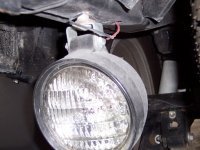
Applying one very basic electrical engineering equation it will be easy to see if this is possible for you or not.
One thing to keep in mind is that this large change in wattage will lead to alot more heat then the space in the lamp was designed for. Without even going into the numbers you may melt the housing by doing this. Lets assume for a minute that it doesn't
Right now the stock bulb has a power of 16W. This means that it draws 1.33 amps from the battery because P=V*I or I=P/V where I is the current, P is the power and V is the voltage. Your truck's electrical system operates at the battery voltage of 12V.
Switching to a bulb that has a power rating of 50 W more than triples the current drawn from the battery to 4.17 amps. You are now drawing an additional 5.68 amps (difference between 1.33A*2 lights and 4.17A*2 lights) into the circuit.
Now I doubt that the reverse lights are on a fuse of their own, but lets assume for a moment they are. They would most likely be on a 5A fuse (1.33A*2 lights = 2.66 A < 5A) with wiring designed for 5A max current. Applying the numbers above the new bulbs would draw (4.17A*2 lights = 8.34A > 5A). Upon installing the new bulbs and turning them "on" the fuse would immediately blow as the circuit is drawing more current than the fuse is designed for.
The easy fix here is to install a fuse w/ a greater max load limit. This is a BAD IDEA!!!!! Your truck's wiring was designed to carry a set amount of current, in this case 5A max. If inserted, say, a 10 A fuse, the weak spot is now the wiring itself, not the fuse. The wires would cook off the insulation and become so hot they could start a fire. Many cars have gone up in flames because of people's ignorance to these type of things.
All circuits in a car or truck are designed the same way. They determine the load of all the devices on the circuit, infer a current (I) number, and design the wire and fusing appropriately with usually a small safety factor built in. For example, if the total load on a circuit infers a current of 18A, they would most likely use a 25A fuse instead of a 20A fuse. A decent amount of difference between operating range and max range, but as you can see from the example above, if you installed the 50W bulbs it would still end up blowing the fuse. The problem of melting wires is more common in cars because the inherently low voltage of the battery means bigger differences in current draw per change in load (i.e. light wattages).
NEVER REPLACE FUSES WITH ONES OF HIGHER RATING.
My recommendation: Leave them as they are. 50W is too much power for the reverse light. Try an alternate solution like the hitch mounted light, or separate reverse lights altogether.
You've been schooled..