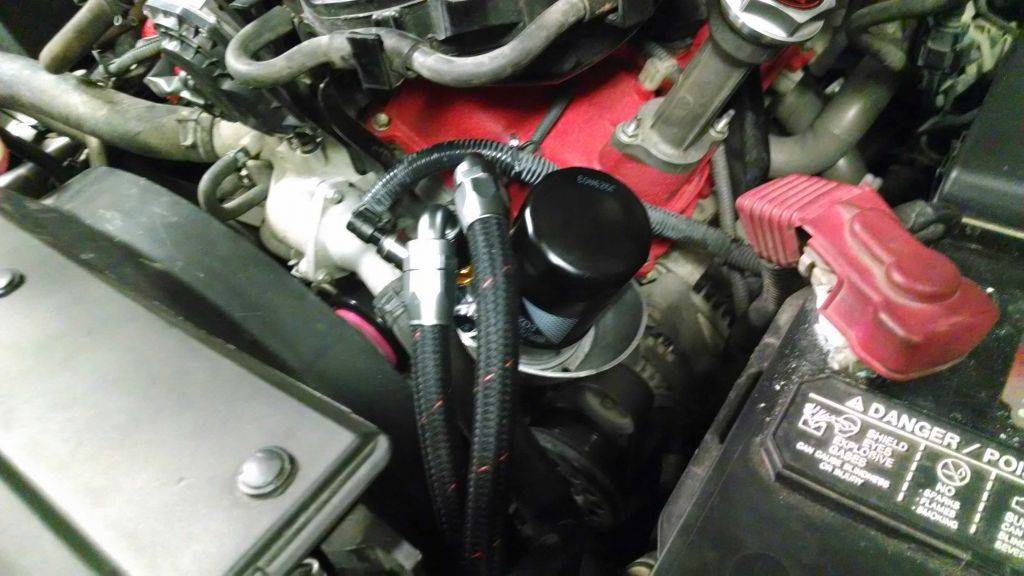
Not sure what part of Texas you have been to; but it sounds like you failed to leave whatever zipcode you were in. A trans cooler is not a bad idea if the OP does any amount of towing. Even a light load can heat up a transmission if he is pulling it around in the city. Besides - a $100 cooler is a lot cheaper than having to have a transmission repaired because of a "just this one time" trip with a load.
I'd agree with tx_shooter. If you have a V6 and tow a lot, adding an auxiliary tranny cooler is a good insurance policy. The factory set up has the hot transmission oil going into the lower part of the radiator to cool it, and then coming back out and returning to the tranny. You can feel the temp difference between the two lines if you warm up your engine and tranny, and then touch each line with your hand after running the truck for a short while. (Be careful... don't get run over, or hurt yourself!).
Heat is the enemy of for your tranny, and I feel that the auxiliary tranny cooler is good insurance if you plan to tow.
Since you plan to get the OBD II reader to check this info, they I suppose you can wait and gather some data first. On my 2004 SR5 V6, with the OBD II reader that I had, i had a gauge for engine temp, but no read out for tranny temp... so I could assume that when the oil temp rose, that the tranny temp rose too, but I didn't have any exact data. Pulling a 4000 lb through some moutains in Rhode Island (guys out west would call them small hills... LOL !!!) I did notice that my engine oil temp rose by as much as 6 to 8 degrees. Slowing down to less than 70 mph helped cool it some, and downshifting , as NuclearN8 said, raised the engine temp noticeably and quickly. I didn't have any direct readings of the tranny temp, and I *did* have the hayden tranny cooler installed. All that I can say is it gave me peace of mind.
Of course, later in the summer, I accidentally sunk the truck at a boat ramp, totalling it in the process, so I suppose the tranny cooler didn't matter at all in that situation.
Regarding the tranny temp, If you add an aftermarket tranny cooler, the recommended set up is to tap into the line that returns cooled fluid to the tranny, and run that cooled fluid through your auxiliary cooler and then back to the tranny. It's also recommended that you place the auxiliary cooler in front of the radiator and AC condensor unit.
I used some brass 90 degree elbows from home depot's plumbing area along with a straight union connector an put them together to make a 180 degree, solid brass "U" connector. This allowed me to tap into the transmission lines, and route the new lines where I wanted without putting any serious bends in the lines.
Sorry I don't have photos. I got rid of that truck (I sunk it accidentally while launching my boat !!!), so I can't give you more specific instructios.
I went with a
hayden transmission cooler in my v6 4Runner. It wasn't that expensive (less than $150 for cooler, lines and all parts), and the install took me a couple of hours (I'm slow, I took my time planning it and protecting the transmission lines from chaffing or damage. Someone "good" could knock it out a lot faster).
Maybe I drank the marketing cool-aid, but the link I included shows how high temps affect tranny life. Plus, I was talking to some guys at an AAMCO shop (while having my tranny repaired on a car... nothing special... after about 20 yrs the tranny went out on an old Benz i drive...), and they felt that a transmission cooler was a very wise investment if you planned on doing any extended towing.
They felt that the tranny should hold up almost indefinitely, as long as you didn't overheat it.
Regarding my new (new to me) V8, I saw a factory cooler in front of the radiator. Can someone tell me if this is a tranny cooler?
If the V8 has a factory auxiliary cooler, then I'm assuming that I'm good to go, and I shouldn't touch a thing.
Regarding an engine oil cooler, I'm not as familiar with using them. My impression is that they really aren't needed. Your radiator does a good job of cooling your engine, and you have a temp gauge, so you can see if you're starting to overheat the engine, and shut it down before you actually do. The V6's can be damaged if you over heat them, so shut it down if it starts to overheat, and let it cool down or get a tow -- not that overheating is GOOD for ANY engine, but my understanding is the V6's can be easily damaged from overheating because the aluminum block can be easily damaged when it is over heated.