johnnywofee
New member
5th Gen 4Runner – On Board Hot Shower (Heat Exchanger, DudaDiesel, $<100 with )
*****Any 5th Gen 4Runner Owners install this under the hood, Heat Exchanger+Pump < $100 ??????
After using the Coleman Hot Water on-demand for years, I was suffering from this bulky design and difficult setup during road trip and camping.
I start to look at alternatives including another standalone hot water on demand system (Coleman or Mr. Heater B.O.S.S) or on board shower with a heat exchanger.
Certainly, there are pros and cons of different kinds of hot shower system while you are on the road. I am looking for something that it can be easily setup with a non-tech guy (like me, no knowledge of the engine/mechanical stuffs at all) without major change under the hood :
1. Heat Exchanger Types : I read through many forum, some of them are self built (brass/copper rods) or purchase a complete set kit (e.g. Helton). They are all outside my technical capability or budget. Recently, people start to use some kind of plate exchanger (e.g. DudaDiesel). They are more affordable nowadays ($40-$110). They have different size, plates and connectors type. Some people said 10 plates should be good enough, meanwhile some people want 40 plates since it can produce hot water even though the engine is in idle state (e.g. 800rpm). You can also adjust the temperature of hot water by changing the air-heater temperature level inside the vehicle (basically control the coolant flow rate).
https://www.dudadiesel.com/search.php?query=b3-12a
a. By adding this kind of Heat Exchanger (e.g. connect in series with the Core Heater return Hose), is there any potential risks in terms of mechanical failure (e.g. coolant leaks, pressure level reduced, heat exchanger cause fire……..) ??
b. Any 5th gen 4runner owner install DudaDiesel plate heat exchanger ? How many plates ? Which model you used?
c. What connector types/size would be the easiest for non-tech person to carry out this project in the 5th gen 4runner? E.g. ½” Male NPT, ½” Hose Barb, 3/8” Copper Sweat…..
d. I want to have “warm water” even though engine is in idle running (e.g. 800rpm) and water temperature “can be increased” by air-heater level inside the vehicle. Should I go for 40 plates instead of 10 plates? (Some people said, more plates may not help too much on temperature, surface area is the key instead)
e. After you install this type of plate heat exchanger, will it be cracked/damaged during winter of freezing weather, some water was left inside the exchanger, right?? What are you going to do in winter time?
2. Connection method :
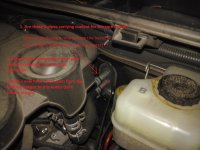
f. I look under the hood, there are 2 pipes (coolant flows through them) of core heater hose going through the firewall into the vehicle. Anybody knows :
Upper Pipe (Coolant returns from the heater) ??
Lower Pipe (Coolant flows into the heater) ??
Certainly, it can be verified by touch them to see which one is hotter (flow into the core heater). But this is not scientific, could be wrong !
g. I intend to connect the heat exchanger in series with the coolant return path (i.e. after coolant going out from the core heater unit). Then, I just need to disconnect one hose to minimise the change. There is no impact on existing core heater for its heating performance. I can also control the water temperature with the core heater knob (coolant flow rate) inside the vehicle as well. Anyone has such similar configuration setup in the 5th gen?
h. :surfer::surfer::surfer:What is the dimension of the core heater hose that I should buy?
3. Tool and Skill : I do not have any tool to disconnect the core heater hose and reconnect it to the heat exchanger, looks like there is a clamp to release and then reconnect, is there any special tool/skill for this installation? This is another reason why I want to choose the simple connector types of the heat exchanger to match the hose dimension. I want Plug and Play method if possible.
4. After installation: I need to refill coolant (there may have some lost by redirect it to the heat exchanger)? How can I verify the existing core heater (hot and cold air blow out from it) still functioning as before? For those professional mechanics, do they have any tool to check the coolant pressure/level, heater performance??
*****Any 5th Gen 4Runner Owners install this under the hood, Heat Exchanger+Pump < $100 ??????
After using the Coleman Hot Water on-demand for years, I was suffering from this bulky design and difficult setup during road trip and camping.
I start to look at alternatives including another standalone hot water on demand system (Coleman or Mr. Heater B.O.S.S) or on board shower with a heat exchanger.
Certainly, there are pros and cons of different kinds of hot shower system while you are on the road. I am looking for something that it can be easily setup with a non-tech guy (like me, no knowledge of the engine/mechanical stuffs at all) without major change under the hood :
1. Heat Exchanger Types : I read through many forum, some of them are self built (brass/copper rods) or purchase a complete set kit (e.g. Helton). They are all outside my technical capability or budget. Recently, people start to use some kind of plate exchanger (e.g. DudaDiesel). They are more affordable nowadays ($40-$110). They have different size, plates and connectors type. Some people said 10 plates should be good enough, meanwhile some people want 40 plates since it can produce hot water even though the engine is in idle state (e.g. 800rpm). You can also adjust the temperature of hot water by changing the air-heater temperature level inside the vehicle (basically control the coolant flow rate).
https://www.dudadiesel.com/search.php?query=b3-12a
a. By adding this kind of Heat Exchanger (e.g. connect in series with the Core Heater return Hose), is there any potential risks in terms of mechanical failure (e.g. coolant leaks, pressure level reduced, heat exchanger cause fire……..) ??
b. Any 5th gen 4runner owner install DudaDiesel plate heat exchanger ? How many plates ? Which model you used?
c. What connector types/size would be the easiest for non-tech person to carry out this project in the 5th gen 4runner? E.g. ½” Male NPT, ½” Hose Barb, 3/8” Copper Sweat…..
d. I want to have “warm water” even though engine is in idle running (e.g. 800rpm) and water temperature “can be increased” by air-heater level inside the vehicle. Should I go for 40 plates instead of 10 plates? (Some people said, more plates may not help too much on temperature, surface area is the key instead)
e. After you install this type of plate heat exchanger, will it be cracked/damaged during winter of freezing weather, some water was left inside the exchanger, right?? What are you going to do in winter time?
2. Connection method :
f. I look under the hood, there are 2 pipes (coolant flows through them) of core heater hose going through the firewall into the vehicle. Anybody knows :
Upper Pipe (Coolant returns from the heater) ??
Lower Pipe (Coolant flows into the heater) ??
Certainly, it can be verified by touch them to see which one is hotter (flow into the core heater). But this is not scientific, could be wrong !
g. I intend to connect the heat exchanger in series with the coolant return path (i.e. after coolant going out from the core heater unit). Then, I just need to disconnect one hose to minimise the change. There is no impact on existing core heater for its heating performance. I can also control the water temperature with the core heater knob (coolant flow rate) inside the vehicle as well. Anyone has such similar configuration setup in the 5th gen?
h. :surfer::surfer::surfer:What is the dimension of the core heater hose that I should buy?
3. Tool and Skill : I do not have any tool to disconnect the core heater hose and reconnect it to the heat exchanger, looks like there is a clamp to release and then reconnect, is there any special tool/skill for this installation? This is another reason why I want to choose the simple connector types of the heat exchanger to match the hose dimension. I want Plug and Play method if possible.
4. After installation: I need to refill coolant (there may have some lost by redirect it to the heat exchanger)? How can I verify the existing core heater (hot and cold air blow out from it) still functioning as before? For those professional mechanics, do they have any tool to check the coolant pressure/level, heater performance??
Attachments
Last edited:

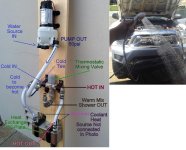
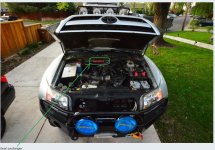


 Finally found a 5th Gen 4Runner installed this kind of Hot Water Shower On Board by using heat exchanger method.