According to Odyssey, 31M-PC2150 is not suitable for our application

[MENTION=8206]harper7[/MENTION] this kind of concludes that without the proper external battery management (an external charger that one would need to hook up to the car), using a single Odyssey 31M-PC2150 or Diehard Platinum 31M is NOT the ultimate solution for our trucks when we want to run a fridge or so always ON accessories. :(

I was hoping that it is the solution, but further research yields unfavorable answer (sucks that I have an Odyssey 31M-PC2150 in transit already).

This may also be the reason why many 4Runner(or automobile) owner ran into problems with these batteries (otherwise should be very good and should have an ultra long life).
You need to wire up a dual battery system with isolators.

For a solar charger,this is what I was looking at to buy and also there is a lot of good reading on their website.I am planning on mounting the solar panel itself on the bottom side of my roof rack. Still doing research and comparisons though.12 Volt 15 Watt Solar Charger Maintainer with Panel | SCC-015 You can get them cheaper too from vendors as that's just the msrp.
 
Last edited:
The alternators main function is not charging the battery

Seriously? I think maybe you have this backwards.....as more and more things were added to the vehicles that required electrical power the alternators have been beefed up to handle keeping the battery charged.

I don't believe there is one single electrical item on the car that runs directly off the alternator.....they all run off the battery.

I'm thinking the alternators only job is to charge the battery....:shrug:
 
Seriously? I think maybe you have this backwards.....as more and more things were added to the vehicles that required electrical power the alternators have been beefed up to handle keeping the battery charged.

I don't believe there is one single electrical item on the car that runs directly off the alternator.....they all run off the battery.

I'm thinking the alternators only job is to charge the battery....:shrug:

I don't want to start an Internet argument but that is completely wrong. The battery is there to start the engine, that's it. It can provide additional juice if the alternator is maxed out or not up to speed but it is not the main power source. You can start you vehicle and take the battery out and drive just fine. You can only drive a short distance on battery power alone. I have done both for different reasons. The alternator is nothing more than a belt driven generator to supply your vehicle with the electricity it needs to function.
It goes like this, the battery supplies the power for the starter to turn the engine over. Once the engine starts and is up to speed the alternator takes over powering the electrical system and retsoring whatever charge to the battery that it lost starting the vehicle.
In the case of these deep cycle batteries that have been discharged you could restore them with the alternator if you drove the vehicle for a while with as little load on the alternator as possible.
It is not my intention to offend anyone, just trying to help with what little I do know.

Edit, more info
In the case of winches and loud stereo equipment people put in bigger batteries to supply the extra juice that they need because they draw more than the alternator can supply, or they put in a high output alternator. If the battery was the main power supply for the vehicle then batteries would have gotten bigger, not alternators.
 
Last edited:
Way back in time at another job I visited Bolder Battery, which now is out of business. I think the company name is now owned by a Chinese company, but the technology is what is used in Optima spiral wound batteries.

While visiting and talking with their engineers about battery life, shelf life, best charging method, etc. one of the key things I learned was 'If you never fully charge a lead-acid battery, its life time is severely reduced', or in other words, its screwed.

I also happen to work at an alternator company now. Up in northern Michigan there was this three-way foot bridge, and that's the way I think of alternator, battery, and load. The alternator mostly supplies current, but needs a little bit of current from the battery to get started. The battery both supplies and consumes current. I have seen batteries suck down over 250A when deep discharged (for military, not your 4Runner). The load mostly mostly consumes current, like headlights, electric heaters, or DC operated air conditioning. Some loads can source (create) current; usually its large DC motors like that found on some armored vehicles, windshield wiper motors, and the worst is the motor in a siren on a fire truck. QE2? They can generate a voltage back, and if the alternator electronics are not designed to handle it, poof!

Almost all single voltage alternators can operate without batteries once they get started; but the ripple will be worse. I have seen some military alternators get going as low a 8V, if you can get the load off, otherwise it just kills it. There's a part in the alternator that is called the field coil, and to make the most efficient design, you design it to work on the voltage it normally sees, so 14V for a 14V system, 28V for a 28V system. When you run a 28V alternator at 8V it just can't make the current it could at 28V because of the field. If the loads are low, the voltage can build up, even if its hooked up to almost drained batteries. If the loads are high, it is helpless.

The 8V is only because the electronics is 5V and it needs a bit of headroom. Some older units without microprocessors can start even lower than that, but again, its the loads, gotta get them off, and 4Runners don't have switches for that.

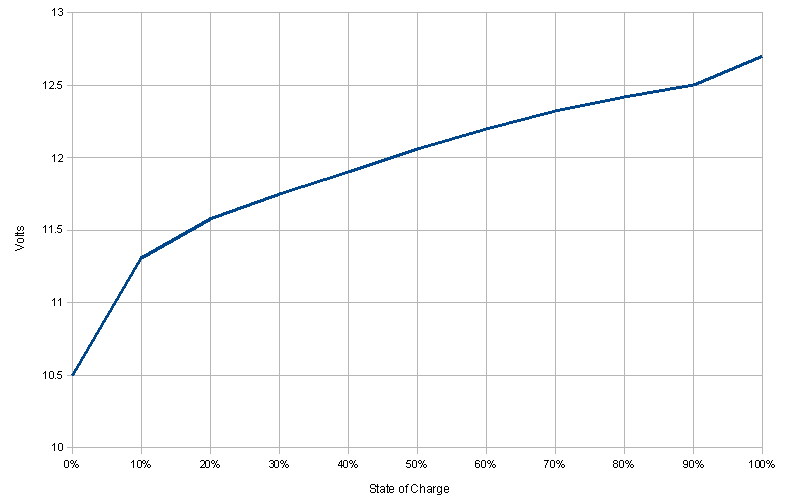
That SoC chart looks like BS, never seen one that is a flat line. Also its temperature dependent. I call BS. Most systems I have seen that measure battery charge try to keep track of the current going into and out of the battery, and 'integrate'. Then if it sees something that tells it is fully charged (like minus delta V), decides it back to 100% and starts trying to count again.
 
Last edited:
Here's a SoC chart for lead acid I found with a Google search, hot linked from Wikipedia ....

Lead-acid_voltage_vs_SOC.PNG
 
Isn't this just basic math? I mean, if you have a HUGE 31M with sizeable reserve capacity, and completely drain it, you will obviously need more current/time to re-charge it when compared to the stock battery, correct? At the same time, the stock battery won't be able to run your fridge anywhere near as long before it shuts off, but would in turn need less recharge time.

A Large Battery drained to a discharged state will need a lot of power (volts@amps * time) to get back to full charge. Seems sensible to me :)

I've run Odyssey AGM's in my Tacoma on the stock 90Amp Alternator and DieHard Platinums AGM's now in my T4R, and have no issues running either of them on stock Toyota electrical systems. (will always go with DieHards now that I now how much cheaper they can be had than equivalent/identical Odyssey's).

That said, I'm in need of instantaneous current in the 300Amp range (plus vehicle's own load), and I never actually "Deep Cycle" my personal batteries - so my use-case and re-charge concerns are drastically different to those that intend to run these things dead or close to dead (and why I can have a dynamic 300-Amp accessory load on the stock 130Amp alternator without re-charge issues).

:cool:
 
Seriously? I think maybe you have this backwards.....as more and more things were added to the vehicles that required electrical power the alternators have been beefed up to handle keeping the battery charged.

I don't believe there is one single electrical item on the car that runs directly off the alternator.....they all run off the battery.

I'm thinking the alternators only job is to charge the battery....:shrug:

Two things need to be cleared up:

~12V Automotive Battery- Its function is two-fold; to start the vehicle and to act as an electrical buffer for sensitive electronics (i.e. dampen voltage variations coming from the alternator to provide a stable Source Voltage for the vehicle to work with.)

~Automotive Alternator- Its function is to MAINTAIN (you could say "charge" but this is slightly misleading as it could be construed that it is a battery charger, which is highly inaccurate) appropriate Source Voltage for the vehicle and distribute it to the battery.


The part that many people confuse is how an automotive battery is designed to operate and how the alternator is designed to function. A 12v battery should, for the most part, never be discharged below about 12.6v (peak amperage/voltage from starting and high load applications prior to engine operation non-withstanding), this is considered a "healthy" 12v Battery at 100% SoC (State of Charge.) The battery is NOT designed to be consistently drawn below "Healthy" and then charged back up, it actually is very hard on the battery and leads to issues like sulfation. Marine Batteries are typically designed for Deep Cycle operation, meaning they are designed to be brought down to low voltages and charge back up with no real impact on the battery's health; but that does not mean simply switching to a marine battery will fix the issue.

Which brings us to misconception of alternators. An alternator is not battery charger or a generator, at best you can consider it a "top-off charger" in that it is designed to maintain an ideal voltage; not charge up a dead battery. The alternator is strictly for maintaining the battery in the "Healthy" operation zone. It actually damages the alternator to have to constantly charge up a low battery; in fact it typically takes about a half-hour to a hour for most vehicles to recharge the battery the equivalent amount of energy you used to start said vehicle under normal operation to give you some perspective. The alternator simply tops off the battery as energy is being used so that the battery is always near 100% when the vehicle is running. Most alternators these days don't put out much more than what the vehicle needs to operate and not too much more than that when fully fielded. Thus trying to drop in a Marine Battery will result in the alternator working too hard if the battery is deep cycled and premature failure of the charging system.

Hopefully that clears things up?
 
So much conflicting info :D

But that's to be expected, battery technicalities can get somewhat deep and they change with type and temperature.

My experience with my Die Hard 31M and my 5th gen so far:

Battery charges to about 93% every day with my commute.
4Runner charger charges at 14.5 volts till it believes the battery is full, then drops to 13.5. The 4runner charger probably thinks the battery is full at about 93% on an AGM battery instead of 100% for a normal lead/acid. (This is really the "not good enough" part IMHO) However:
Do I have to recharge 100% every time?
No, the typical cruising routine is to charge to 80 to 85% bank capacity daily, with a full recharge once a week. It is extremely important to avoid letting the batteries set for extended periods partially discharged. Leaving the batteries in a state of partial charge or discharge for extended periods will potentially cause sulfation of the batteries.


AGM batteries do fine as long as you keep them above 80% most of the time with the occasional 100% top off.

Using the fridge overnight and with daily driving, hardly a hit on the battery at all (maybe 10 AH?). If you were to sit for 4 days and do an 80% discharge, the outcome may be different. If you do that, use a 50 watt solar panel (About 20 AH a day recharge) or a generator to keep the battery up. Don't rely on any auto voltage cutoffs, know your usage.

These batteries are great for winches, but of course you can deeply discharge them. Get/use a battery meter to keep an eye on what you are taking out of it and you should have no problems!

And when you get back from that trip where you were hard on the battery? Be nice and hook up an AGM rated charger, set to 15A and top it off!

That's about it.

[Edit]Actually Was just reading about the sulfication some more, there are a lot of chargers now that have desulphate charging modes. SO doing that once a month or after a trip might go a long way to slowing the deterioration even further. It may be time to update my ancient 5/15amp "mechanical" charger :D [/Edit]

Seems like it's not really a big deal in that just a /tiny/ bit of battery maintenance procedure should go a LONG way to getting good life from these things. While totally ignoring it might shorten it, but over all it doesn't seem like that drastic a problem :/
 
Last edited:
Seems like it's not really a big deal in that just a /tiny/ bit of battery maintenance procedure should go a LONG way to getting good life from these things. While totally ignoring it might shorten it, but over all it doesn't seem like that drastic a problem :/

Indeed - It's literally been "Zero maintenance" so far for me :) (unless you count wiping-off the battery so it looks new!). Been running the DieHard 31M off the stock 130A Alternator for 27 months now, and haven't hooked up a battery charger to my truck as of yet. No signs of starter dragging, and the 300Amp dynamic audio system load seems well served by this 31M beast (haven't noticed any deterioration in voltage @ load since I installed the current-hungry power-amps back in Jan '13).

On another note: Back when I had the '99 Taco, I accidentally left the headlights on about a month after I replaced my pair of Optima Red Tops with a single Odyssey AGM, and drained the Odyssey 100% dead (one month old $300 battery). It never quite seemed as capable after that idiot move.

So - as mentioned - don't rely on voltage shut-offs to protect your expensive batteries (and associated recovery scenarios) - rather: be proactive and plan your runtime needs accordingly. Cold beer and unspoiled meat in the fridge is probably nice, but waiting for a jump in freezing cold B.F.E. can't be fun...

:cool:
 
I don't want to start an Internet argument but that is completely wrong.

Thanks for that.....I might need therapy now. Perhaps I didn't state my comment correctly.

Two things need to be cleared up:

~12V Automotive Battery- Its function is two-fold; to start the vehicle and to act as an electrical buffer for sensitive electronics (i.e. dampen voltage variations coming from the alternator to provide a stable Source Voltage for the vehicle to work with.)

~Automotive Alternator- Its function is to MAINTAIN (you could say "charge" but this is slightly misleading as it could be construed that it is a battery charger, which is highly inaccurate) appropriate Source Voltage for the vehicle and distribute it to the battery.

No clearing up needed. I think you all need to look at it on a more basic level. We had batteries and alternators LONG before we had 2000w stereos, 200amp boosters, HID, Halogens, power inverters, refrigerators, winches or any other power guzzling add on's.

No one added all that crap to the rig and then said, "hey we should put in an alternator in to run this stuff". They simply beefed up the already existing alternator, that was originally put into charge (or whatever you want to call it) the battery. Some of you might remember they were called generators back in the day....even your most basic old school tractor engine has a battery and an alternator/generator. Why? So that the next time you want to start it, the battery will have enough juice to crank it over.

I'm not sure what came first the chicken or the egg.....but I do know that without the alternator re-charging or topping off the battery, eventually the engine won't start and therefore if it doesn't start the alternator is kind of useless and so are all the added on power guzzling accessories.

I can do with out all the added on power guzzling crap....I can't do with out a charged battery, that will crank the engine, starting the engine, that will allow the alternator to recharge the battery for the next time I need to start it.

And yes the engine will run fine with out a battery if your willing to hand crank it to get it started. I also will bet all your power guzzling add ons won't run as nice without that battery as they do with a battery installed, especially if your engine isn't running.
I will also agree that all that fancy gear won't run as well without the alternator to help power them.

Everyone is entitled to their own opinion, but for my money.....If your engine doesn't start because of a discharged battery, then the whole car is pretty much useless no matter how big your alternator is or how many watts you've got pumping.

Sorry for the long winded reply.........

 
Thanks for that.....I might need therapy now.

You know, as I read my previous post I realize I should have worded that first sentence differently. Maybe something like I disagree or that's different from how I've alway understood it. Anything beside how I said it..... Sorry.
This is a good thread though, lots of good information.
 
Will that actually keep it topped off?

You need to wire up a dual battery system with isolators.

For a solar charger,this is what I was looking at to buy and also there is a lot of good reading on their website.I am planning on mounting the solar panel itself on the bottom side of my roof rack. Still doing research and comparisons though.12 Volt 15 Watt Solar Charger Maintainer with Panel | SCC-015 You can get them cheaper too from vendors as that's just the msrp.

So I'm confused from earlier...
If the battery needs >14.5 V to fully charge won't a 12V charger leave you with the same problem? The vehicle will sit with a partially charged battery?
 
So I'm confused from earlier...
If the battery needs >14.5 V to fully charge won't a 12V charger leave you with the same problem? The vehicle will sit with a partially charged battery?

I think the key word there is "Maintainer". I think it is supposed to add energy into the system so that you do not "drain" only from the battery.
 
So I'm confused from earlier...
If the battery needs >14.5 V to fully charge won't a 12V charger leave you with the same problem? The vehicle will sit with a partially charged battery?

That's referring to a 12V system, not that it will only charge it to 12V.

There are many different voltage systems ,like 6V used on some farm tractors ,antique cars,lawnmowers ect,8V for some golf carts, 24V systems are used on most aircraft and 48V for some solar systems,E cars ect.
 
Last edited:
Very good read, and very good info.

Odyssey Battery Technical Manual (8th Edition):
http://www.odysseybattery.com/documents/US-ODY-TM-002_1214.pdf

List of recommended/"approved" charger:
http://www.odysseybattery.com/documents/ODYSSEY_approved_12V_chargers.pdf

Nice info!

I also found this on their Site. A discontinued charger for less than half price:
ODYSSEY Batteries - OMAX-40AS-3B

The 31M 2150 battery is listed as supported. It is a triple battery charger but I read the manual and it charges single battery like a regular charger. But if you have 2 or three it'll charge them all at the same time if you want. Pretty good deal!

Since I am still working with a 40 year old battery charger, I ordered one. The only downside is it is ONLY an AGM battery charger :/
 
Last edited:
I think the key word there is "Maintainer". I think it is supposed to add energy into the system so that you do not "drain" only from the battery.

Yeah, it'll offset some of the drain from the fridge (Though I think you need about 50 watts to 100% offset it)

I think you would still need to do the FULL charge with an AGM battery charger every month or two to keep it in top shape.
 
If you use up a lot of electric juice in the boonies, a Honda or a Yamaha generator (1-2KW) weights the same as a large battery and provides *much* more power.

Also, FWIW, I use a STEK charger to recharge and trickle-charge my deep-cycle AGM battery.
 
Last edited:
I see...

I think the key word there is "Maintainer". I think it is supposed to add energy into the system so that you do not "drain" only from the battery.

That makes sense, just keeps the battery high enough to function.

That's referring to a 12V system, not that it will only charge it to 12V.

There are many different voltage systems ,like 6V used on some farm tractors ,antique cars,lawnmowers ect,8V for some golf carts, 24V systems are used on most aircraft and 48V for some solar systems,E cars ect.

I was just confused, I thought you were saying this would solve the OPs issue with the Odyssey battery not getting 14.5+ from the alternator which keeps it from ever getting beyond ~80% charged and eventually ruins it.
 
Ok so I got my new ODYSSEY charger the other day.

This weekend While the truck was parked for at least 12 hours. I disconnected the battery from the vehicle and put it on the charger.

Charger read 12.8V and said 99% charged. Which for sitting over night after a commute home pretty much indicated to me that it was as fully charged as it can get.

I turned on the charge cycle, immediately after the battery check was done it said "100%" charged and went into it's maintenance cycle which I left on for about 5 hours just for fun.

So at least with the 5th gen runner and not having a lopsided charge discharge scenario (I.e. fridge 100% of the time, 4 mile daily commute), it looks like the vehicle itself it plenty capable of keeping the thing fully charged.
 

Members online

No members online now.

Forum statistics

Threads
278,317
Messages
3,554,129
Members
248,016
Latest member
Advally Service

Trending content

Back
Top