Airing down stock Dunlop AT20's

jhmoore

New member
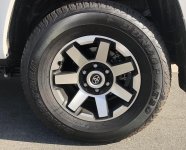
2018 T4R TRDORP with stock Dunlop Grandtrek AT20's

Not intending to replace the tires right away.

But planning some pretty mild off-roading. Am not experienced at this & am greatly appreciating all the advice--thank you all!

Have been reading on this forum about airing down, but need some practical advice.

For those tires, and

1. Back-country gravel road with plenty of sharp rocks. Examples of the northern route to Eureka Dunes in Death Valley (higher speed, perhaps less brutal), or

2. the road to The Racetrack in Death Valley (lower speed, well known for puncturing tires!)

Would you take the stock tires on those roads (especially The Racetrack, if you know that road)? If so, what tire pressure would you drive at? Would it be different between those two?

3. Desert wash... mix of hard sand, soft sand, gravel, small to mid-size rocks, mud...

What pressure to air down to?

Is it the same pressure for all circumstances? Is there some online guidance you can refer to me?

Is the pressure that you air down to dependent on which tires you have?

Any general comments on the stock tires? I see lots of disparaging comments on stock tires, but aren't the stock tires different from a base SR5 to a TRDORP? Are the Dunlop AT20's on the TRDORP any better?

Thanks!
 

Attachments

  • 4Runner-tires.jpg
    4Runner-tires.jpg
    136.5 KB · Views: 3,010
Register to hide this ad
Those tires are pretty much useless. Basically, a summer tire masquerading as an AT tire OR AT tires have come a long way since those tires were introduced.

When I had them, they sucked in rain (on road), and in snow (on road), and in mud (offroad). Got rid of them, b/c I needed a AT tire that did better in those all weather conditions (except for mud).

If I wanted or needed tires that offered puncture resistance, I would get a E rated AT/MT tire for the extra protection they offered.

There is no set formula on what to air down your tires to. Basically, I air down until my teeth don't rattle on wash boards. Not sure what your dunlops can handle, so sorry cant answer that question.
 
I'll make general comments about the dunlops.

I've had them for 25k miles and I haven't had any problems in the rain or on the road. I don't brake hard or floor it when I drive. People say they're a slip n' slide when it rains but I disagree. I had the original BFG KO tires on my tundra and I slid in the rain multiple times while approaching a red light/stop sign at <30 mph. What a nightmare that was.

Not really sure about their offroad manners other than for sure don't go in mud.
 
Last edited:
I’m pretty sure the Dunlop’s are P rated tires meaning very thin sidewalls. They do this so the ride on the stock suspension is better. This also is the reason you cannot corner on a stock ride without feeling very top heavy. If you air them down you will most likely puncture a sidewall.

I would suggest getting a pair of good quality good price AT tires. My suggestion would be Falken wildpeak AT3W or nitto grappler AT both of which are on sale right now and have the best bang for your buck if you want to keep costs down.

I run the Falkens on my rig.

0fe845e2838e37f6d2a63a33c895e091.jpg


Sent from my iPhone using Tapatalk
 
There’s lots of threads regarding the factory tires, but I’ve been on all of those roads so I feel I could help specifically here. I also wheeled the factory Dunlop’s quite a bit. It’s certainly not advisable to travel those roads with these tires, but they’re up to it so long as you exercise good judgement, reduce your speed, and avoid obvious dangers. Mine squealed and moaned when aired down but never failed. If you have it in your budget then nicer tires would help ease some of that mental tension. Anything is possible, it’s just a matter of budget and common sense, while acknowledging the risks.

I was in the Maze district once and got passed by a 3rd gen on Michelin LTX. Dude was crazy in my opinion to be on those trails, and that remote, but he apparently made it. I was happy I had upgraded my tires (ran ko2’s) cause I really didn’t have to worry so much about sidewall damage and could focus more on not getting hung up or scraping bumpers.

Are you planning to traverse Lippincott? If so my opinion would shift heavily in favor of new tires. The exposure on that trail alone would influence me to spend the extra $$ to avoid any potential hazards.

I do recommend airing down, it’ll help spare the vehicle and the ride while improving traction. Keep an eye on tire temps though, if they start to feel noticeably hot then let them cool down and air up a bit (kind of a joke in DV I realize). Something modest like 25-28 psi for the stock tires should be ok, but it’s all dependent on vehicle load and conditions, so you have to experiment for yourself.
 
You could always hope for the best, expect the worst. A buddy of mine and I took a trip to DV, and we went north from Panamint Springs along Saline Valley Rd up to the warm springs, then back down and over Lippincott Rd to the Racetrack and out past Teakettle Junction and Ubehebe Crater. This was all in a rental Hyundai Santa Fe.
 
I had the OEM Dunlop’s on for 25k before switching over to LT “c” load Cooper AT3’s. The Dunlop’s we acceptable in anything but mud. If you want to see some of the stuff I did on the stock Dunlop’s check out my thread linked in my signature. As [MENTION=96425]JSparky[/MENTION] mentioned, going further out in the desert is a little different as there is more exposure to sharp rocks and the OEM Dunlop’s do have a thinner sidewall.

This is what I aired down to in different scenarios with the stock tires.

Gravel Roads/Moderate Rocky Trails:
25 psi

Slower Technical Rocky or Soft Dirt/Muddy:
20 psi

Sand:
15 Psi

Compared to Air Down Pressures LT Tires
Gravel Roads/Moderate Rocky Trails:
20-22 Psi

Technical Rocky or Soft Dirt/Muddy:
18 PSI

Sand:
12 - 15 Psi

Some of the best $ I’ve spent is enrolling in an Off-Road Consulting class. I have some info also in my thread, although not near your location it might be worth looking into, also going out with a local group of experienced guys would also be really helpful. There are lots of members on here that are local to you and I’m sure they would be more than willing to go out with you, just post up here or in the off-roading section of the forum.
 
I gave up on the Dunlops at about 34k miles, largely due to wet pavement/slight hydroplane issues. They were ok for a while...
 
I'll make general comments about the dunlops.

I've had them for 25k miles and I haven't had any problems in the rain or on the road. I don't brake hard or floor it when I drive. People say they're a slip n' slide when it rains but I disagree. I had the original BFG KO tires on my tundra and I slid in the rain multiple times while approaching a red light/stop sign at <30 mph. What a nightmare that was.

Not really sure about their offroad manners other than for sure don't go in mud.

Lets put it this way -- yes, they technically don't slide off the face of the earth when it rains. But I think you may just forget what it's like to have good tires (sounds like the KO's weren't great either). This would be like getting used to four wheel drum brakes and saying "eh they're fine" when in reality, it's comparatively bad. Not the way to treat something that affects every part of your safety.

I think I drove 200 miles on those dunlops before I had to replace them.
 
Last edited:
Some of the best $ I’ve spent is enrolling in an Off-Road Consulting class. I have some info also in my thread, although not near your location it might be worth looking into, also going out with a local group of experienced guys would also be really helpful. There are lots of members on here that are local to you and I’m sure they would be more than willing to go out with you, just post up here or in the off-roading section of the forum.

I plan on enrolling in a class with one of the off-road schools that teaches out in Anza-Borrego this fall. Also need to find some folks to go explore with... who aren’t rock-crawler types (which at this point I have no desire to be)... the forum here is a good suggestion.
 
There’s lots of threads regarding the factory tires, but I’ve been on all of those roads so I feel I could help specifically here. I also wheeled the factory Dunlop’s quite a bit. It’s certainly not advisable to travel those roads with these tires, but they’re up to it so long as you exercise good judgement, reduce your speed, and avoid obvious dangers. Mine squealed and moaned when aired down but never failed. If you have it in your budget then nicer tires would help ease some of that mental tension.

I expect to get new tires eventually... it’s a matter of a bunch of things, including money (I just bought the vehicle, which was not cheap... plus I’m taking a 3-4 week trip in a couple months... so “honey, I need to spend nother grand on new tires” doesn’t have a great ring to it...) as well as wanting to do a lot more readin/research on which tires. This is also my daily driver (my excuse/reason for getting the 4Runner was giving my old daily driver to our 18 year old), so while I want tires that’ll give me confidence off-road, I also want a decent daily ride (feel, sound, gas mileage). I even wonder whether what I really need is a second set of wheels (at what cost??) and just swap the entire set of wheels when going on an adventure??


Are you planning to traverse Lippincott?

Definitely not! I’m not even convinced yet whether I should try the road to The Racetrack in these tires...
 
The stock tires are fine unless your are doing serious rock climbing that would puncture a standard tire. Learn to use the features your vehicle came with. That combination will take you well past your expectations. I know, I have been there. Air down may be peace of mind, but not required either.
 
Lets put it this way -- yes, they technically don't slide off the face of the earth when it rains. But I think you may just forget what it's like to have good tires (sounds like the KO's weren't great either). This would be like getting used to four wheel drum brakes and saying "eh they're fine" when in reality, it's comparatively bad. Not the way to treat something that affects every part of your safety.

I think I drove 200 miles on those dunlops before I had to replace them.

I'm not sure I understand. If the dunlops are quiet and they grip well, what makes them bad tires?
 
I'm not sure I understand. If the dunlops are quiet and they grip well, what makes them bad tires?


I did 16,000 miles on mine. I thought they performed great on the road and surprisingly well on the trails. The tread still looks new. Oh 18 psi seemed to work well.


Sent from my iPhone using Tapatalk
 
Last edited:
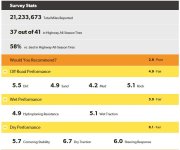
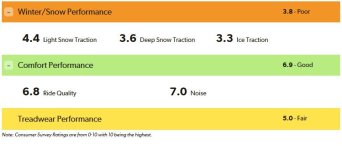
Tirerack consumer ratings of the stock Dunlop AT20's
 

Attachments

  • Dunlop AT20 1.JPG
    Dunlop AT20 1.JPG
    60.6 KB · Views: 630
  • Dunlop AT20 2.JPG
    Dunlop AT20 2.JPG
    36.6 KB · Views: 636
I expect to get new tires eventually... it’s a matter of a bunch of things, including money (I just bought the vehicle, which was not cheap... plus I’m taking a 3-4 week trip in a couple months... so “honey, I need to spend nother grand on new tires” doesn’t have a great ring to it...) as well as wanting to do a lot more readin/research on which tires. This is also my daily driver (my excuse/reason for getting the 4Runner was giving my old daily driver to our 18 year old), so while I want tires that’ll give me confidence off-road, I also want a decent daily ride (feel, sound, gas mileage). I even wonder whether what I really need is a second set of wheels (at what cost??) and just swap the entire set of wheels when going on an adventure??

Definitely not! I’m not even convinced yet whether I should try the road to The Racetrack in these tires...

Perfectly understandable. You should be fine getting out to the Racetrack if you're coming in through Teakettle, and I highly recommend it. Just talking about it is giving me an itch to get back outside! Take it slow and steady, bring lots of extra water, and you should be ok. I believe the Racetrack is monitored on a near daily basis by the park as well, so it's one of the more frequented areas, relatively speaking, in the northern half of the park.
 
OP, I know you're not griping about the tires, but other folks in this and a lot of other threads are.
I always get a kick out of reading complaints about the 4Runner in stock form. Are there things that could've been done better...sure! But I have no problem with the sunlight glare off the Trail/TRDP hood "scoop", headlights (although they could be better), suspension, or the Dunlop tires.

I'm coming up on 22k miles with the AT20's and haven't had a single problem with them be it dry, wet, snow, sand, or mud. I've used crawl control twice to get me out of a couple dicey situations but, I got out (one in mid, the second in snow). I haven't aired down once in the past 16 months. I've seen sidewalls mentioned, and the P rating isn't ideal for low pressure. However at road-PSI I've been on multiple trails with jagged rocks and come out with only a few sidewall scuffs, no cuts or punctures though.

With my 4R slowly getting taller and taller, I do plan on upgrading to either the Falken AT3W or KO2 in 285/70 fashion before the end of the year.
 
I’m pretty sure the Dunlop’s are P rated tires meaning very thin sidewalls. They do this so the ride on the stock suspension is better. This also is the reason you cannot corner on a stock ride without feeling very top heavy. If you air them down you will most likely puncture a sidewall.

I would suggest getting a pair of good quality good price AT tires. My suggestion would be Falken wildpeak AT3W or nitto grappler AT both of which are on sale right now and have the best bang for your buck if you want to keep costs down.

I run the Falkens on my rig.


Sent from my iPhone using Tapatalk
Where are the grapplers on sale?
 
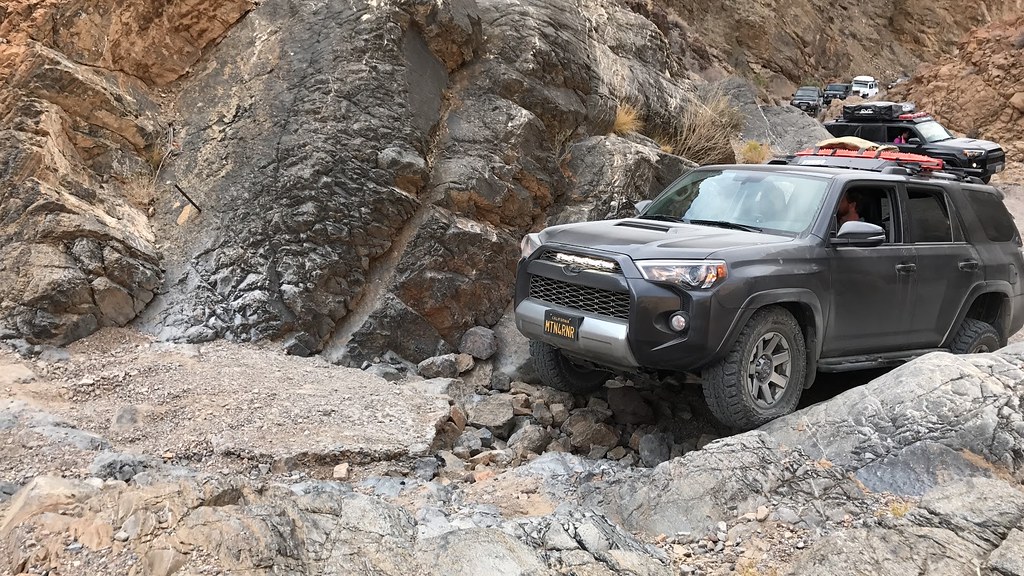
Having been through those areas myself, I'll throw in my $.02. I read that you mentioned that you were planning on taking an off-road course to hone your skills on dirt and the like. Based on that, I would suggest that a new set of AT tires with thicker sidewalls would be a good investment for your adventure. I say that because your sidewalls will be the most susceptible to slices or punctures in the Death Valley regions. There are a lot of "sidewall biters" out there on the trails that you mentioned that someone with less experience in that terrain might not know to look out for or spot. Others will mention getting by just fine without incident, but I also had a friend with Duratracs (known for a thinner side wall) and he got 2 sidewall slices in a day rendering him immobile and waiting for someone to come along to help him into town. It took him 3 days to get back, get his tires replaced in town and back to his truck. Add any heat factors to that scenario and you have a bad situation if you're not prepared. So, while it might be a financial burden at the time, I would either hold off on a trip like that until your vehicle is ready, or invest in a good set of tires and enjoy the adventure. With a good set of tires, I ran through DV at around 20psi, and that proved a good pressure for me through rocks, washboards, sand and gravel. Best of luck!

30752719750_df7d02517f_b.jpg
 
Last edited:

Members online

Forum statistics

Threads
278,315
Messages
3,554,104
Members
248,016
Latest member
Advally Service

Trending content

Back
Top