
You are using an out of date browser. It may not display this or other websites correctly.
You should upgrade or use an alternative browser.
You should upgrade or use an alternative browser.
All things Overlanding thread
- Thread starter el_kab0ng
- Start date


Terrapod
New member
Howdy all... getting ready for fall/winter excursions and I finally got around to getting the trailer updated.
Items completed: Reconfigure and simplified the entire electrical control and wiring, eliminated the forward tongue box and replaced it with a couple jerry can mounts, replaced the Timbren rubber compression springs and last but not least....got a new FSR tent...but...
...the rainfly was useless, so I made a new and improved one.
And last but not least...the 4Funner got new shoes.


Items completed: Reconfigure and simplified the entire electrical control and wiring, eliminated the forward tongue box and replaced it with a couple jerry can mounts, replaced the Timbren rubber compression springs and last but not least....got a new FSR tent...but...
...the rainfly was useless, so I made a new and improved one.
And last but not least...the 4Funner got new shoes.
Howdy all... getting ready for fall/winter excursions and I finally got around to getting the trailer updated.
Items completed: Reconfigure and simplified the entire electrical control and wiring, eliminated the forward tongue box and replaced it with a couple jerry can mounts, replaced the Timbren rubber compression springs and last but not least....got a new FSR tent...but...
...the rainfly was useless, so I made a new and improved one.
And last but not least...the 4Funner got new shoes.
Very cool!


Here's a video from Thursday, people trying to leave Sunday was probably hilarious, hopefully there's some more videos
https://youtu.be/XRIdunlcXA4

Sent from my SM-G960U using Tapatalk
https://youtu.be/XRIdunlcXA4
Sent from my SM-G960U using Tapatalk
Last edited:

Cymon
New member
Lol at everyone getting stuck in a wet field at overland expo
Sent from my SM-G960U using Tapatalk
LOL. Post up some pics...
C
Here's a video from Thursday, people trying to leave Sunday was probably hilarious, hopefully there's some more videos
https://youtu.be/XRIdunlcXA4
Sent from my SM-G960U using Tapatalk
Lol! Looks like the MaxTrax booth likely did well.
from the discussion on expedition portal:
- lots of people turned away
- lots of reports of people giving up waiting for shuttles and heading to the mountains instead
- reports of thefts from vendors
still haven't found videos of people trying to leave sunday
i assume fast spinning wheel meets sudden tractionGlad I missed this. I heard one guy talk about blowing up an axle on a 4Runner trying to get through the campground.
- lots of people turned away
- lots of reports of people giving up waiting for shuttles and heading to the mountains instead
- reports of thefts from vendors
still haven't found videos of people trying to leave sunday

bradze
New member
i'm sure there are many of us out there with this issue so i thought i would share my setup.
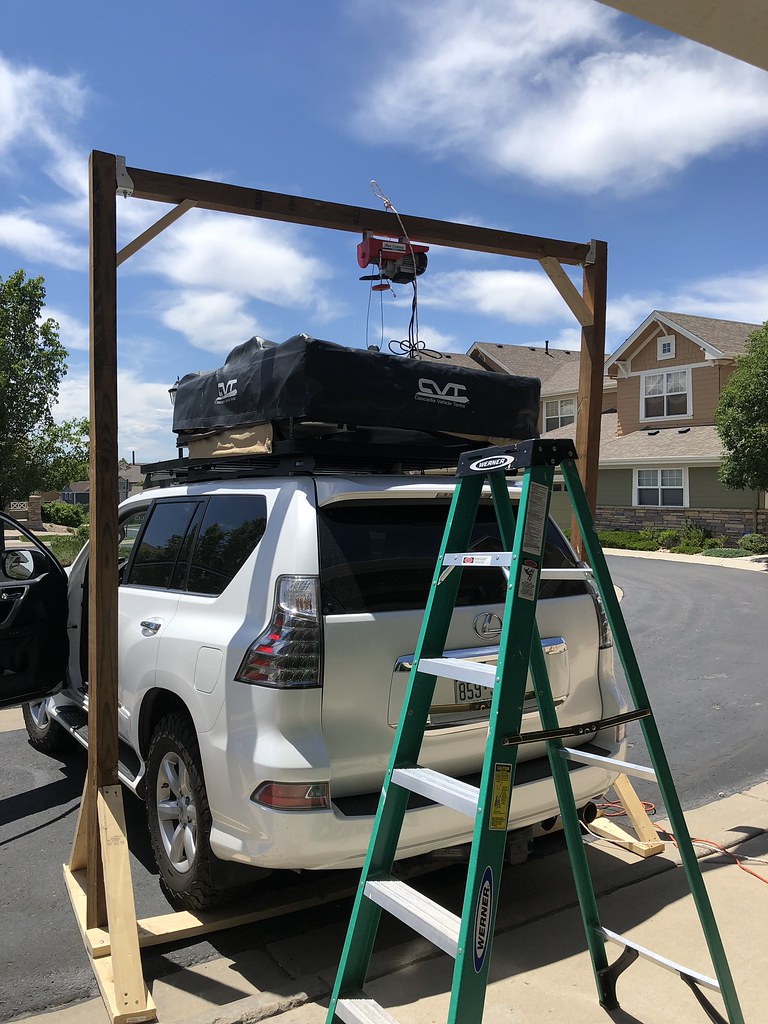
my garage entrance is only 7' high so i am not able to load my rooftop tent inside. i usually don't have help and need to load the tent myself. loading it was the easy part. unloading was a pain. i tried many different ideas last summer with a Gobi Rack on a 4th gen 4Runner. i really messed up the rack loading/unloading the tent. this summer i changed to the Lexus GX using the front runner rack with quick release tent mounts. i was determined to find a better option. one idea i toyed with i found here . i started going down this route but did not like any solution for attaching to the rack securely. all options i tried would have scratched up my rack pretty bad. plus raising up that platform, supporting all of that weight and still having to slide it on to the rack didn't appeal to me.
ultimately i settled on building a hoist to load it on/off. it is not cheap to build, it is worth it though for easy loading. all of the lumber and hardware was over $50. the hoist was $90
Building Supplies
2 - 10' long 4x4s.
1 - 8' long 4x4 for the horizontal beam
2 - 4' long 2x6's for the feet.
1 - 8' long 2x6 for the bottom support.
a few 2x4's angled for support.
2 - 4" joist hangers
electric hoist
*this can also be done cheaper using pulleys. i chose to use the hoist for effortless lifting.
small furniture cart i found at harbor freight for $8 and two caster wheels to roll it out in to my parking lot.
the reason for 10' high is my vehicle rack sits at 6'5". the tent closed is 18". the hoist at its minimum is about 22".
i can fit this inside my garage on its side, inside my garage the ceiling is 9' high. once im done loading tent ill roll it back in and stand it up on its side. this way it only takes up 4' from the side wall(width of the feet).
to secure the tent to the hoist i use a 2' long 2x6 i had laying around with an eye hook. i lay it flat across the ladder on the tent top. use ratchet straps to keep this in place. i clip the hook from the hoist to the eye hook. i originally tried tow ropes and lifting slings, these did not work due to stretching/flexing and finding the right length. i wasn't able to lift the tent high enough once the ropes started flexing.
i also have an eye hook at the top, i tie a rope to this to help me stand it up. i lift it up and support it on a 6' tall ladder. then grab the rope to pull it up from here standing it up. to take it down i just rock it back and forth and use my hands to walk it down on the 10' side post.
all of the lumber i purchased i failed to check before coming home. the 4x4s are very crooked making it hard to build it square. one side is really bad with the twisted post. it is strong and sturdy using these 4x4's so i wasn't too worried about going back for straighter lumber.
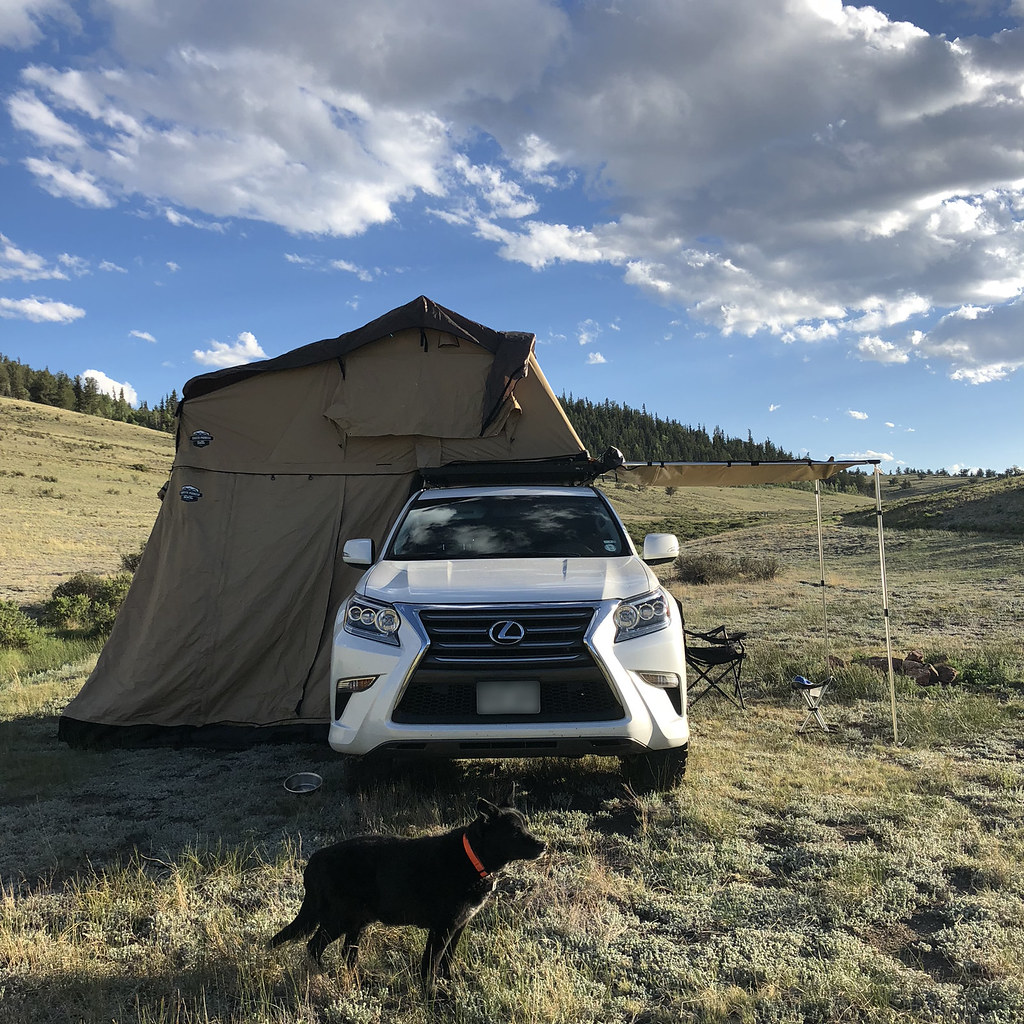
this is my setup. a CVT Mt Shasta Pioneer extended with matching awning. my dog will be 15 years old in a couple of days, but he still loves camping
hopefully some of you can find use out of this
I wish I would've found this sooner! im so glad to see im not the only one who was thinking about something like this. I was considering getting a carport. this is a much better solution.

Outinfront
New member
Needed some campfire time and finally got a chance to test out the revised setup. Fall in the Appalachians is always awesome.

Beautiful pictures!

leftyguns21
New member
airing down and up question.
when everyone goes camping on roads that require airing down...do you air back up when setting up camp? especially with a RTT
when everyone goes camping on roads that require airing down...do you air back up when setting up camp? especially with a RTT

MAST4R
New member
airing down and up question.
when everyone goes camping on roads that require airing down...do you air back up when setting up camp? especially with a RTT
Require=soft/deep sand or equivalent. Or very serious rock climbs without a locker.
If you have D/E load tires the requirement is for comfort. They would also have less traction than P or LTC at equivalent pressures when installed on a vehicle lighter than what designed for.
If you run P-metric with a serious load it would be better to stay above 25 psi at all times except deep/soft sand and such. I don't air down at all. If the terrain has a lot of sharp rocks like in Central AZ, then I would do 25 but in reality I don't do it even here. Maybe tomorrow!
If you run LTs, it becomes a largely on-paper discussion. Otoh, you are supposed to run much higher pressures to maintain equivalent capacity. Otoh, the LTs esp D/E come with so much excess capacity that it does not normally matter.
So, what ends up happening is airing down to 20sh as SoP for comfort.
I would not go below 20 unless it is actually required, especially on less than D/E load.
I am no fan of "offroad=airing down no matter the tire or trail condition" credo. MTs are usually E-load in the larger sizes so for people running MTs that's true but not everyone runs MTs.
leftyguns21
New member
[MENTION=306890]MAST4R[/MENTION] i have E rated tires and will some times air down for comfort. i dont air down too much never below 20. lowest ive gone is 25. usually down to around 30-35 for a softer ride. i dont usually air back up though when setting up camp and wondering if i should be.
MAST4R
New member
[MENTION=306890]MAST4R[/MENTION] i have E rated tires and will some times air down for comfort. i dont air down too much never below 20. lowest ive gone is 25. usually down to around 30-35 for a softer ride. i dont usually air back up though when setting up camp and wondering if i should be.
I wish I were a tire expert. Or maybe not. Well, sometimes!
Against my own advice above, I aired down to 25 yesterday and destroyed completely a sidewall six miles later at a reasonable but not crawling speed. I would like to think that going unnecessarily slowly for the conditions would help with those small, nasty, sharp rocks. The problem is that for years on KO2s in D-load (not on the 4R) worrying about punctures was the one issue I did not have. So, there is a re-learning curve here.
Since you have E-load, you have to find out what works for you. I did not air up until back to pavement. The issue with underinflated tires would be the same as on road: overheating at speed. I am not sure what the folks who go really fast do.
Last edited:
Well I read through all 32 pages, and wow. I had a Xterra that was made for overlanding and we were usuallt good for a week in it when we went out. the only mods were bigger tires roof rack and a 1.5 lift and a front bumper with a winch. Now we have a 19 trd off road Premium. I am only thinking of a few mod for it. Roof rack dual batteries, bumpers, and lift and tires. When I lived in IL we went to WI and did a trans something rift. Or something like that for 4 days. It was a blast. Now that we have the 4 Runner I am in the process of installing the HAM radio and plan on going to the most Northern, Southern (Again) eastern and western points of the US and FL wil more than likely be 1st since we are in AL.
4RExplorer
New member
Inergy K2
The Inergy K2 is a portable solar generator, consisting of a 90Ah 12V Lithium ion (NMC) battery, an MPPT solar charge controller, and a 1500W pure sine wave inverter, along with 110V AC, 12V DC USB and other sockets for powering appliances and devices. It also comes with a standard charger for charging from 110V shore power. There is an optional Car Charger for charging the K2's battery from the vehicle cigarette lighter charger, but it requires a circuit with a 20A fuse; I think the 4Runner cigarette lighter sockets are not rated this high. The Inergy K2 seems to be a beefier version of the newly released Dometic PLB40. It is compact (8" x 7" x 14") and weighs 25 lbs. Currently on pre-sale with promotion codes enabling purchase for $1300; it is a new product and will begin shipping on May 1. I am not affiliated with Inergy, just wanted to let people know for those who may find it useful for powering refrigerators, LED lights, etc.
The Inergy K2 is a portable solar generator, consisting of a 90Ah 12V Lithium ion (NMC) battery, an MPPT solar charge controller, and a 1500W pure sine wave inverter, along with 110V AC, 12V DC USB and other sockets for powering appliances and devices. It also comes with a standard charger for charging from 110V shore power. There is an optional Car Charger for charging the K2's battery from the vehicle cigarette lighter charger, but it requires a circuit with a 20A fuse; I think the 4Runner cigarette lighter sockets are not rated this high. The Inergy K2 seems to be a beefier version of the newly released Dometic PLB40. It is compact (8" x 7" x 14") and weighs 25 lbs. Currently on pre-sale with promotion codes enabling purchase for $1300; it is a new product and will begin shipping on May 1. I am not affiliated with Inergy, just wanted to let people know for those who may find it useful for powering refrigerators, LED lights, etc.

violation
Member
Require=soft/deep sand or equivalent. Or very serious rock climbs without a locker.
If you have D/E load tires the requirement is for comfort. They would also have less traction than P or LTC at equivalent pressures when installed on a vehicle lighter than what designed for.
If you run P-metric with a serious load it would be better to stay above 25 psi at all times except deep/soft sand and such. I don't air down at all. If the terrain has a lot of sharp rocks like in Central AZ, then I would do 25 but in reality I don't do it even here. Maybe tomorrow!
If you run LTs, it becomes a largely on-paper discussion. Otoh, you are supposed to run much higher pressures to maintain equivalent capacity. Otoh, the LTs esp D/E come with so much excess capacity that it does not normally matter.
So, what ends up happening is airing down to 20sh as SoP for comfort.
I would not go below 20 unless it is actually required, especially on less than D/E load.
I am no fan of "offroad=airing down no matter the tire or trail condition" credo. MTs are usually E-load in the larger sizes so for people running MTs that's true but not everyone runs MTs.
this definitely makes sense in theory. so people with long travel just dont bother airing down? wouldn't they get sort of a "double benefit" by both airing down and having long travel? airing down widens contact patch for more traction, but long travel allows better patch contact? Or is the trouble just not worth it if you are running long travel?
MAST4R
New member
this definitely makes sense in theory. so people with long travel just dont bother airing down? wouldn't they get sort of a "double benefit" by both airing down and having long travel? airing down widens contact patch for more traction, but long travel allows better patch contact? Or is the trouble just not worth it if you are running long travel?
I have no idea about that. My comment was in response to a specific question.
You may want to ask [MENTION=118321]Jetboy[/MENTION] about long travel and psi.
Generally, people on forums love to throw Physics 101 around, forgetting that 101 courses are nothing more than mere introductions. They like to say that it is all about psi and load but clearly there are many other factors, including tire construction, the suspension as a whole, and the whole issue of how dynamic forces change the tire patch. I was able to locate some actual studies that touch on the issue but haven't really read them, one is over 700 pages of mostly tangential info.
One interesting tid-bit I got for me and offroading is that, as per gut feeling from anecdotes, the optimum psi is some sort of a middle range, but that will vary by application. Specifically and obviously too high psi leads to very high stress on the center of the thread--this is presumably why you hear about high psi = tread punctures. However, low psi--not so obviously--does not necessarily mean less stress on the tire--it can actually mean severe stress in isolated spots as the tire rotates. This, too, is well known by wheelers from personal experience: that's when you have a small chunk of tire get a rock crawler over the hump. The reason the study helped is that it made me realize you don't need extreme terrain for that to happen.
I have no experience with performance suspensions and thus no comment on long travel either.
But there is a reason that people who are into big speeds use special tires and those in the big obstacles want the toughest tires.
The issue is more for those of us who do a lot but without the extremes and who are determined to maintain road comfort.
Last edited:

Jetboy
New member
this definitely makes sense in theory. so people with long travel just dont bother airing down? wouldn't they get sort of a "double benefit" by both airing down and having long travel? airing down widens contact patch for more traction, but long travel allows better patch contact? Or is the trouble just not worth it if you are running long travel?
Airing down does a few things that are good and some that are bad. I would air down with long travel just the same as I would without. Long travel doesn't really help the small bump compliance or traction that low pressure does. The good things are first traction. It is nearly universally true that lower pressure results in higher friction with the ground or more traction. There are exceptions - but I've never found a scenario where higher pressure resulted in better traction.
Second would be durability - it's a lot harder to pop a half full balloon than a full one. You get the idea there.
And the third is the ability to deform over small rocks and obstacles so you get a lot nicer small bump compliance and comfort. If you imagine something like a rumble strip on a highway - with full tire pressure your suspension will have to absorb and manage every bump. If your tire is soft enough to simply conform to the bumps as it passes - the suspension essentially never moves and all of the small bumps are essentially just eliminated by the tire. The tire's not really acting like a shock absorber in this case - really just eliminating the shock by deforming.
The soft tire can also act as a shock absorber on the bigger stuff that it doesn't deform around. This is more like the washboard situation. It's the first line of suspension before the actual suspension. The larger the tire the more effective it can be.
The other primary benefit is flotation. On soft surfaces the lower pressure will help you float on top. This is especially true in snow and sand.
The down sides to low pressure are the loss of stability. Especially when you start going faster the tire may have more traction, but it's not as rigidly connecting the wheel to the tread. So it'll feel a lot less controlled.
Lower pressure means more sidewall flex during every rotation. This causes heat buildup and can ruin tires really fast if they overheat. The friction also means more resistance and requires more power to turn and lowers mpg.
Lower pressure can put you at risk of a pinch flat where the sidewall is pushed in so far the the tire sidewall is pinched between the rock and the wheel and causes a flat tire. It can also cause the tire to come off the wheel. A larger sidewall and larger tire can really help in this regard. Honda tried to run the Ridgeline in the Baja 1000 a bunch of times. At least once when they DNF'd they said that the reason was that they ran out of tires. You're only allowed a certian amount. And the Ridgeline has large wheels - 17 or 18" and only a 32" max tire size that can fit. The result was that they ruined all the tires they had by about half way through the race. And they couldn't make it through the sand/silt at higher tire pressures.
So there's not a perfect answer that works in every situation. Every tire is going to act a little different. And all the different types of terrains and speeds also play into the pressure choice.
Heavier sidewall tires like E rated tires build heat in the sidewalls faster, so they tend to have higher pressures for comparable load ratings. They also are more prone to overheat going faster at low pressures. The benefit is a stronger sidewalls. They simply have more metal and rubber in the sidewall so they are more durable to rock punctures. E rated tires are heavier and have more rolling resistance. If I were driving across Africa as my primary function - I'd be running E rated tires without question. It's not technical terrain and durability is the #1 priority. They are more durable and will handle more miles of rocks than P rated or C rated tires.
However, you give up comfort and mileage with them. For what we typically do in north america - I think P rated tires are usually just fine. My preference overall is a C rated LT tire, but there are very few options in C rating that are smaller than 35" tall. There few P rated tires larger than 265. So in the 33-34" range where most of us are looking, most tires are E rating only. That's unfortunate. It's a result of the "rule of the intolerant minority" - every vehicle that fits a 285/70/17 can run a E rated tire, therefore if I want to build a tire that fits everything I'll build it in E rating. Even though 50% of the buyers would be better off with a C rated tire - the market will have almost all E rated tires so they can also fit the other 50%.
There's a point of speed and durability where a heavier casing becomes worthwhile and the extra weight and rigidity becomes less of an issue. But we're rarely doing that in a 4Runner. In desert racing the typical tires are very heavy sidewalls because comfort gives way to durability. And they have very big tires that run at more like 10psi so they still are pretty soft. A typical trophy truck is running around a 40" tire. Similarly on my own trail rig I switched to bias ply tires. They're really tough side walls because radial sidewalls were just getting ruined too often. But the tradeoff is that they're really terrible for highway use. They're nice and soft at 5psi though! That's where I'd usually run them in the snow. More like 7psi for rocks. Otherwise they're a terrible tire for anything faster than about 30mph.
So... long rambling response, but my general thought is that most overland use is 90% pavement and 10% dirt. And of the dirt most of it is hard packed at moderate speeds. Most AT or moderate MT tires work great. I personally would rather have a more comfortable highway ride for the 1500 mile round trip to the Rubicon and pull a winch two more times. That's my balance in the tradeoff. When I was 15 years younger I'd be driving my FJ40 on bias ply super swampers for 1500 miles of torture. Narrower tires are probably going to be more comfortable on the road where most of the time is spent and will do just fine in the dirt. Larger and wider tires start to be better with more weight or more technical offroad terrain. I think 20psi for a 265 or 285 tire size once you leave the pavement is a great spot to start and leave the tire pressure there unless you're finding you need lower for rock crawling or sand/snow type terrain.
My. 02
Similar threads


- Replies
- 9
- Views
- 4K


