
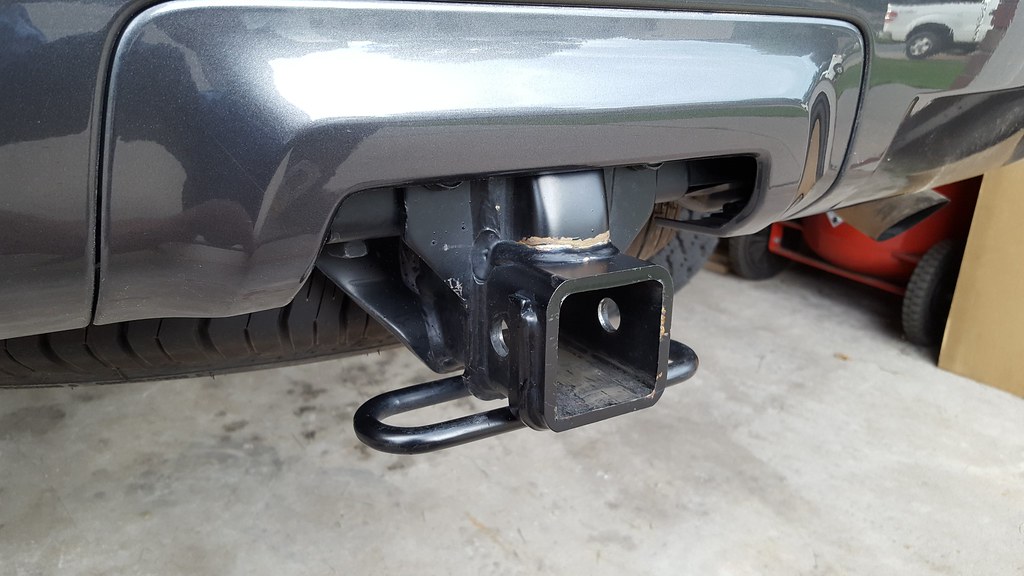
An interesting observation after my first season towing

Off2Mtns

New member
36443405492_3f203ffa74_b.jpg


Just saw this last night and it has me a little concerned. There is no visible metal fatigue or cracking… yet… but the fact that the paint is all chipped off in what would appear to be the logical place for a stress crack to occur is a rather unsettling.

There seems to be some debate as to whether or not the stock 5th gen receiver bolted to the rear cross member is up to the task of handling and adequately distributing the forces applied by a weight distributing hitch. I thought so, but after seeing this I have my doubts. I’ve heard the cross member mounted receiver on the 4th gen is a no-go; I presume they are similar although I have not compared the two. Before we bought the 4Runner I emailed Toyota to ask about use of a WDH and received the following green light response:

33334755523_f7fd8baa48_b.jpg


33988606132_20e54f8968_b.jpg


For those of you not familiar with a WDH set-up, here is what it looks like:

34860980862_7288a3630f_b.jpg


Mine is an Equal-i-zer set-up. The principal of how it works: the hitch head is attached to a set of long spring arms. There are a set L-brackets which attached to the trailer a-frame which the spring arms rest on. The hitch head pivots down, rotating the spring arms down. You couple the trailer to the ball, jack up the rear of the vehicle with the trailer jack, swing the spring arms over the brackets, and lower the jack. This in turn applies force to the spring arms, creating a lever effect to transfer weight off the rear wheels to the front wheels, with a resulting multi-fold benefit: less rear end sag due to greater weight distribution to both front & rear axles of tow rig, a more coupled and stable total tow rig/trailer combo, and reduced sway by way of the spring arms wanting to maintain equal force on each side and thus, minimizing pitch and roll effects. The system really works well and the Equal-i-zer set-up is crazy heavy duty with all components are made from solid steel stock.

However, a platform is only as strong as its weakest link, right? In this case, it looks potentially like the stock receiver might not be up to the task of handling all the additional force after all. We’ve easily towed better than 5k+ miles with the OEM frame mounted class III hitch on my 2nd gen Xterra for 5 years before the 4Runner, but this is my first season with the 4Runner. We’ve made 4 trips with it over the summer totaling less than 1k miles.

Next step? We are done towing for the season already, so I am going to look into fabricating something a bit more heavy duty over the off season.
 
Register to hide this ad
I thought there was a note in the owners manual that explicitly stated to not use a WDH on the stock receiver.

Someone else on here has already bolted up a 4th gen frame mounted hitch to a 5th gen with no modifications. If I was going to routinely tow with a WDH, that is most likely the route I'd go.
 
i'd bet more on paint defect or possibly rust at the weld, i would probably follow up to your previous inquiry though with toyota and let them know

if you really want to be sure you could have someone inspect it
 
I tow a 27' Travel Trailer with WDH, right at 4800-4900 lbs. I have been doing so for 2 years, and 2 years previous with my FJ. Thankfully, no problems, and hopefully continued no issues. I am sure I have logged at least 7500 miles towing, with stretches of 300-700 miles at a time. I will inspect my hitch welds tonight.
 
I was told by CanAm (the guys that sold me the camper; 19' vista cruiser weighing in at around 2800# dry; Airstream and towing specialists here in Canada) that to use the WDH that I used on my previous vehicles, I would have to strengthen the hitch welding in additional bars bracing the hitch to the frame which would force me to downsize the spare. I tow the old fashion way without any bars and our 16 Trail does well. I did add the Firestone airbags and have them inflated to 30 PSI with tires at around 50-55 PSI when towing.

Truck does well. We already have done plenty of long distance travels including Florida in the winter.

I will check the welds tomorrow as that's quite disturbing to see. I wonder what my 4th gen looks like then ... I pulled many trailers over the recommended weight.
 
36443405492_3f203ffa74_b.jpg


Just saw this last night and it has me a little concerned. There is no visible metal fatigue or cracking… yet… but the fact that the paint is all chipped off in what would appear to be the logical place for a stress crack to occur is a rather unsettling.

There seems to be some debate as to whether or not the stock 5th gen receiver bolted to the rear cross member is up to the task of handling and adequately distributing the forces applied by a weight distributing hitch. I thought so, but after seeing this I have my doubts. I’ve heard the cross member mounted receiver on the 4th gen is a no-go; I presume they are similar although I have not compared the two. Before we bought the 4Runner I emailed Toyota to ask about use of a WDH and received the following green light response:

33334755523_f7fd8baa48_b.jpg


33988606132_20e54f8968_b.jpg


For those of you not familiar with a WDH set-up, here is what it looks like:

34860980862_7288a3630f_b.jpg


Mine is an Equal-i-zer set-up. The principal of how it works: the hitch head is attached to a set of long spring arms. There are a set L-brackets which attached to the trailer a-frame which the spring arms rest on. The hitch head pivots down, rotating the spring arms down. You couple the trailer to the ball, jack up the rear of the vehicle with the trailer jack, swing the spring arms over the brackets, and lower the jack. This in turn applies force to the spring arms, creating a lever effect to transfer weight off the rear wheels to the front wheels, with a resulting multi-fold benefit: less rear end sag due to greater weight distribution to both front & rear axles of tow rig, a more coupled and stable total tow rig/trailer combo, and reduced sway by way of the spring arms wanting to maintain equal force on each side and thus, minimizing pitch and roll effects. The system really works well and the Equal-i-zer set-up is crazy heavy duty with all components are made from solid steel stock.

However, a platform is only as strong as its weakest link, right? In this case, it looks potentially like the stock receiver might not be up to the task of handling all the additional force after all. We’ve easily towed better than 5k+ miles with the OEM frame mounted class III hitch on my 2nd gen Xterra for 5 years before the 4Runner, but this is my first season with the 4Runner. We’ve made 4 trips with it over the summer totaling less than 1k miles.

Next step? We are done towing for the season already, so I am going to look into fabricating something a bit more heavy duty over the off season.

What's the loaded weight of your trailer and what's its tongue weight?
 
I'm going to guess that it is merely a paint defect. I had areas on my new Tundra's frame and rear axle where the paint flaked off exactly like that in the first 2000 miles. I simply hit the areas with a wire brush/wheel and repainted. You could remove the hitch, clean it up where the paint flaked off and have it checked for cracks using a dye penetrant or magnetic particle method just to be sure.
 
I'm going to guess that it is merely a paint defect. I had areas on my new Tundra's frame and rear axle where the paint flaked off exactly like that in the first 2000 miles. I simply hit the areas with a wire brush/wheel and repainted. You could remove the hitch, clean it up where the paint flaked off and have it checked for cracks using a dye penetrant or magnetic particle method just to be sure.

Showed a friend who is a CWI and he was not so sure either, recommended the dye penetrant as well. Will start there in the off season.
 
Showed a friend who is a CWI and he was not so sure either, recommended the dye penetrant as well. Will start there in the off season.

I'm also a CWI with a degree in welding technology. Lots of factors to consider - but in the end, a crack is the worst discontinuity you can have, followed by incomplete fusion. So that is pretty bad. Hard to factor where it came from. Can be so many contributing factors from poor material prep, improper amperage, etc.

I would replace the whole assembly, personally. If it was welded improperly who knows how long the rest will last.
 
It's possible to have a bad weld - but pretty unlikely. These are all welded by a robot with pretty sophisticated electronics that monitor the welds. If you ever get a chance to see one in action - it's pretty amazing. I'm also in the camp of it probably being paint defect, but I'm curious to know. Any chance you could take some better pictures?
 
It's possible to have a bad weld - but pretty unlikely. These are all welded by a robot with pretty sophisticated electronics that monitor the welds. If you ever get a chance to see one in action - it's pretty amazing. I'm also in the camp of it probably being paint defect, but I'm curious to know. Any chance you could take some better pictures?


I am curious if its perhaps anti-spatter residue that didn't get fully removed before powder coating, and the stress just caused that area to fall off.
 
Based on the letter you originally posted from Toyota, I picked up a 3800 lb (empty), 4500 lb ready to roll 21 foot Lance 1865 in Shoemakersville PA in July. I'm using a E2 Fastway 600/6000 WDH.

I towed that sucker down to DC, over the Appalachian mountains, and back to Saint Louis. I also use airbags, but the WDH is set so that body depression is approximately equal on all 4 corners of the T4R.

I will inspect, and report back. My woman's father is a welding expert, so I can have him take a look if anything looks funky. He is about to turn 90 years old, so I don't want to bug him unless necessary.

;)
 
I am curious if its perhaps anti-spatter residue that didn't get fully removed before powder coating, and the stress just caused that area to fall off.

I don't think anti-spatter is part of the program. The robotic welders have almost no spatter unless there's something wrong. I'm not sure what happens between the fabrication process and painting. I don't think these hitch parts are painted with the frame - so they are probably not done with the same paint process and quality that the frames have in terms of prep and finish. May just be something along the lines of primer spray that didn't hit that area and then the finish coat didn't adhere.
 
Last edited:
Can you post a close up of the area of concern..

Looks like similar paint flaking that can be seen on the weld seams on the front LCAs. Nothing to be concerned with, but the picture you posted is not detailed enough to really see anything.

The WDH definitely puts a different type of force on the receiver.. I personally have never used one and have always opted for air bags.

You need to know what your WDH bars are rated at and what the loaded tongue weight of your trailer is.
 
I was told by CanAm (the guys that sold me the camper; 19' vista cruiser weighing in at around 2800# dry; Airstream and towing specialists here in Canada) that to use the WDH that I used on my previous vehicles, I would have to strengthen the hitch welding in additional bars bracing the hitch to the frame which would force me to downsize the spare. I tow the old fashion way without any bars and our 16 Trail does well. I did add the Firestone airbags and have them inflated to 30 PSI with tires at around 50-55 PSI when towing.

Truck does well. We already have done plenty of long distance travels including Florida in the winter.

I will check the welds tomorrow as that's quite disturbing to see. I wonder what my 4th gen looks like then ... I pulled many trailers over the recommended weight.

a canam representative doesn't know nearly as much about what the hitch and cross member can handle than the company that made it and engineers who designed it. canam is basing their assessment off eyeball engineering, you should trust toyota over eyeball engineering.

toyota said not to use a WDH on the 4th gen, but says nothing about it for the 5th gen and when asked specifically about it says its fine to use. Toyota wouldn't just remove that restriction for no reason going from 4th gen to 5th gen.
 
Its not uncommon in the paint industry to have delamination failures on welds due to issues such as poor adhesion over the heated bead and possible outgassing issues on cure. I would touch it up to prevent rust and not worry to much about it unless it gets worse.

I don't see it signifying a crack, based only on your pictures.
 

Members online

Forum statistics

Threads
278,316
Messages
3,554,120
Members
248,016
Latest member
Advally Service

Trending content

Back
Top