Another Dual Battery Setup

Airgazm

New member
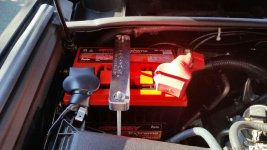
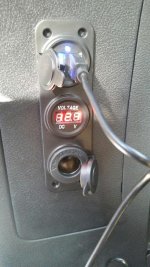
Hi guys, finally got my version of Dual Battery completed. So far I'm pretty happy with it, it was an experiment for me. So, I went a different route. I have a 16 4runner with a pretty new battery, so I didn't want to replace it just yet, and adding an additional AGM battery means that the AGM battery will not be able to be charged past 80 percent due to required voltage, so it will end up sulfated, which is bad.

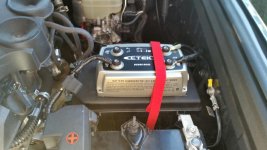
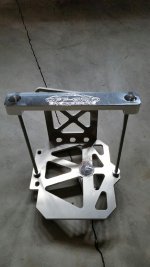
So my solution was to go with a DC-DC charger to charge the additional AGM properly. I found this C-Tek that seems to work flawlessly. It was $210 dollars shipped, so for about the same price as a good solenoid, I got the charger. I purchased the Off Road Engineering mount and the Odyssey Group 35 - 65 Amp-hour battery. Shouts out to Off Road Engineering, first they told me it would be 2 weeks wait, but then the thing came in 3 days, so I was very happy with the mount, very good quality and it fits perfectly.

I got everything installed and immediately the battery charged fully. The thing about the C-Tek charger is it uses an intelligent charge to fully charge the battery properly, much better than an alternator charge.
This type setup is the Australians preferred setup.

So, for the Pros and Cons.

Pros.
The C-Tek charges the battery up at 20 amps, so it will never tax your electrical system more than needed and will not harm your alternator.
You will always get a 20 amp charge at idle, regardless of anything else going on in the vehicle. 65 hour battery flat will charge fully in 3 hours driving or idling.
The C-Tek charger acts as a battery isolator.
The C-Tek charger also will charge with a solar panel, which I plan to add next.
No need to add diodes to the vehicle and possibly cause other problems with higher voltage.
Ability to run both a regular lead acid and AGM battery at the exact same time.
Cheaper, only having to add one AGM battery is cheaper than adding two new AGM batteries and a diode.
No need to plug into an AC charger at home to top of the battery to prevent sulfation.

Cons.
The C-Tek charger only charges at 20 amps, so it's slower than an alternator charge at higher rpm. Although there are other model available for higher charge rates.
There is no battery solenoid, so reverse jump starting is not possible, although I carry a single cable in the engine compartment I can simply jump if needed, so it's not a big deal in the event a reverse jump is needed.
The charger takes up space in the engine compartment.

In the future I plan to add a solenoid to the mix to get the best of both worlds, where I can jump the two battery's to get a faster charge and reverse jump start if needed, but for now, this setup works sweet.

My fridge goes for about a day on the 65 hour battery, which combined with my generator and/or solar panel for recharging in the day is just about all I need.
 

Attachments
  • 20170810_150737.jpg
    20170810_150737.jpg
    126.7 KB · Views: 2,536
  • 20170816_090848.jpg
    20170816_090848.jpg
    132.7 KB · Views: 2,649
  • 20170816_090903.jpg
    20170816_090903.jpg
    129.3 KB · Views: 3,100
  • 20170820_174044.jpg
    20170820_174044.jpg
    137.8 KB · Views: 2,521
Last edited:
Register to hide this ad
DC-DC charger is the best way to go for dual battery, it avoids any of the voltage issues from stock charging system not having high enough voltage for adsorption on deep cycle batteries
 
It already acts as a battery isolator, not sure I understand what you mean by charge relay?

You said in your original post that you planned to integrate a solenoid. Like a relay, a solenoid in a dual battery setup allows you to run the batteries separately or in parallel. A charging relay - such as a blue sea ACR or national luna setup - also controls when the house battery receives current from the alternator to charge it, but unlike a solenoid a charging relay measures the battery voltage to avoid over and under voltage situations. Since this gizmo already serves the purpose of controlling the charge state, I'm curious how you would plan to integrate a solenoid
 
You said in your original post that you planned to integrate a solenoid. Like a relay, a solenoid in a dual battery setup allows you to run the batteries separately or in parallel. A charging relay - such as a blue sea ACR or national luna setup - also controls when the house battery receives current from the alternator to charge it, but unlike a solenoid a charging relay measures the battery voltage to avoid over and under voltage situations. Since this gizmo already serves the purpose of controlling the charge state, I'm curious how you would plan to integrate a solenoid

Ahh, I see what you mean. My thoughts were to just implement a simple relay(solenoid) to connect both battery's together. The reasoning for this would be to get a faster charge when the battery is low, or to jump start the original battery, or possibly to simply add more amp-hours of juice when needed.

There are times when I might not have a genny, or it's cloudy which leaves only the engine to provide recharging so a faster charge would be nice. I would have to rig it so the dc-dc charger disconnects when the two battery's connect together. A simple switch in the dash I press to connect/disconnect, only for those times when needed. Seems like a pretty cheap solution to get the best of everything.

I probably should have just gone with the redarc 40amp dc-dc solution. Live and learn.
 
IIRC Blue Sea systems makes a "break before make" switch that should allow you to switch between alternator charging and the c-tek unit without the risk of back feeding the c-tek.

This is an interesting little piece of tech. If I wasn't already so far down the rabbit hole on my dual battery setup, I would seriously consider going this route. As it is, I'm going to have to upgrade my alternator to handle two big AGM Optima batteries.

Thanks for sharing.
 
IIRC Blue Sea systems makes a "break before make" switch that should allow you to switch between alternator charging and the c-tek unit without the risk of back feeding the c-tek.

This is an interesting little piece of tech. If I wasn't already so far down the rabbit hole on my dual battery setup, I would seriously consider going this route. As it is, I'm going to have to upgrade my alternator to handle two big AGM Optima batteries.

Thanks for sharing.

Thanks for the link to Blue Sea product. That might work too. Last night I was thinking I could simply get by with a cheap SPDT relay (using the closed terminal) for the Ctek portion. You can buy qty 5 SPDT 30amp relays for $10 bucks shipped and it's only a 20 amp charger so the relay would work fine. Then use an inexpensive Solenoid relay to connect the two battery's together and a single switch in the dash that when pressed, disconnects the Ctek and connects the battery's together for fast alternator charging. Ctek also makes a device that allows bypassing for an 80 amp charge, but they want another $200 for it and it takes up more space.

I just love the fact that I can now use power without having to worry about not being able to start the vehicle. So glad I did this mod. Next I want to wire the main stereo into the aux battery so I don't need a key to use it.

Anyone having any recommendations for a solar panel. I really like the ones that are bendable and paper thin, seems like this would be easy to store away somewhere or mount to roof rack. Guessing I probably need a 100 watt to get by.
 
So - I understand this is probably a stupid question, but anything connected to the aux battery running this system is in effect pulling power from both the starter battery and the aux battery simultaneously, until the point this charge controller recognizes a lower voltage starter battery situation, and then it isolates the two systems.... correct?

I could run all accessories off the Aux battery alone and not have to worry - ever - about draining the starter battery by accident? I don't need to run any additional switches/relay's/solenoids?

Thanks.
 
So - I understand this is probably a stupid question, but anything connected to the aux battery running this system is in effect pulling power from both the starter battery and the aux battery simultaneously, until the point this charge controller recognizes a lower voltage starter battery situation, and then it isolates the two systems.... correct?

I could run all accessories off the Aux battery alone and not have to worry - ever - about draining the starter battery by accident? I don't need to run any additional switches/relay's/solenoids?

Thanks.

Actually, only the Aux battery gets drained. The charge controller isolates the starting battery from the second battery, it never connects them together, in any event. There is zero chance draining the starting battery with this setup.

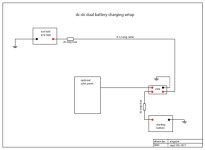
No, there is no need to run anything additional, I posted above that I'm thinking about adding some additional functionality with relays and solenoids, but it's not needed. All that's needed is the aux battery, the dc-dc charger and some 8-12 gauge cable in-between.
 
[MENTION=160360]Airgazm[/MENTION]
could i bother you for a simple sketched out schematic of this DC-DC setup going to and from the CTEK?
 
[MENTION=160360]Airgazm[/MENTION]
could i bother you for a simple sketched out schematic of this DC-DC setup going to and from the CTEK?

sure thing, simple it is though.
 

Attachments

  • t4r-dual-battery.jpg
    t4r-dual-battery.jpg
    27.6 KB · Views: 2,112
Last edited:
Update. I finally got a chance to take the 4runner camping for a 4 day weekend. I was presently surprised that my Engel 50L fridge lasted 3 full days(75 hours) on the Odyssey Group 35 battery and the voltage was still around 11.5 volts before I started the truck and left.

So, very happy with that, once I get a solar panel on there, it shouldn't have any trouble with extended run-time.
 
Great write up. I've been researching the web, and it appears that the Aussies all use DC-DC chargers. Redarc makes some nice systems. I don't see many of the folks overseas using VSRs or ACRs as the newer alternators can't charge the deep sea AGM batteries fully. Here's a 25A DC-DC I plan on using.

https://redarcelectronics.com/products/dual_input_25a_in-vehicle_dc_battery_charger


Considering a M31 AGM battery as my reserve and a M34/35 AGM as my starter.

Looks like a great system. A total noob at electronics, but will try and figure it out!
 
Last edited:
DC-DC charger is the best way to go for dual battery, it avoids any of the voltage issues from stock charging system not having high enough voltage for adsorption on deep cycle batteries

The only downside to a DC-DC setup like this over an ACR like the BlueSea is that the DC-DC can only pass along the max charge current.

The alternator can not participate in feeding the AUX side loads when the car is running.

If you have a DC-DC charger throwing out 25A, and you have 50A worth of load (say a night run with light bars on along with the fridge and other items) you can still run down the house battery while driving.

So, its all depends on the application. The smallest BlueSea ACR is good for at least 120 amps, with gives you much faster charge times, and allows for true parallel battery when the motor is running.

ALTERNATELY... that problem could be solved with a manual switch. But its no longer automatic.

I have both, ACR and DC-DC setups. I use DC-DC almost exclusively when dealing with Lithium Ion batteries in custom setups where I have to deal with custom voltages. I do love DC-DC chargers, converters, and other items.

I have a 24v Lithium system that can run my ARB for a week in freezer mode unattended. The coolest part is, the fridge is native 24v and has a build in LVD. I never have to worry about battery protection.

4rYDDUR.jpg


For more our typical applications we see around here, I am still a huge fan of a BlueSea ACR.
S25hxW0.jpg
 
Last edited:
The only downside to a DC-DC setup like this over an ACR like the BlueSea is that the DC-DC can only pass along the max charge current.

The alternator can not participate in feeding the AUX side loads when the car is running.

If you have a DC-DC charger throwing out 25A, and you have 50A worth of load (say a night run with light bars on along with the fridge and other items) you can still run down the house battery while driving.

So, its all depends on the application. The smallest BlueSea ACR is good for at least 120 amps, with gives you much faster charge times, and allows for true parallel battery when the motor is running.

ALTERNATELY... that problem could be solved with a manual switch. But its no longer automatic.

I have both, ACR and DC-DC setups. I use DC-DC almost exclusively when dealing with Lithium Ion batteries in custom setups where I have to deal with custom voltages. I do love DC-DC chargers, converters, and other items.

I have a 24v Lithium system that can run my ARB for a week in freezer mode unattended. The coolest part is, the fridge is native 24v and has a build in LVD. I never have to worry about battery protection.

4rYDDUR.jpg


For more our typical applications we see around here, I am still a huge fan of a BlueSea ACR.
S25hxW0.jpg

Very cool. Will I be able to get a full charge on a M31 AGM with the blue sea? Alternatively I could charge occasionally at home from a smart charger I guess, but now I am even more confused!!! Back to the books!
 
people put driving lights on their house battery? why? yeah i guess if you have high draw stuff on your house battery you'll want it charging from the alternator, but i think most people just have stuff like fridges and camp lights where they are in no danger of using more than the ~20A - 40A you can get with DC-DC charger

one thing i didn't originally notice about the redarc is that a couple models are also rated for LiFePO4 which is a neat option to have if you ever upgrade your house battery, i would probably pay a bit more to have that flexibility.
 
Last edited:
OK, so now I am even more confused!!! Back to the books!

Nothing to be confused about...

An ACR (Automatic Charge Relay) is a very simple device. It’s basically connecting, or disconnecting the 2nd battery in parallel with the starter battery. It’s doing this by monitoring the voltage on both Bank A, and Bank B.

It alone is not a charger, but a smart voltage sense relay with additional features build it depending on the model. Like AUX battery priority or Start Isolation. I use them both, and I did a write up on those two ACRs here.
http://www.toyota-4runner.org/engin...cr-automatic-charging-relays.html#post2642084

A DC-DC can be a charger, step up/down converter, and or a battery maintainer. Another member made a comment about not having enough voltage to properly maintain a AGM, which can be a valid concern, but getting those higher voltage is more of a maintenance item. Something that can be easily accomplished by a simple AGM maintainer/battery tender if used a traditional ACR.

The key take-away from my post was that it DEPENDS on what you want to do with the setup… I run a fridge, lighting, air pumps, and other loads all from the AUX side that can easily exceed most DC-DC chargers so the ACR was a natural pick. I very much like the #7611 BATTERYLINK version because with a push of a button, I can force the starter to participate in feeding AUX loads like my fridge until 12.5 volts instead of 12.75, increasing my fridge total runtime. I don’t even use AGM batteries because my voltage never get low enough to worry about it. I save a ton of cash just buying regular starter batteries.

If all you are doing is running low load, but persistent loads, than a DC-DC is an excellent choice, but I find them most valuable with different battery chemistries, or when mixing regular and AGM in the same system for low load applications.
 

Members online

Forum statistics

Threads
278,306
Messages
3,554,045
Members
248,016
Latest member
Advally Service

Trending content

Back
Top