eastsideride
Member
Hey everyone,
I figured I would add to the flexplate knowledge database here on the forum after... you guessed it... my flexplate grenade-ed itself. I talked to people on Facebook, I read through the forums, and I spoke to Toyota techs. One thing we know is, we don't have a conclusion for how they break.
If you have not heard about a flexplate, it is in our automatic transmissions and is attached to the crankshaft and torque converter in the bell housing of the transmission. The flexplate could be referred to the drive plate or even a flywheel (though not politically correct since a flywheel is what is in a manual transmission). Should you ever replace or install a flexplate, buy OEM only. If you read the article below, someone learned this out the hard way so we don't have to.
Flexplate Replacement PSA
Also, if you don't know what a bad flex plate looks or sounds like, check out this YouTube video:
Engine knocking? Could be a bad flexplate
Back story with my 02 4Runner SR5 4x4... I started noticing a quite and infrequent metallic rattle from the engine area but resonating under the vehicle. This started over a month prior to date of failure. I brushed it off because sometimes the exhaust may rattle but it also would go away for some time or I just wouldn't hear it since I would jump in the car and drive. The rattle is only really heard when you get outing the vehicle and then engine is still running. Fast forward to last week and i was hearing it clear as day when i had the vehicle idling. Something was wrong and it wasn't from the cold weather. I diagnosed it as the flexplate and said I'd take the inspection cover off on Sunday before leaving for a drive from Wisconsin to Toronto, Canada today (Wednesday). Well on Friday, it failed and I rolled to the side of the road.
When the flexplate fails, your motor will run while it is on, but it doesn't sound good because you have broken metal in the bell housing. Pro tip, shut that sucker off. You also will not be able to start it back up and when you try, it will also sound nasty, real real nasty.
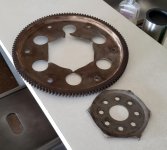
In my case, the flexplate separated in two parts. One part was bolted to the crankshaft and the other was bolted to the torque converter. This is a pain to remove like this - FYI. When the bell housing was removed, I found DIRT in there. This might have aided the flexplate failing by maybe adding something that shouldn't be in the mix to a moving part. Do yourself a favor if your flexplate is good, CHECK YOUR INSPECTION PLATE and consider adding some gasket maker to it so it helps seal crap out! I believe this may have helped it go, and that was a consensus by some. I didn't best to remove most of the dirt that I could so hopefully it's good. But adding a lot of engine torque may also aid to this. Like being stuck in mud or deep water and being hard on the motor because your stuck (been there)....
Anyways, here was my flexplate that came out of my transmission. The new one is in and I just drove ~800 miles before writing this before falling asleep.
I figured I would add to the flexplate knowledge database here on the forum after... you guessed it... my flexplate grenade-ed itself. I talked to people on Facebook, I read through the forums, and I spoke to Toyota techs. One thing we know is, we don't have a conclusion for how they break.
If you have not heard about a flexplate, it is in our automatic transmissions and is attached to the crankshaft and torque converter in the bell housing of the transmission. The flexplate could be referred to the drive plate or even a flywheel (though not politically correct since a flywheel is what is in a manual transmission). Should you ever replace or install a flexplate, buy OEM only. If you read the article below, someone learned this out the hard way so we don't have to.
Flexplate Replacement PSA
Also, if you don't know what a bad flex plate looks or sounds like, check out this YouTube video:
Engine knocking? Could be a bad flexplate
Back story with my 02 4Runner SR5 4x4... I started noticing a quite and infrequent metallic rattle from the engine area but resonating under the vehicle. This started over a month prior to date of failure. I brushed it off because sometimes the exhaust may rattle but it also would go away for some time or I just wouldn't hear it since I would jump in the car and drive. The rattle is only really heard when you get outing the vehicle and then engine is still running. Fast forward to last week and i was hearing it clear as day when i had the vehicle idling. Something was wrong and it wasn't from the cold weather. I diagnosed it as the flexplate and said I'd take the inspection cover off on Sunday before leaving for a drive from Wisconsin to Toronto, Canada today (Wednesday). Well on Friday, it failed and I rolled to the side of the road.
When the flexplate fails, your motor will run while it is on, but it doesn't sound good because you have broken metal in the bell housing. Pro tip, shut that sucker off. You also will not be able to start it back up and when you try, it will also sound nasty, real real nasty.
In my case, the flexplate separated in two parts. One part was bolted to the crankshaft and the other was bolted to the torque converter. This is a pain to remove like this - FYI. When the bell housing was removed, I found DIRT in there. This might have aided the flexplate failing by maybe adding something that shouldn't be in the mix to a moving part. Do yourself a favor if your flexplate is good, CHECK YOUR INSPECTION PLATE and consider adding some gasket maker to it so it helps seal crap out! I believe this may have helped it go, and that was a consensus by some. I didn't best to remove most of the dirt that I could so hopefully it's good. But adding a lot of engine torque may also aid to this. Like being stuck in mud or deep water and being hard on the motor because your stuck (been there)....
Anyways, here was my flexplate that came out of my transmission. The new one is in and I just drove ~800 miles before writing this before falling asleep.