Auto transmission compromised if flexplate fails?

There is 1 solenoid that controls the torque converter lockup. There is a slim possibility that the solenoid isn't functioning properly, but when that happens you will get a trouble code 99 percent of the time.

Is that one of the 3 solenoids that's accessed with the transmission pan removed?

Edit: Part numbers for 3 transmission solenoids
35250-30050
35250-30070
35250-50030
 
Last edited:
I have the Metabo 18v brushless impact. It has the perfect size and power to remove crank bolts which is why I initially bought it. It's listed at 295 ft/lbs but seems to put out every bit of it. My 1100 ft/lb ingersoll rand 20v impact never gets used anymore.

Edit: Amazon link for metabo impact


I'm pretty sure metabo HPT is just the new name for hitachi & don't think there's any compatibility between metabo HPT & metabo.

Yes I was getting confused with Metabo HPT multivolt thing, you have the legit Metabo. 295 ft/lbs is good enough for everything then, like axle nuts?
 
Last edited:
Yes I was getting confused with Metabo HPT multivolt thing, you have the legit Metabo. 295 ft/lbs is good enough for everything then, like axle nuts?

Axle nuts too. It has to hammer on it a little longer than my 1100 ft/lb impact but will still zip it off. Haven't encountered a fastener it hasn't been able to remove yet. It has a good balance of small size, power & very ergonomic feel in your hand. I'm pretty confident that anyone that buys it will not be disappointed.
 
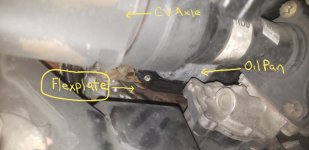
Removed the access cover & rotated the crank bolt clockwise to inspect the flexplate. Also used a borescope. I couldn't see any cracks & the teeth looked intact. I took it for a drive to get the atf to 170*F. Fluid looked clean & within normal range on the dip stick (I've drained & filled my atf every other oil change for as long as I've owned it). I still heard the rattling/ticking sound during my drive. Didn't experience any slipping this time but acceleration seemed a little sluggish.

Still no codes or pending codes which I checked periodically on my scangauge during my test drive. Is there anymore troubleshooting I can do to confirm that it's my flexplate & torque converter? If not my next step is most likely going to be draining the atf and dropping the pan to prepare for replacing the torque converter & flexplate. Will start getting a parts list together.
 

Attachments

  • Flexplat 2002 4runner.jpg
    Flexplat 2002 4runner.jpg
    119.7 KB · Views: 443
Last edited:
There is also the stall test, to see if the 4Runner dies or not. It is in the FSM; mine is in a box somewhere in storage at the moment since the move. However mine passed the test.

One other thing that I noticed when my TC was going out was that the ATF heated up quickly once up past 150f. Once I got it replaced the temps stayed a good 10 to 20 degrees cooler than before, given that ever other variable was close to constant.

But drop the pan first, before putting the cart before the horse.
 
There is also the stall test, to see if the 4Runner dies or not. It is in the FSM; mine is in a box somewhere in storage at the moment since the move. However mine passed the test.

One other thing that I noticed when my TC was going out was that the ATF heated up quickly once up past 150f. Once I got it replaced the temps stayed a good 10 to 20 degrees cooler than before, given that ever other variable was close to constant.

But drop the pan first, before putting the cart before the horse.

Did you have any codes when your torque converter was going out? My ATF temps seem to be behaving normally. I got the temps to a little over 170*F during my drive but didn't notice rapid increases. I have a hard copy of the FSM & will look up the stall test. Is the stall test for the torque converter?

The one consistent symptom I had when I took it for a drive the other day was a ticking/rattling sound. It was there at initial start up & would hear it at times throughout my drive. Was also happening as I was pulling into my garage at operating temps. It seemed to be more noticeable at stops and slower speeds. The sound seems to be coming from the transmission area but I've been fooled by sounds before.

Are there other things I should be looking into to avoid misdiagnosing this? Exhaust manifold leak, etc.?
 
Flex Plate usually cracks at crank bolt holes..not going to see it unless its extreme. Stop the guessing / backyard diagnosing.. you can rent ,borrow a gauge to test??


HYDRAULIC TEST
Measure the line pressure.

NOTE:
- Do the test at normal operation fluid temperature 50 - 80 °C (122-176 °F).
- The line pressure test should always be carried out in pairs. One technician should observe the conditions of wheels or wheel stoppers outside the vehicle while the other is doing the test.
- Be careful to prevent SST's hose from interfering with the exhaust pipe.

1. Warm up the ATF.
2. Remove the test plug on the transmission case front left side and connect SST.
SST 09992 - 00095, 09992 - 00151, 09992 - 00271
3. Fully apply the parking brake and chock the 4 wheels.
4. Start the engine and check idling speed.
5. Keep your left foot pressing firmly on the brake pedal and shift into D position.
6. Measure the line pressure when the engine is idling.
7. Depress the accelerator pedal all the way down. Quickly read the highest line pressure when engine speed reaches stall speed.
8. In the same manner, do the test in R position.

ty024runn_rm1_di-169a_svg
 
I don't have any experience with doing diagnostic work with transmissions which is why I've been googling, youtubing & looking through the FSM. I prefer to not guess which is why I started this thread to get some direction. I'm aware from what I've read that looking at the flexplate through the inspection cover will often times not show an issue but since this is my first time encountering something like this it was a logical starting point with my lack of knowledge on the subject. Appreciate the steps listed for doing a hydraulic test. That is something I'm not familiar with. Will look up what tools/equipment I'll need & see if I can find the specific steps in the FSM.
 
Nope, no codes were present nor did I expect any. Nor did I hear any noises. But at that time the POS Aisin fan clutch bearing was drowning out any other sounds. Can you get underneath while in P/N and hear the origin of the noise?

Yes, the stall test is a test to test the tc, though as in my case it passed yet the TC was bad.

I don’t know if anyone rents a tranny pressure gauge. I am not even sure the FSM gives numerical parameters for a pass/fail. I do know specific tranny FSMs for the a340 are listed on Fleabay from time to time.

Exhaust original?
 
ty024runn_rm1_di-169b_svg


Where is Trans cable adjustment?
No trans cable to adjust on 2001-2002. OP has a 2002.

I'm sure you and OP know this, but for others who stumble upon this thread in the future: a line pressure test doesn't test torque converter failure or flexplate failure. A line pressure test is for checking the transmission fluid pump operation (and also the correct way to set the transmission throttle cable to set line pressure).
 
Can you get underneath while in P/N and hear the origin of the noise?

Yes, the stall test is a test to test the tc, though as in my case it passed yet the TC was bad.

I don’t know if anyone rents a tranny pressure gauge. I am not even sure the FSM gives numerical parameters for a pass/fail. I do know specific tranny FSMs for the a340 are listed on Fleabay from time to time.

Exhaust original?

When I was underneath over the weekend the sound seemed to be in the general bell housing region but not convincing enough to be definitive. That's when I started to consider the exhaust/manifold since an issue there can create similar symptoms from what I've read. It's also possible the slight slipping I thought I experienced a few nights ago could have been poor acceleration due to an exhaust leak? To my knowledge the exhaust is original. The previous owner had all records of maintenance from Toyota & didn't see any mention of a new exhaust.

I've been flipping through my FSM for stall test instructions but haven't found it yet.

If the FSM doesn't give numerical parameters for pass/fail trans pressure test, is it worth doing or safe?


No trans cable to adjust on 2001-2002. OP has a 2002.

I'm sure you and OP know this, but for others who stumble upon this thread in the future: a line pressure test doesn't test torque converter failure or flexplate failure. A line pressure test is for checking the transmission fluid pump operation (and also the correct way to set the transmission throttle cable to set line pressure).

I had no idea what a line pressure test tests for so thank you for the clarification.
 
Update:
I got a pending P0770 code, Shift Solenoid E malfunction, last night on my drive home. Shortly after I noticed my trans temps seemed about 10-20* hotter. Started a new thread specific to that code since I can rule out the flexplate for now.

P0770: Deciding on repair options

FSM P0770 & solenoid testing procedure:
http://www.teamtoyota4x4.org/archiv...ypdf/02rmsour/2002/024runne/di/at/cip0770.pdf

FSM torque converter testing procedure:
http://www.teamtoyota4x4.org/archiv...pdf/02rmsour/2002/024runne/at/tccadp/insp.pdf
 
Last edited:
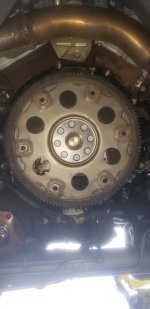
Inspected my flexplate after dropping my transmission this weekend. Flexplate looks good & no signs of cracking. Thought about getting a new one but decided to keep the original and just replace the transmission. I'm guessing my rattling noise was from the torque converter.
 

Attachments

  • Flexplate.jpg
    Flexplate.jpg
    74.7 KB · Views: 344

Members online

Forum statistics

Threads
278,316
Messages
3,554,107
Members
248,016
Latest member
Advally Service

Trending content

Back
Top