
Ball Joint bolts and torque specs

cj80cruiser

Senior Member
I've noticed a couple threads stating the lower 4 bolts on OEM ball joints have sheared off. There may be more but these two come to mind.

http://www.toyota-4runner.org/3rd-gen-t4rs/88252-new-twist-lower-ball-joint-failure.html
http://www.toyota-4runner.org/3rd-gen-t4rs/118298-bolts-sheared-off-lbj.html

So when I ordered my ball joints from Toyota I also ordered new bolts but there are no clear markings on the head stating what grade the bolts are. This got me to thinking that maybe the new bolts were of lower quality and needed to be upgraded to avoid this situation from happening.

I'm no bolt expert by any means so I took an old bolt out of my part out truck and a new OEM bolt to a local shop that sells only nuts and bolts to get an idea of differences of materials. The owner of the business said he believes that both the old and new OEM bolt are of low quality but he can't be certain since there are no bolt grade markings on the head of the bolts.

He also printed me off a torque spec for an 8.8 grade bolt with the same pitch as OEM. I've read on TTORA and on this forum that the online FSM has a misprint and that the 37 ft/lbs are incorrect and that it should be torqued to 59 ft/lbs but this print out says otherwise. The only problem is that I don't know what the recommended OEM bolt grade is but here is the chart that stats the 37 ft/lbs is probably correct.
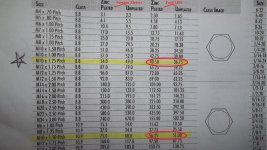
Bolt Torque Specs.jpg
 

Attachments

  • Bolt Torque Specs.jpg
    Bolt Torque Specs.jpg
    140 KB · Views: 64,285
Register to hide this ad
Not sure if I should use the OEM bolts and torque to 37 ft/lbs or go with the 8.8 bolts he gave me and torque to 37 ft/lbs.
 
The trick is that the lines on the bolt head are the markings. There are 4 lines which means it is a 9T class bolt which I think is grade 6.
 
IIRC the metric grade 8.8 is and sae grade 5 which is a pretty low grade bolt.
 
Last edited:
The trick is that the lines on the bolt head are the markings. There are 4 lines which means it is a 9T class bolt which I think is grade 6.

From what I understand metric bolts won't have lines to signify grade. Like I said in my post above I'm not an expert on bolt manufacturing or markings so if you have info to the contrary please post up.

IIRC the metric grade 8.8 is and sae grade 5 which is a pretty low grade bolt. I don't think you can really use the markings on any Toyota bolt to deduct grade, I would think most are application specific.

You are correct 8.8 is equivalent to a grade 5 and a 10.9 is equivalent to a grade 8.

The bolt shop owner seemed to think the OEM bolts were of a lesser quality than the 8.8s. The torque specs in the online FSM state the same for the OEM bolts and the 8.8s at 37ft/lbs.

I may end up using the OEM bolts supplied but now I wonder if 59ft/lbs is too high and if I should use the spec in the online FSM.

I hate making such a big deal about this discrepancy but it has me a little paranoid on such a crucial part.
 
There is a key in the factory service manual which spells out which marking equals what class bolt. There is a key in the front section of the manual.
 
There is a key in the factory service manual which spells out which marking equals what class bolt. There is a key in the front section of the manual.

Ok, I finally found it in the FSM. It's an 11T according to the chart which States that a 10mm bolt with 1.25 thread pitch should be torqued to 64 ft/lbs. Hopefully I read that correctly since the new bolts don't have 6 lines but 4 lines and 2 dots. I can only assume at this point that the 59 ft/lbs is the correct torque spec.
 
Replace those weak yoto bolts with some ARP 12 pointers. They are suposed to be rated at 180,000 psi. Plus they have some type of guarantee on them.

image002.jpg


Summit sells 5 for 16$

ARP 673-1004 - ARP Chromoly Bolts - Overview - SummitRacing.com

I find it a bit funny that they show 6-point bolts in the 12-point bolt listing...

Anyway, I know I have said it a million times, but be careful of going and replacing important bolts with "better" ones; there is a whole host of reasons Toyota might have used "lower grade" bolts rather than higher grade ones not including cost.

1. Lower grade bolts can often tolerate more strain. Hardness and ultimate tensile strength are typically a trade-off with elasticity. Different loading conditions favor different strain properties.
2. Lower grade bolts won't strip out your knuckle as easily. Differential hardness and UTS are used to prevent damage to mating components for many reasons. For example, you typically can rip a lug nut straight off a lug, and the lug threads won't be badly damaged because the lug is a much higher grade or different temper. This is strategic design, and can be used to eliminate multiple failure modes, or unpredictable failure modes.
3. Different tempers can be affected by heat exposure, so if you are exposing them to high heat, like right near the brakes, then over time they can lose their temper (not saying the LBJ bolts heat up, just a general comment)
4. Precise shoulder lengths may vary. Any bolt under shear probably has a shoulder placed precisely to prevent shear on the threads. aftermarket bolts may not have the exact shoulder length, and may cause shear on the threads, greatly reducing the effective strength of the bolt in application.
5. The bolt may intentionally be the weakest link in a system. Again, this is typically done to eliminate other failure modes and make failure easier to predict.

You will probably be fine with high grade bolts, but by getting new OEM, the numbers are on your side, and you will probably be less likely to damage mating components. And with aftermarkets, you are definitely losing some behind the scenes engineering, probably alot of behind the scenes engineering.
 
Last edited:
Anyway, I know I have said it a million times, but be careful of going and replacing important bolts with "better" ones; there is a whole host of reasons Toyota might have used "lower grade" bolts rather than higher grade ones not including cost.........You will probably be fine with high grade bolts, but by getting new OEM, the numbers are on your side, and you will probably be less likely to damage mating components. And with aftermarkets, you are definitely losing some behind the scenes engineering, probably alot of behind the scenes engineering.

Great comment and makes perfect since.

cj80 I am interested to see which way you go here. Subscribed.
 
Everything that NelsonMD said is accurate, but to contrast a bit with his position:

-LBJ bolts shearing off is generally the worst possible type of "failure mode". If, in a high stress situation, the stronger bolts hold and instead the ball comes out of the socket or the end of the LCA shears off you are no worse off.

-Design is always a compromise and cost is a huge factor, even for Toyota. So it can be beneficial to improve upon the strength of OEM parts.


Bolt strength aside, I suspect that the biggest cause of the LBJ bolts shearing is too much torque during install.
 
those really use a 10mm bolt?
no wonder they break.

and, all the ones ive changed, im sure they were bigger than that. atleast 12mm, maybe 14mm.
and i have never used a torque wrench. and never seen any bolts sheared off.
 
Of all the stories of failed bolts for the ball joints, i have not heard of any of the aftermarket bolts failing. Makes you wonder.

I hear every one commenting on getting new bolts from Toyota for the ball joints but that is BS. Replacing the bolts with new ones every time front end work is done is crap. Those bolts get undone any time cv work has to be done, sometimes when shock work has to done, or just to check the ball joint for worness and slop.

The Toyota bolts aren't anything special. They are not shouldered, they are not cotter-pined. So upgraded bolts would be an improvement to the "one time use only bolts from Toyota".
 
those really use a 10mm bolt?
no wonder they break.

and, all the ones ive changed, im sure they were bigger than that. atleast 12mm, maybe 14mm.
and i have never used a torque wrench. and never seen any bolts sheared off.

I believe you are referring to the head size. 10mm is the thread size.
 
-Design is always a compromise and cost is a huge factor, even for Toyota. So it can be beneficial to improve upon the strength of OEM parts.

This is very dangerous phrasing... If cost was the only driver to go with lower grade bolts, then yes, you are correct. But if ANY other reason, or combination of any other reasons are why they went with lower grade bolts, then you are incorrect, and are encouraging people to subvert alot of engineering work and testing.

Design is always about compromises, but unless you are the Toyota suspension designer, you don't know what the compromises here are, and so you don't know how to make it better (at least not without doing enough testing to prove your point).

Bolt strength aside, I suspect that the biggest cause of the LBJ bolts shearing is too much torque during install.

This I totally agree with. It doesn't matter what grade or temper your bolts are, if someone torques them beyond their intended pre-load, or if they are high grade and they are torqued beyond the max preload of the knuckle threads, you just significantly lowered the strength of your suspensions system.

Of all the stories of failed bolts for the ball joints, i have not heard of any of the aftermarket bolts failing. Makes you wonder.

It doesn't make me wonder at all. It's all a statistics game.

% 4runners with aftermarket LBJ bolts (tiny)
X
% of people whose aftermarket bolts fail (probably quite small)
X
% of those people that somehow inform you of the failure (also probably very small)
=
Really really really really small.

Then throw in the fact that anyone putting aftermarket bolts on their rig is probably doing their own work, and is more likely to understand the need to change their LBJ's periodically (and bolts), so that greatly reduces the second % there.

I hear every one commenting on getting new bolts from Toyota for the ball joints but that is BS. Replacing the bolts with new ones every time front end work is done is crap. Those bolts get undone any time cv work has to be done, sometimes when shock work has to done, or just to check the ball joint for worness and slop.

The Toyota bolts aren't anything special. They are not shouldered, they are not cotter-pined. So upgraded bolts would be an improvement to the "one time use only bolts from Toyota".

I don't think you need to replace them every time you do front end work. If you have made sure that they have been torqued properly every time they have been tightened, I think you could safely re-use them a couple times (though they will still "wear out"). If they have been overtorqued by a shop, then I don't think you should put them back on period, not even once; they have plastically deformed.

You can't just say that "upgraded" bolts are an "improvement". Improvement of what? Ultimate tensile strength? That's not a measure of the fatigue strength of a material. Maybe the material has a higher UTS and a higher fatigue strength, but the aftermarket bolt doesn't have as smooth a finish, or corrodes a little more, you just lowered your REAL fatigue strength significantly (way more than the material strength gain).

All this talk of "improved" and "stronger" or "higher grade" is fine, but it is all statistics. You don't know the real story until you have seen a large amount of data and found the patterns that suggest something is "improved" or "stronger". In the absence of that data (which none of us have, but Toyota most likely does), just make the judgement call for yourself and live with the consequences.

Me personally, as a mechanical engineer in the auto industry, I trust Toyota more than ANY aftermarket company, because I design components that have to meet their specs, and I know how much testing we have to do on our parts to qualify. Aftermarket companies are required to do zero testing (just what they want to do), and they can disclaimer their product so that you take all the liability of using their product in an application. OEM's can't do that.
 

Members online

Forum statistics

Threads
278,312
Messages
3,554,083
Members
248,016
Latest member
Advally Service

Trending content

Back
Top
