Ball Joint Failure - My Turn

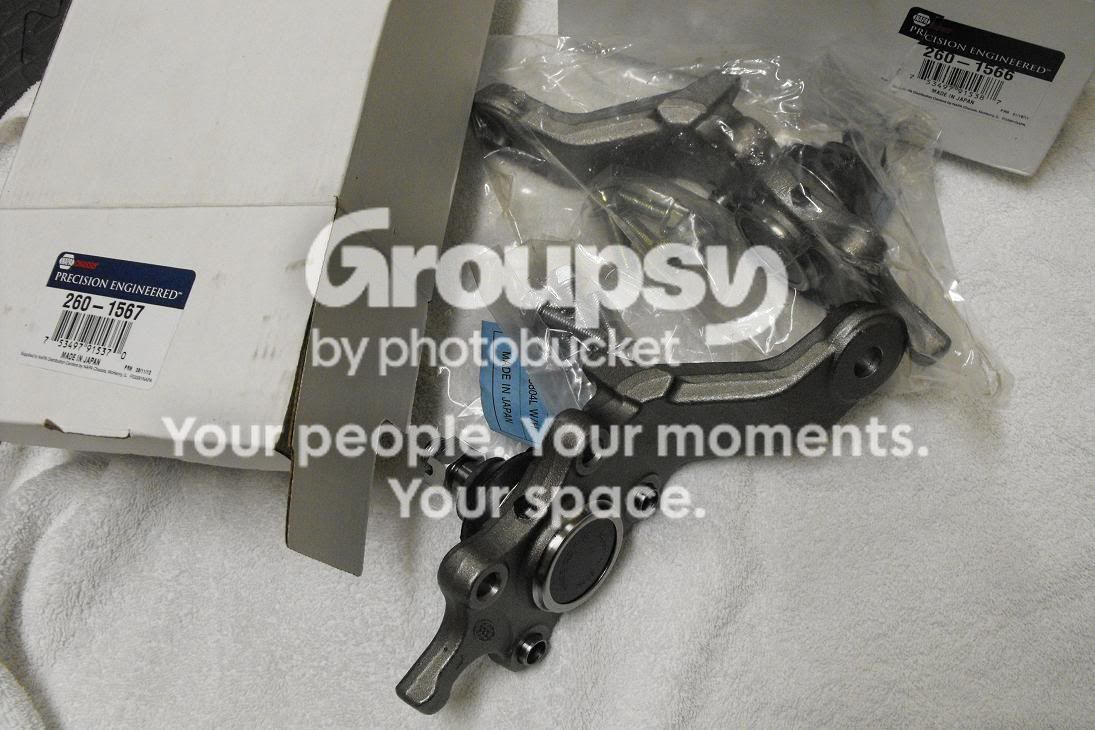
Quick question... anyone know what the Toyota Part Number is for the bolts (4 each side) to secure the LBJ? I have been searching online without any luck. Found the ball joints at Toyota of Dallas, but for the life of me I can't figure out the bolts. I know it comes with a new castle nut already... just need bolts in addition to the LBJ's. -TGIF
 
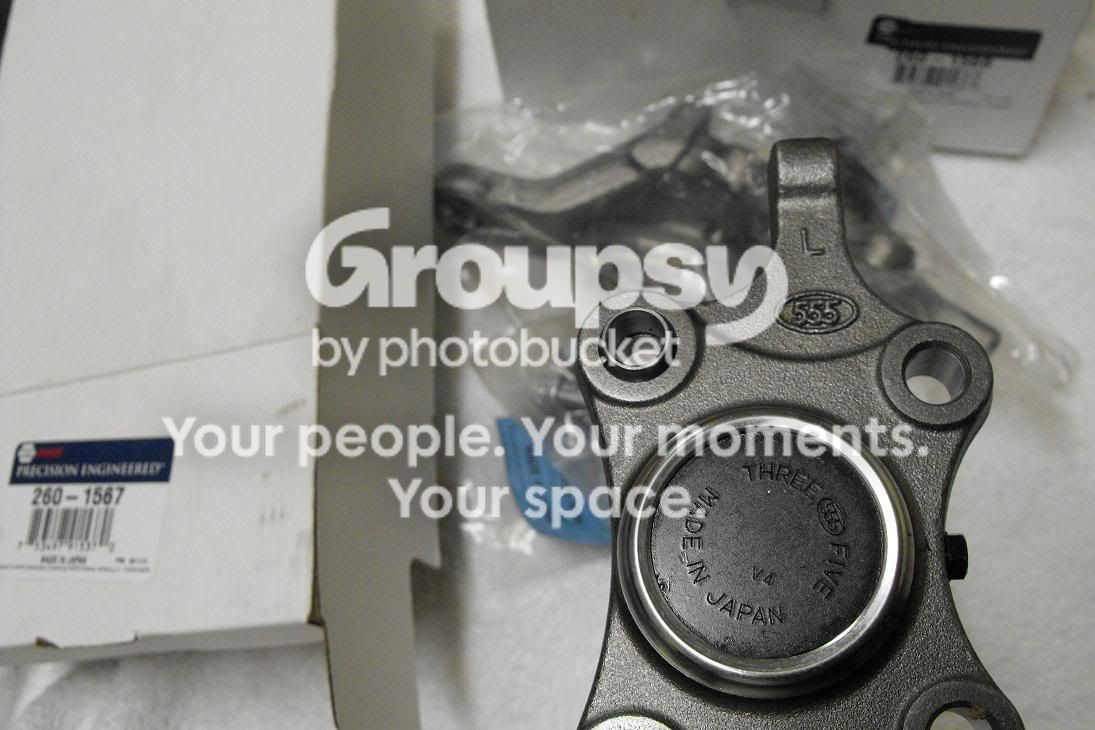
I bought mine from NAPA weeks back, and I got a pretty substantial discount on them too...:trophy:plus they also came with the bolts!

19.jpg~original

20.jpg~original

I'm installing a set of these bad boys right now. There doesn't appear to be grease inside the boots. Do I need to grease them myself or are they fine how they are out of the box?
 
You should be able to move the joint and here the grease inside. Someone who has already installed these will hopefully chime in.
 
I had a closer look and there is grease inside already, although I assumed the boots would be full. Maybe I assumed wrong. I sent Napa an email just to make sure.
 
I left the LBJ's as they were without adding any more grease and they have been ok so far since I installed them. IIRC, they have some zirk fitting that you can fit a grease gun onto, should you feel the need for additional insurance grease.
 
Last edited:
Just received my lower BJs from Rockauto. They are the 555 brand made in Japan but sold under the Moog brand with lifetime warranty. They came with bolts, castle nuts, cotter pins:

Left side: Moog K90262 $56.79
Right side: Moog K90263 $57.79
Shipping: $8.15
Tax: $0
Total: $122.73
$61.37 per side

I was very happy with this price!:guitar3:

So I did a little more poking around looking for info on 555 (three five) and found some more info. They are a brand name of Sankei Industry Inc, a 300 person company in Japan. They make parts exclusively for Japanese and other Asian car manufacturers.

Main point... Looking at their website, it looks like they only sell to OEM's, which means if you get an LBJ from Napa or some other place with the 555 stamp, it is likely reman'd unit.

The point here is that the part that always fails is the ball, not the casting, so while the casting may be OE quality, the ball, the weakest link, is not. This is a reason to go OEM even though it may be more expensive. It seems that only through OEM can to be guaranteed to be getting a 555 ball.
 
So, if its 555, you will have OEM quality?

Well, it's not that simple... The 555 is likely only marked on the casting, not on the ball (which is hidden inside the boot anyway). Your ONLY concern is the weakest part of the joint, which is typically the ball, not the casting. As such, if 555 is the OEM manufacturer of the whole joint, then for quality, you want to have a 555 ball and casting (so as to match the OEM part).

Now I don't know for sure how the whole reman process works, but if a company like Moog, Napa, or someone else is reman'ing the ball joint, then I think they are not likely getting a 555 ball, and working to the same INTERNAL specs as 555. So you could have a high quality (555) casting, with a POS ball, and since the ball is the weakest link, you risk early failure.

This is just my guess at how it is. If someone out there knows from experience how the reman process works, or knows details of specific company's reman process, I would love to hear it. I am making assumptions based on how the company I work for works, where we make custom parts for OEM's (to their spec), and we are contractually not allowed to sell those parts on the aftermarket (nor do we want to do this anyway). Some of our parts end up on the general market, but if we found out a customer sold our parts like that, then they would be in breach of contract as well.

So my point is that without intimate knowledge of Napa, or Moog's process, which I doubt even company reps have, the only way to make sure you are getting OEM quality (555) joint, and not just oem quality casting with a crap ball, you have to go through Toyota distribution (dealer).

 
How to check your ball joints.

I didn't see anyone post instructions on how to check the ball joints. Here's some videos I found.

4runner with a good and bad ball joint.
VERY BAD Ball Joints - WATCH THIS!!! - YouTube

More "detailed" inspection with a Ford Explorer.
Front Suspension & Steering Inspection - YouTube

I checked mine today just by pushing and pulling, but I didn't have a pry bar handy so I might not have put enough pressure on the ball joint to see if they separated, so I'll have to do it again later this weekend. I also noticed on both my upper ball joints, there is a wire that penetrated the boot and is sticking out. They're in the exact same place on both boots. Doesn't this break the seal? How can Toyota not put a zerk valve there if it's designed this way?

On another note, anyone else notice how ridiculously small the factory bottle jack is? It's impossible to raise a tire with it using the instructions on the bottle. Not only that, the instruction manual does not mention the pulley system to remove the spare tire. What idiot thought this out?
 
Last edited:
09/13/2005 LOWER BALL JOINT LOWER BALL JOINT ~|~CUSTOMER REQUEST SPECIAL SERVICE CAMPAIGN SSC-50J FRONT SUSPENSION LOWER BALL JOINT ~|~COMPLETED SSC 50J OP# 5522DK 2.60 HRS ~|~REPLACE THE FRONT SUSPENSION LOWER BALL JOINTS

Parts
Name Qty
JOINT ASSY, LWR BALL 1
WARRANTY PAY

Mine were replaced at 35,000 due to a recall.
 
I've been searching for any DIY write ups for LBJ and OTR replacement. I know it's fairly straight forward, but just want to read through it to make sure I don't have any special moments. :)
 
Yeah, you're right, I was looking at the wrong spot.

I am trying to order new LBJ's and TRE's from toyota of dallas, but the inner TRE comes up as $120, so I suspect that is for both sides, but they havn't gotten back to me as to whether it is both sides, or $120 for each.

you ever find out if the Inner tie rods were for a pair or one?
 
That price for each is a little nuts to me considering you can source a re-built rack which includes the inner TRE's for ~$350ish.
 
That's more than a little nuts. But I guess it's the price you pay for quality. If it ain't in the box with "Toyota" or "aisin" I def don't want it.
 
I didn't see anyone post instructions on how to check the ball joints. Here's some videos I found.

4runner with a good and bad ball joint.
VERY BAD Ball Joints - WATCH THIS!!! - YouTube

More "detailed" inspection with a Ford Explorer.
Front Suspension & Steering Inspection - YouTube

I checked mine today just by pushing and pulling, but I didn't have a pry bar handy so I might not have put enough pressure on the ball joint to see if they separated, so I'll have to do it again later this weekend. I also noticed on both my upper ball joints, there is a wire that penetrated the boot and is sticking out. They're in the exact same place on both boots. Doesn't this break the seal? How can Toyota not put a zerk valve there if it's designed this way?

On another note, anyone else notice how ridiculously small the factory bottle jack is? It's impossible to raise a tire with it using the instructions on the bottle. Not only that, the instruction manual does not mention the pulley system to remove the spare tire. What idiot thought this out?

Informational video. All the relatively recent talk about LBJ failure got me worried. Drop by the mechanic, and he performed the same test with the pry bar. My driver's side was solid, but the passenger side had some play. Decided to pay the ~$350 price tag to get them replaced.

I was surprised to a small degree about the play. My 4runner is pretty much factory except for CAI and exhaust with about 140k miles on it-- not much of any off-road action too, but a little snow here and there. All in all, just as many said before, better to be on the safe side.
 

Forum statistics

Threads
278,316
Messages
3,554,109
Members
248,016
Latest member
Advally Service

Trending content

Back
Top