Battery/Alternator issue. Voltage is OK

First off, let me say thank you to everyone assisting with this. I understand the concepts of electrical, just not too good at troubleshooting.

[MENTION=10169]TheDurk[/MENTION]: no Canuck model, no daytimes.

I found the EA1 plug.
I have continuity from EA1, terminal #1 to wire #2 @ the alternator.
I have continuity from EA1, terminal #2 to wire #1 @ the alternator.
I have continuity upstream from EA1, terminal #4 to the fuse.

I DO NOT have continuity DOWNSTREAM from EA1, terminal #4 to wire #3 @ the alternator. Looks like maybe I've got a faulty splice.. Or connector.

I think we may have found the culprit! Just need a warm place to pull in and repair it. ...Also need to find my damn heat gun so I can put heat shrink on again.

Anyone know how I can test the terminals inside the plug to narrow it down to my sh*tty splice job? :redbrick:

I'll update ya'll as soon as I make the repair.

Well, assuming issue is plug or splice, you will need to break the splice either way. And once you break it, testing the plug is easy. So break the splice.
 
By the way, thank you for the precise description of your test results and for providing the picture. If everybody I worked with did the same, lots of things would have been done faster.
 
I DO NOT have continuity DOWNSTREAM from EA1, terminal #4 to wire #3 @ the alternator. Looks like maybe I've got a faulty splice.. Or connector.

I think we may have found the culprit! Just need a warm place to pull in and repair it. ...Also need to find my damn heat gun so I can put heat shrink on again.


I'll update ya'll as soon as I make the repair.

Ordinarily I'd invite you to California, but we've had more rain this month than the last 3 years combined. My garage is full and the sun isn't doing it's job!

Good job on localizing the fault. I think you see now how easy it CAN be after all.

:cheer2:
 
Ordinarily I'd invite you to California, but we've had more rain this month than the last 3 years combined. My garage is full and the sun isn't doing it's job!

Good job on localizing the fault. I think you see now how easy it CAN be after all.

:cheer2:
Thanks, but there's a reason I left California... I love my guns [emoji1]

Sent from my SM-G930U using Tapatalk
 
Mr durk I couldn't open your PDF. So I didn't know what you posted prints wise. And wrong picture, sorry. But it had enough correct info to know what was going on.

I only do "western union splices", or uninsulated crimps that I solder after crimping then heat shrink with the shrink that has the glue inside to make it water proof.


Sent from my iPhone using Tapatalk
 
By the way, thank you for the precise description of your test results and for providing the picture. If everybody I worked with did the same, lots of things would have been done faster.

I used to be a service writer who also submitted warranty claims.. I fully understand the need of specific details. I started off with voltage readings because I didn't know where else to start. Hoping somebody could point me in the write direction. Also, as much as I want answers given to me, I do like to personally diagnose and figure out the principles of how these things work.
 
Since [MENTION=102606]infamousRNR[/MENTION] and I have a video that relates to the topic, I figured it was another good opportunity to share a video. Worn brushes is a common reason alternators will charge ineffectively and eventually drain your battery, so here's a video showing you how to get more life out of your OEM alternator.

<iframe width="560" height="315" src="https://www.youtube.com/embed/71_kBhg6_-A" frameborder="0" allowfullscreen></iframe>
 
Thanks, but there's a reason I left California... I love my guns [emoji1]

Sent from my SM-G930U using Tapatalk

I love my guns too, but I love my son, my step-daughter, my granddaughter, the weather, and my friends more.

Gun ownership is still legal in California :hunter:

And it doesn't get down to 20°, so I can actually hold my gun without it freezing to my hand. AND I can work on my cars year round! But we do have WAY too many people here, so I don't mind if a few leave, or a lot. :pound:
 
Update

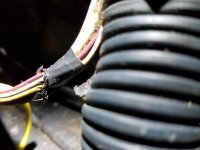
So there was nothing wrong with my splicing. Rather, it was a broken wire right where it branches off the fatter main harness. Hard to tell by the picture, but the break was under the insulation. Not sure if the tape was factory, or if it was the previous owners quick fix, but the wire loom is what tore the electrical tape.

Its late. I was happy to fix it. Didn't stick around long enough to check my volts. All I know is I cut this section out, spliced in a new one and started the truck. NO ALTERNATOR LIGHT NOW!!!

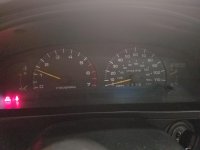
Disregard my high idle. I started the vehicle long enough to verify the light was off and snapped a picture.

Thank you to everyone who helped me with the resources to diagnose this.
 

Attachments

  • 20170121_220528.jpg
    20170121_220528.jpg
    144.8 KB · Views: 319
  • 20170121_184450.jpg
    20170121_184450.jpg
    113.1 KB · Views: 321
Mr durk I couldn't open your PDF. So I didn't know what you posted prints wise. And wrong picture, sorry. But it had enough correct info to know what was going on.

I only do "western union splices", or uninsulated crimps that I solder after crimping then heat shrink with the shrink that has the glue inside to make it water proof.


Sent from my iPhone using Tapatalk
I googled your western union splice. Is this the professional method preferred in the automotive world? Looks easy enough, I can start doing this. If so, how much insulation on each end do you normally strip off?

Sent from my SM-G930U using Tapatalk
 
It is something you need to practice on scrap wire. I try and strip enough so the wraps end at the insulation. This is the best non crimped and soldered splice you can make. Weather or not it's preferred in the auto industry I don't know. I make it as neat as I can and trim the sharp ends so it doesn't poke through the heat shrink.

But it's that or a non-insulated crimp that is soldered after the crimp with the proper crimping tool. The solder keeps the crimped connection from going bad.

Edit: the picture shows the splice before soldering it. I failed to mention I solder the splice.


Sent from my iPhone using Tapatalk
770e3b5d73a47730ef2ca5ff89ff0d93.jpg
 
Last edited:
It is something you need to practice on scrap wire. I try and strip enough so the wraps end at the insulation. This is the best non crimped and soldered splice you can make. Weather or not it's preferred in the auto industry I don't know. I make it as neat as I can and trim the sharp ends so it doesn't poke through the heat shrink.

But it's that or a non-insulated crimp that is soldered after the crimp with the proper crimping tool. The solder keeps the crimped connection from going bad.

I was taught that the WU splice is only to be used on solid wire like they had on telegraph poles. A quick Google gets you plenty of people saying the same thing. For the stranded wire in automotive work, I use a simple in-line twist, solder and heat shrink. I have joints going back to the 60s in service done that way (although those were taped, heatshrink came later.)
 
I was taught that the WU splice is only to be used on solid wire like they had on telegraph poles. A quick Google gets you plenty of people saying the same thing. For the stranded wire in automotive work, I use a simple in-line twist, solder and heat shrink. I have joints going back to the 60s in service done that way (although those were taped, heatshrink came later.)


Everyone has their own way of doing things. It's never failed me and after soldered will never pull apart, and takes up less room in the shrink wrap. He can chose how he wants to do it. My friend at a dealership likes doing the crimp and soldering the crimp method. I do both. You method is as good. I was just giving suggestions.

Maybe I should have specified soldering the western union splice. Which I do


Sent from my iPhone using Tapatalk
 
Everyone has their own way of doing things. It's never failed me and after soldered will never pull apart, and takes up less room in the shrink wrap. He can chose how he wants to do it. My friend at a dealership likes doing the crimp and soldering the crimp method. I do both. You method is as good. I was just giving suggestions.

Maybe I should have specified soldering the western union splice. Which I do


Sent from my iPhone using Tapatalk

Fine, except the WU does not take up less room, it takes more. You have three diameters of wire with the WU,(one from the straight wire, and two from the wrapped wire) and only two diameters with the simple overlapping twist. That's one reason I prefer it my way. It just looks cleaner and will pull through holes more easily.

Yes, WU is more resistant to pulling apart, which is great for telegraph wire. Not so much an issue for auto wires.
 
Last edited:
Battery reads 0 volts when attached to alternator

I’m hoping someone in the thread will know the solution to my problem.
Earlier in the year I upgraded my alternator to the 95 caddy 140 amp. Ran fine for a few months, then stopped working, I returned it and got a new one.
After connecting this new one, I attached the positive with all the grounds attached. The battery read 0 volts. I removed the alternator cable, volts went back up. Removed the grounds with the alternator attached, volts went back up.
Every time I try to ground my starting battery with the alternator attached, the battery drops all the way to 0. I’ve never seen this before and have no idea where to start.
 
The post voltage was good at nearly 12 (11.8 or something)
After doing some investigative work I discovered that the Positive post coming off the alternator was too close to the block and was shorting out. I threw some electrical tape over it, and runs like a champ now!
 
The post voltage was good at nearly 12 (11.8 or something)
After doing some investigative work I discovered that the Positive post coming off the alternator was too close to the block and was shorting out. I threw some electrical tape over it, and runs like a champ now!

That'll last a week, if you're lucky. Vibration eats tape.
 

Members online

Forum statistics

Threads
278,312
Messages
3,554,085
Members
248,016
Latest member
Advally Service

Trending content

Back
Top