Battery Charging

TRD_Mike

New member
Hey guys, I wanted to share some info about a few products I have recently purchased from NOCO. I recently installed an Odyssey 31M-PC2150ST Battery in order to handle auxiliary lighting but more so my fridge for several days without the vehicle having to be turned on to recharge the battery or it ends up drained so low it will not crank the vehicle. Upon research, you'll find the Odyssey requires between 14.4and14.7 volts in order to charge the battery to 100%. The stock alternator output is about 13.6VDC, so I wanted to find a solution to charge the battery. I decided to use a charger the battery completely before going on a trip to ensure optimal performance throughout the trip.

I opted for a few of the NOCO products:

1. Noco G7200: I chose this charger from their long list of other Multi-Purpose Chargers for a few reasons.

  • I wanted a charger I could charge both Lead Acid and AGM batteries with since I have vehicles that have both and I also wanted to be able to charge my motorcycle along with any other things I own or will own in the future. The output of this charger is ideal for all of this. Their other chargers that would charge the group 31 quicker would not support a motorcycle or smaller battery so I sacrificed time for versatility (which I am completely ok with).

  • I wanted a charger that was safe, and NOCO chargers and products scream safety in a lot more than one way. all their chargers are safe to leave connected with zero overcharging. the charger has spark-proof technology on the terminals and reverse polarity protection if you make a mistake. These are just some of the many safety feature their chargers offer.

  • They also have advanced diagnostics indication for damaged batteries.

  • This charger also has a ton of different supporting accessories in their X-Connect accessories that can be utilized.

2. GC016 X-Connect 12V Dashmount Indicator:
[/LIST]
  • I chose this product because I am going to be mounting it in the 4Runner in a place that is visible and easily connectable. this will be just another safety to monitoring the battery health and a place I can easily disconnect and connect the Noco G7200

3. GB70 Jump starter:
  • Lastly, I wanted a compact jump starter to leave in the 4runner just in case the battery does die due to a light being left on or the fridge failsafe fails or even just being drained cause of the cold. I wanted to have the peace of mind of having something that is able to kick over the big battery and bring it back to life.
  • I did opt for the bigger charger because I wanted to have more jumps whether I just used it on another vehicle or multiple vehicles I wanted the battery life to do a lot of jumps. This one I have not tried to fit in the glove compartment but I leave this on under my seat in the GBC014 EVA Protective Case For Boost HD
  • I also chose NOCO for jump starters for many of the same reasons as their charger; their jump starters are a lithium battery jump starter rated at 2,000 Amps (15,700 Joules3S). which means the battery is gonna last a good long time and have more than a few jumps in it.
    Spark-proof connections and reverse polarity protection, it is able to recharge USB devices (like smartphones, tablets, GPS trackers etc..), Power 12V devices anywhere(like tire inflators, power inverters, and more), it has a
    400 lumen LED flashlight with multiple modes, including SOS. Lastly, it is able to jump-start gas engines up to 8 liters, and diesel engines up to 6 liters while Providing up to 40 jump starts on a single charge.

And finally if you are looking to purchase their products use noco promo code: T4RNOCO20 for a percentage off!

Here are a few pictures from the products arriving:
 
Register to hide this ad
Mike, you could have avoided all if you read this - "Voltage Booster" for 31M AGM Battery

I didn't/don't want to opt for a voltage booster at the time of ordering this. In order for the voltage booster to charge the vehicle has to be on I wanted a charger to top off the battery and keep it maintained while the runner isn't being used. I use my motorcycle mostly for commuting and the 4runner sits unless it's long trips or camping. I know and knew about voltage boosters and opted in a different direction this is for people that don't want to run a booster or want to maintain a battery on a vehicle that sits. I also don't like the voltage booster since accessing it is more of a hassle than connecting a charger especially with a power tray installed and circuit breakers attached to the fuse cover of the vehicle. I also gave info on the jump starter as well since the voltage booster cannot do that. I may opt to put a voltage booster down the road to maintain the battery on my drive to wherever but for now my options work perfectly!
 
Last edited:
I also don't like the voltage booster since accessing it is more of a hassle than connecting a charger especially with a power tray installed and circuit breakers attached to the fuse cover of the vehicle.

i have a voltage booster and also have a charger (although i use an onboard charger, so i just plug the 120V extension cord into a plug on the front cowl), but i'm very confused by this statement and think maybe you misunderstand what the voltage booster is?

There is no hassle accessing a voltage booster - you don't need to access it. it's installed by replacing a fuse in an easy to get to fuse box then it just lives there happily boosting your voltage without you ever needing to access it.
 
I didn't want to opt for a voltage booster at the time of reading this and in order for the voltage booster to charge the vehicle has to be on I wanted a charger to top off the battery and keep it maintained while the runner isn't being used. I use my motorcycle mostly for commuting and the 4runner sits unless it's long trips or camping. I know and knew about voltage boosters and opted in a different direction this is for people that don't want to run a booster or want to maintain a battery on a vehicle that sits. I also don't like the voltage booster since accessing it is more of a hassle than connecting a charger especially with a power tray installed and circuit breakers attached to the fuse cover of the vehicle. I also gave info on the jump starter as well since the voltage booster cannot do that. I may opt to put a voltage booster down the road to maintain the battery on my drive to wherever but for now my options work perfectly!

Your solutions are bandaid approaches that still don't solve the underlying problem that the stock voltage doesn't provide enough voltage to fully charge AGM batteries when the car is being driven.
 
i have a voltage booster and also have a charger (although i use an onboard charger, so i just plug the 120V extension cord into a plug on the front cowl), but i'm very confused by this statement and think maybe you misunderstand what the voltage booster is?

There is no hassle accessing a voltage booster - you don't need to access it. it's installed by replacing a fuse in an easy to get to fuse box then it just lives there happily boosting your voltage without you ever needing to access it.

There is a hassle if you are using one that has a switching feature and you are switching between different modes i.e. Normal, boost, or overboost. I understand that it's very rare to switch it or even access it but like I said as of right now I just don't need it. Could that change down the road I don't doubt it or put it past that I will install one! As I said I more so wanted my battery to be maintained properly when not in use and having the opportunity to charge other vehicles and toys with the same thing was important to me.
 
Your solutions are bandaid approaches that still don't solve the underlying problem that the stock voltage doesn't provide enough voltage to fully charge AGM batteries when the car is being driven.

I can agree with you and that's where a voltage booster comes into play if I choose to install one down the road, for now, I haven't had a need since I haven't been going on insanely long trips due to work priorities.
 
I use the exact same model... hasn't let me down yet. Works pretty good. 7+ amps is plenty to keep both batteries topped off and the fridge running when prepping for trips.

W9PFi5D.jpg
 
I use the exact same model... hasn't let me down yet. Works pretty good. 7+ amps is plenty to keep both batteries topped off and the fridge running when prepping for trips.

W9PFi5D.jpg

Which accessories are you using if any or are you just using eyelets and clamps?
 
i think even with promo, its still cheaper on amazon sometimes?

i have the g7200.. gb70 and gb150 all from amazon..
 
Which accessories are you using if any or are you just using eyelets and clamps?

The first thing I did was cut off the X-Connect end and crimp Anderson Powerpole disconnects onto it... its pretty much my standard for all my 12v quick disconnects because I can run much higher currents though it.

In short, I basically make all my own adapters and accessories. Everything I own is plug & play...

Anderson Powerpole and SB Connectors | Powerwerx

i71ThuX.jpg

7aJ0ftR.jpg

Q1vRblW.jpg

STjk83G.jpg
 
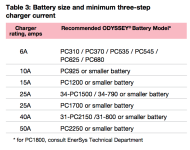
I'd recommend a higher amp charger. Per Odyssey's technical guide for the group 31 battery they recommend a 40A charger for this application. They recommend this due to the group 31's high capacity and need for higher current during the bulk charging phase to un sulphate the battery which is where the majority of the charge happens.

With the NOCO you're only giving 18% of the recommended amps.

Also you do need a VB. The moment you crank your engine and leave for your trip you've discharged the battery and will never get it back to 100%. Odyssey recommends the alternator put out 14.0 to 14.7 volts which the stock alternator does not deliver without a booster. In the end it's your rig and investment but there's some misinformation here.

http://www.odysseybattery.com/documents/US-ODY-TM.pdf
http://www.odysseybattery.com/documents/US-ODY-WS-AA.pdf
 

Attachments

  • Screen Shot 2019-02-22 at 9.06.41 AM.png
    Screen Shot 2019-02-22 at 9.06.41 AM.png
    78.6 KB · Views: 2,653
[MENTION=246344]RobotTrader[/MENTION]

It’s fine… Those recommendations around battery sulfation have more to do with a deep discharge condition over extended periods of time, or when the load is larger than the charge coming in. For most people, the bulk charging phase is going to be taken care of by the alternator… These chargers are really just to maintain the battery. Most of the time its going to be near full charge anyway as we run the truck regularly.

These guidelines are also the manufacture trying to manage expectations for people who don’t really understand batteries. You get someone buying a 0.75A charger expecting results, and in reality it will get it charged, but it’s going to take days. Less calls into support for people who degrade their batteries using them incorrectly.

If you ever monitor the current when the ACR pairs a partially charged battery in parallel with the starter, you will see a peak, bulk charge from alternator, and then will quickly taper off into the single digits while it equalizes. It’s not going to slam in more current than the battery can accept. If it does, it’s using a voltage higher than acceptable.

I’ve tested, monitored, and observed this on multiple occasions across different systems I have built.

AyR99Au.jpg
 
Last edited:
OP, you said you use your NOCO for trip preps. I have the NOCO 7200 as well as was thinking of using it while car camping with full hook up to maintain the battery while running lights and fridge. I have a blue sea outlet on the back of the rig. have you done something similar?
 
OP, you said you use your NOCO for trip preps. I have the NOCO 7200 as well as was thinking of using it while car camping with full hook up to maintain the battery while running lights and fridge. I have a blue sea outlet on the back of the rig. have you done something similar?

Sorry to revive this from last year, but two different schools of thoughts on this. I've seen folks who never AC charge their batteries when under load yet others who do it and have done it for quite a while. NOCO actually makes accessories that allow you to do this so it shouldn't be problematic IMHO.

I plan on tapping into AC/shore power if available if I'm camping at a camp ground for example but I'll probably use it to run my refrigerator directly though I don't think we need to worry about plugging in the AC charger into shore power and charging the battery that way.

I have a 10 Amp Noco and an OBDII connector in case I want to AC charge it with the battery installed.

I agree with some of the views on this thread in terms of best approaches to keep an AGM topped up and happy so that it lasts a long time. IMO the correct order in terms of investing in this should be VB/or an appropriate alt upgrade --> AC charger --> Solar but that's just based on my research and talking to folks here and with others who have gotten many years out of their AGM's. VB's run anywhere from $10 to $75 so are probably the cheapest options out there. Excellent place to start.

I have one question here for those running stock alternators and a VB and cycling their battery often. How long does it typically (i realize that it depends on quite a few variables) take to get a high capacity AGM (G31 or 27 for example) back up from 50% to say 90% SOC with the engine on or the when driving? This with the VB on and getting at least 0.5 V above the stock alt capacity on these 5th gens? Just trying to figure out how many amps the stock alternator will be happy to give to these batteries at that SOC. I'm primarily interested in this because I plan on running a G27 starter battery that would be supplemented by solar and wanted to know how much daily engine run time I'd need to bring the state of charge up from say 60% to 90% in case of cloudy skies and nothing from solar. I currently have a G34 Odyssey but haven't really discharged it to that SOC as I don't currently run a fridge so don't have personal experience of this particular vehicle.
 
Last edited:
i usually see about 40ish A net (not gross) going into my battery after it's been parked for awhile and the battery SOC is lower. I only monitor amperage on the total battery output so i can't differentiate between load vs charging amperage, but i think my idle load is about 10-20A depending on if the fridge is running so my guess is that the alternator is putting out about 60 A after I'm parked for awhile and the battery SOC is lower.
 
i usually see about 40ish A net (not gross) going into my battery after it's been parked for awhile and the battery SOC is lower. I only monitor amperage on the total battery output so i can't differentiate between load vs charging amperage, but i think my idle load is about 10-20A depending on if the fridge is running so my guess is that the alternator is putting out about 60 A after I'm parked for awhile and the battery SOC is lower.

Thanks for this. So assuming 40A on average with say 35 A on idle being conservative, this should mean that a 90 Ah battery should be able to get through 50% SOC to that 85%+ stage in about 45 minutes or so. Do you think that is a good ballpark to assume in case solar is of no use?
 

Members online

Forum statistics

Threads
278,309
Messages
3,554,067
Members
248,016
Latest member
Advally Service

Trending content

Back
Top