
You are using an out of date browser. It may not display this or other websites correctly.
You should upgrade or use an alternative browser.
You should upgrade or use an alternative browser.
Breaking in period
- Thread starter strangler
- Start date
Register to hide this ad

MikesToy
Banned
RUN IT HARD! Well, at least 65-75mph.
Nowadays, the piston ring seal is really what the break in process is all about. Contrary to popular belief, piston rings don't seal the combustion pressure by spring tension. Ring tension is necessary only to "scrape" the oil to prevent it from entering the combustion chamber.
If you think about it, the ring exerts maybe 5-10 lbs of spring tension against the cylinder wall ...
How can such a small amount of spring tension seal against thousands of PSI (Pounds Per Square Inch) of combustion pressure ?? Of course it can't.
How Do Rings Seal Against Tremendous Combustion Pressure ??
From the actual gas pressure itself !! It passes over the top of the ring, and gets behind it to force it outward against the cylinder wall. The problem is that new rings are far from perfect and they must be worn in quite a bit in order to completely seal all the way around the bore. If the gas pressure is strong enough during the engine's first miles of operation (open that throttle !!!), then the entire ring will wear into the cylinder surface, to seal the combustion pressure as well as possible.
The Problem With "Easy Break In" ...
The honed crosshatch pattern in the cylinder bore acts like a file to allow the rings to wear. The rings quickly wear down the "peaks" of this roughness, regardless of how hard the engine is run.
There's a very small window of opportunity to get the rings to seal really well ... the first 20 miles !!
If the rings aren't forced against the walls soon enough, they'll use up the roughness before they fully seat. Once that happens there is no solution but to re hone the cylinders, install new rings and start over again.
Fortunately, most new sportbike owners can't resist the urge to "open it up" once or twice, which is why more engines don't have this problem !!
An additional factor that you may not have realized, is that the person at the dealership who set up your bike probably blasted your brand new bike pretty hard on the "test run". So, without realizing it, that adrenaline crazed set - up mechanic actually did you a huge favor !!
Notice that this technique isn't "beating" on the engine, but rather taking a purposeful, methodical approach to sealing the rings. The logic to this method is sound. However, some will have a hard time with this approach, since it seems to "go against the grain".
The argument for an easy break-in is usually: "that's what the manual says" ....
Or more specifically: "there are tight parts in the engine and you might do damage or even seize it if you run it hard."
Consider this:
Due to the vastly improved metal casting and machining technologies which are now used, tight parts in new engines are not normal. A manufacturing mistake causing a tight clearance is an extremely rare occurrence these days. But, if there is something wrong with the engine clearances from the factory, no amount of gentle running will fix the problem.
The real reason ???
So why do all the owner's manuals say to take it easy for the first thousand miles ???
This is a good question ...
--------------------------------------------------------------------------------
Q: What is the most common cause of engine problems ???
A: Failure to:
Warm the engine up completely before running it hard !!!
Q: What is the second most common cause of engine problems ???
A: An easy break in !!!
Because, when the rings don't seal well, the blow-by gasses contaminate the oil with acids and other harmful combustion by-products !!
Ironically, an "easy break in" is not at all what it seems. By trying to "protect" the engine, the exact opposite happens, as leaky rings continue to contaminate your engine oil for the rest of the life of your engine !!
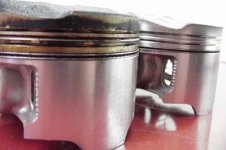
Now look at the pics below:
Although these pistons came out of engines which were raced for a full season, they weren't set-up with any special clearances or other preparation.
These engines were never worked on prior to being raced. They were totally stock.
The only difference was the break in method they used...
The one on the right was broken in hard.
The one on the left was broken in exactly according to the owner's manual. The resulting leaky rings have allowed pressure to "blow by" down into the crankcase on acceleration, and oil to "suck-up" into the combustion chamber on deceleration.
It's up to you:
The loss in power from an easy break-in and the resulting poor ring seal can be anywhere from 2% - 10% !!
In other words:
The gain in power from break-in it hard can be anywhere from 2% - 10% !!
My 2 cents....
Nowadays, the piston ring seal is really what the break in process is all about. Contrary to popular belief, piston rings don't seal the combustion pressure by spring tension. Ring tension is necessary only to "scrape" the oil to prevent it from entering the combustion chamber.
If you think about it, the ring exerts maybe 5-10 lbs of spring tension against the cylinder wall ...
How can such a small amount of spring tension seal against thousands of PSI (Pounds Per Square Inch) of combustion pressure ?? Of course it can't.
How Do Rings Seal Against Tremendous Combustion Pressure ??
From the actual gas pressure itself !! It passes over the top of the ring, and gets behind it to force it outward against the cylinder wall. The problem is that new rings are far from perfect and they must be worn in quite a bit in order to completely seal all the way around the bore. If the gas pressure is strong enough during the engine's first miles of operation (open that throttle !!!), then the entire ring will wear into the cylinder surface, to seal the combustion pressure as well as possible.
The Problem With "Easy Break In" ...
The honed crosshatch pattern in the cylinder bore acts like a file to allow the rings to wear. The rings quickly wear down the "peaks" of this roughness, regardless of how hard the engine is run.
There's a very small window of opportunity to get the rings to seal really well ... the first 20 miles !!
If the rings aren't forced against the walls soon enough, they'll use up the roughness before they fully seat. Once that happens there is no solution but to re hone the cylinders, install new rings and start over again.
Fortunately, most new sportbike owners can't resist the urge to "open it up" once or twice, which is why more engines don't have this problem !!
An additional factor that you may not have realized, is that the person at the dealership who set up your bike probably blasted your brand new bike pretty hard on the "test run". So, without realizing it, that adrenaline crazed set - up mechanic actually did you a huge favor !!
Notice that this technique isn't "beating" on the engine, but rather taking a purposeful, methodical approach to sealing the rings. The logic to this method is sound. However, some will have a hard time with this approach, since it seems to "go against the grain".
The argument for an easy break-in is usually: "that's what the manual says" ....
Or more specifically: "there are tight parts in the engine and you might do damage or even seize it if you run it hard."
Consider this:
Due to the vastly improved metal casting and machining technologies which are now used, tight parts in new engines are not normal. A manufacturing mistake causing a tight clearance is an extremely rare occurrence these days. But, if there is something wrong with the engine clearances from the factory, no amount of gentle running will fix the problem.
The real reason ???
So why do all the owner's manuals say to take it easy for the first thousand miles ???
This is a good question ...
--------------------------------------------------------------------------------
Q: What is the most common cause of engine problems ???
A: Failure to:
Warm the engine up completely before running it hard !!!
Q: What is the second most common cause of engine problems ???
A: An easy break in !!!
Because, when the rings don't seal well, the blow-by gasses contaminate the oil with acids and other harmful combustion by-products !!
Ironically, an "easy break in" is not at all what it seems. By trying to "protect" the engine, the exact opposite happens, as leaky rings continue to contaminate your engine oil for the rest of the life of your engine !!
Now look at the pics below:
Although these pistons came out of engines which were raced for a full season, they weren't set-up with any special clearances or other preparation.
These engines were never worked on prior to being raced. They were totally stock.
The only difference was the break in method they used...
The one on the right was broken in hard.
The one on the left was broken in exactly according to the owner's manual. The resulting leaky rings have allowed pressure to "blow by" down into the crankcase on acceleration, and oil to "suck-up" into the combustion chamber on deceleration.
It's up to you:
The loss in power from an easy break-in and the resulting poor ring seal can be anywhere from 2% - 10% !!
In other words:
The gain in power from break-in it hard can be anywhere from 2% - 10% !!
My 2 cents....
Attachments
Last edited:

Nuke
New member
Just drive it. I wouldn't go nutz the first 1000 miles but I shouldn't talk. At 800 miles I stomped on it at 65 and WOT to 100+ MPH before I backed off.
As Mikes Toy states, todays engines are cast better and built to tighter tolerances. I know that the engine in my late model Mustang GT was designed to be driven off the lot and straight to the track. Don't fret about break-in. Drive it as you intend to drive it.
As Mikes Toy states, todays engines are cast better and built to tighter tolerances. I know that the engine in my late model Mustang GT was designed to be driven off the lot and straight to the track. Don't fret about break-in. Drive it as you intend to drive it.
Last edited:

Cape 4RUNNER
New member
The one on the left was broken in exactly according to the owner's manual. The resulting leaky rings have allowed pressure to "blow by" down into the crankcase on acceleration, and oil to "suck-up" into the combustion chamber on deceleration.
It's up to you:
The loss in power from an easy break-in and the resulting poor ring seal can be anywhere from 2% - 10% !!
In other words:
The gain in power from break-in it hard can be anywhere from 2% - 10% !!
My 2 cents....
Nice to see the picture representation, I have always gone this route with my vehicles and also my motorcycle, no problems!
MikesToy,
If you're going to copy/paste from a website, you should really give the original author credit or at the very least you should provide a link to the original website.
BTW, that article was more about motorcycle engines than car engines. IMO, they are design and built differently, so I wouldn't always follow the advice.
If you're going to copy/paste from a website, you should really give the original author credit or at the very least you should provide a link to the original website.
BTW, that article was more about motorcycle engines than car engines. IMO, they are design and built differently, so I wouldn't always follow the advice.

Thai
Elite Member
What Mikestoy wrote is incorrect thinking IMHO. It was by a motocycle enthusiast/mechanic (forgot which).
Anyway, i would NOT do what that guy said. From my experience with sports car (BMW M3) to SUVs, i would just follow Owner's Manual or factory recommendations. DO NOT BELIEVE EVERYTHING ON THE INTERNET!!
In addition, in today's cars, there could be a memory chip that records HOW you broke in your car. Can they use this to deny warranty work (e.g. engine losing oil)?? I don't know, but anything is possible i guess.
Here is my tidbit...when i had my BMW M3, you had two camp of owners regarding break-in procedure. One camp followed BMW recommendations (me) and the other camp ran the car hard (like above "advice"). Unfortunately, camp #2 (who ran the car hard) had more than a few cases of engine leaking/losing oil with no difference in performance. My M3 never lost a single drop of oil while still fun as hell to drive!
In fact, in all my cars (Honda CRV, 4runner, M3, Corolla, Highlander, Sienna, and G500), i follow the factory recommendations and have never had an engine lose oil. Never. And some of those engines were ran hard (after the break-in period).
This is why my signature says: "Everyday is Halloween on the Internet." Take what you read on the internet with a large ass grain of salt! (including my advice in this post)
Please don't let trees die in vain...read the Owner's Manual and follow it's instructions.
Here are some more info: http://www.toyota-4runner.org/showthread.php?threadid=183
Hope this helps.
Anyway, i would NOT do what that guy said. From my experience with sports car (BMW M3) to SUVs, i would just follow Owner's Manual or factory recommendations. DO NOT BELIEVE EVERYTHING ON THE INTERNET!!
In addition, in today's cars, there could be a memory chip that records HOW you broke in your car. Can they use this to deny warranty work (e.g. engine losing oil)?? I don't know, but anything is possible i guess.
Here is my tidbit...when i had my BMW M3, you had two camp of owners regarding break-in procedure. One camp followed BMW recommendations (me) and the other camp ran the car hard (like above "advice"). Unfortunately, camp #2 (who ran the car hard) had more than a few cases of engine leaking/losing oil with no difference in performance. My M3 never lost a single drop of oil while still fun as hell to drive!
In fact, in all my cars (Honda CRV, 4runner, M3, Corolla, Highlander, Sienna, and G500), i follow the factory recommendations and have never had an engine lose oil. Never. And some of those engines were ran hard (after the break-in period).
This is why my signature says: "Everyday is Halloween on the Internet." Take what you read on the internet with a large ass grain of salt! (including my advice in this post)
Please don't let trees die in vain...read the Owner's Manual and follow it's instructions.
Here are some more info: http://www.toyota-4runner.org/showthread.php?threadid=183
Hope this helps.
Last edited:
Thai
Elite Member
strangler said:Yeah, I can be gullible sometimes when it comes to internet. Anyways, thanks man. Cam on! This really helps me.
Just want to re-emphasize what i wrote above about internal computer "remembering" how you "abuse" your car...see this link about the Nissan GT-R's rear diff failure: http://www.edmunds.com/insideline/do/Features/articleId=140966?tid=edmunds.il.home.photopanel..1.*
See quote: "In fact, the GT-R owner's manual has always expressly warned against driving with the VDC system turned off except when trying to extract the vehicle when it's stuck in mud or snow. And the internal memory of the GT-R's computers will tattle on an owner who launches with VDC turned off. Indeed, it will record any events in which the VDC is turned off."
 So, like i said above, be careful how you break-in your 4runner. I would just follow what the Owner's Manual recommends. After your warranty goes out, then feel free to abuse your machine!
 There's one trouble with this post and that is when you buy a new vehicle it ALREADY has been driven and you have NO choice as to how it was driven those first few miles. Chances are it was not driven too hard or not hard enough. Ya' just don't know. So you don't really get to break it in if what Mikes toy thinks is true. I'm not convinced one way or the other.
Thai
Elite Member
hoggy said:There's one trouble with this post and that is when you buy a new vehicle it ALREADY has been driven and you have NO choice as to how it was driven those first few miles. Chances are it was not driven too hard or not hard enough. Ya' just don't know. So you don't really get to break it in if what Mikes toy thinks is true. I'm not convinced one way or the other.
True...this is why i always aim for the car with the least amount of miles on the odometer. For me, anything above 30 miles is too much...i much prefer single digit mileage.
