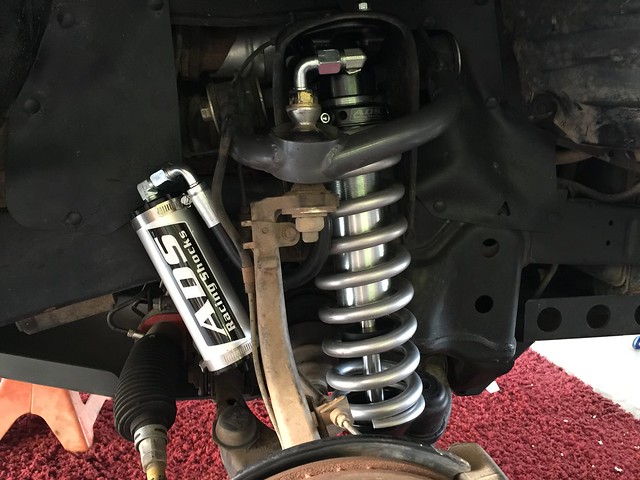
Building Front UCA's

MStudt

official vendor
I'm going to be building some front UCA's, and hopefully by the end of the month. I do have a question that I'm hoping someone can answer. I'm trying to decide between going to the traditional route of using poly bushings, and sleeves like most companies use. Or, going a different direction and something like a weld-on Johnny Joint or Flex Joint for the frame mount side.

I'm hoping that maybe [MENTION=100116]D Farms[/MENTION] [MENTION=92884]snivilous[/MENTION] [MENTION=75445]4Running Daily[/MENTION] might have some insight?
 
Register to hide this ad
Unless you want adjustment out of a Heim I would just go with bushings, they're more simple and cheaper to replace. The only real benefit of using a metal joint is it's stiffer. Noticeably? Probably not.
 
Going bushings will open your sales to a way larger group. I think that would be your best but but having option to order both would be good also.

Is this a plan to get us an affordable set of UCA's or are you trying to improve the design for around the same price?
 
I would stick with bushings. I switched out a set of factory UCA's with 170k on them for a set with poly bushings, and even that was a difference in ride rigidity. Rides firmer now.
 
Plan on using bushings on these. I have zero desire to use heim joints, and there's no benefit to using something like a Johnny Joint. All I have left to get are some 1" uni-balls, and some 3/16" plate. I think I'll go with a full boxed UCA rather than tubing. Since I already have tubing I might go ahead and make both. I should be able to build a jig for these towards the end of next week. Once I have a jig built I'll figure out the plating with some foam-core board. Then I'll put them in a DTX file, and send it to the cutter.
 
Do you plan to do analysis on your design, or are you going with "when in doubt make it stout?"

For my purposes I'm just to build them, and run them. I'm not 100% sure this is something that I'm even going to sell yet. I'm really just wanting to build them for myself. That being said though, if there's an interest for them I'll need to make a decision on what to do.
 
Following. I'm thinking about making some of my own also. But if I find a decent price for some well built ones then it takes out a weekend of fabricating
 
honestly shaved stock ucas with energy suspension bushings are good for 11+ inches of travel. the only thing you are gaining is some caster if you arent getting enough out of pushing the lower arm foreward.

Stock uppers and lowers with energy suspension poly bushings and tundra 5100 shocks, for this test i took out the spring and just measured from max compression to max droop. the travel is roughly 11.5" but I run shortened bump stops and a too plate spacer to get the wheel travel in the range i want.

 
honestly shaved stock ucas with energy suspension bushings are good for 11+ inches of travel. the only thing you are gaining is some caster if you arent getting enough out of pushing the lower arm foreward.

Stock uppers and lowers with energy suspension poly bushings and tundra 5100 shocks, for this test i took out the spring and just measured from max compression to max droop. the travel is roughly 11.5" but I run shortened bump stops and a too plate spacer to get the wheel travel in the range i want.


Is not the entire idea of going with aftermarket control arms to get at least 2* additional caster. I have mine pushed to 4* to help keep the tire out my firewall.
 
Is not the entire idea of going with aftermarket control arms to get at least 2* additional caster. I have mine pushed to 4* to help keep the tire out my firewall.

so the way caater is adjusted is by moving the lower arm foreward, in order to use the upper arm it actually moves bavk towards the firewall in order to give, more caster.
 
so the way caater is adjusted is by moving the lower arm foreward, in order to use the upper arm it actually moves bavk towards the firewall in order to give, more caster.

I know how it works. But isnt the entire reason of going aftermarket UCA's is to get more caster. Not for more flex since the UCA is not the limiting factor. You where saying to the OP why go with a new UCA when you get 11" flex from stock UCA's.
 
honestly shaved stock ucas with energy suspension bushings are good for 11+ inches of travel. the only thing you are gaining is some caster if you arent getting enough out of pushing the lower arm foreward.


This is what I said. What I think he should do is modify the stock arms with poly bushings and then shave them to gain clearance for the inner wall of the tire. Upgrading the stock rubber to poly bushings is cheap, $45 for upper and lowers and offers a massive improvement over the stock rubber bushings when it comes to wheel travel, because the stock rubber bushings will naturally bind. Personally I don't want to run an aftermarket UCA because it would cause my tires to rub at full compression. The added caster you gain from aftermarket UCAs moves the tire towards the firewall, the exception is the light racing arm which is adjustable.
 
This is what I said. What I think he should do is modify the stock arms with poly bushings and then shave them to gain clearance for the inner wall of the tire. Upgrading the stock rubber to poly bushings is cheap, $45 for upper and lowers and offers a massive improvement over the stock rubber bushings when it comes to wheel travel, because the stock rubber bushings will naturally bind. Personally I don't want to run an aftermarket UCA because it would cause my tires to rub at full compression. The added caster you gain from aftermarket UCAs moves the tire towards the firewall, the exception is the light racing arm which is adjustable.

From my understanding you get 2* caster to move tire away from fire wall. Why would they want to move it towards firewall?
 
SPC's will get you a little over 6* of caster while the Uni-ball UCA's will usually get around 2* of caster. Both of which will pull the tire away from the fenderwell.
 
Last edited:
ok well i guess no one understands whats going on when it comes to caster and how the aftermarket ucas achieve caster. basically what you want is called negative caster, this means the pivot point on the lower arm is forward of the point on the upper arm. the lower arm is parallel with the frame, the upper arm is angled slightly and this causes the amount of caster to change when you lift the truck, it also cause the tire to move backwards as it gets compressed giving a smoother ride. in order to correct caster you use the alignment cams to push the arm forward. in order to use the uca to give more negative caster it actually has to move the pivot point backwards.

heres a picture of a stock uca, note the position of ball joint compared to the coil. this is taken from the passenger side.
154198d1429441426-d-farms-build-thread-goldilocks-20150418_225829.jpg

heres a picture of a camburg uca in the same position, notice how its farther to the left of the coil, therefore being closer to the firewall.
17217673642_9e74d65e4d_z.jpg


you cannot change the angle if they both go in the same direction, thats just not how this works haha.

another thing is that by using an aftermarket uca, you change the distance between the pivots on the spindle, you can see the stock uca ball joint is lower compared to the camburg, because the uniball is mounted in the arm instead of in the spindle. this is a good thing and gives a bit more control over the spindle.
 
Last edited:

Members online

Forum statistics

Threads
278,309
Messages
3,554,063
Members
248,016
Latest member
Advally Service

Trending content

Back
Top